Waterproof Camouflage Material Review: Best Fabrics for 2026 Builds
We review the best waterproof camouflage material options for 2026, comparing PVC, TPU, and multi-spectral fabrics for tactical and eco-builds.

The Engineering of Concealment and Moisture Defense
Selecting the correct waterproof camouflage material requires balancing visual concealment, near-infrared (NIR) defeat, and absolute moisture impermeability. In modern construction—ranging from tactical forward operating bases and wildlife observation blinds to eco-resort glamping structures—standard tarpaulins fail to meet the dual demands of environmental integration and structural weatherproofing. The architectural and tactical textile market has evolved significantly, moving beyond simple printed polyethylene toward engineered composite membranes. This review evaluates the top three material classes dominating the 2026 landscape, providing specific hydrostatic head ratings, tensile strengths, and installation frameworks required for permanent and semi-permanent concealed structures.
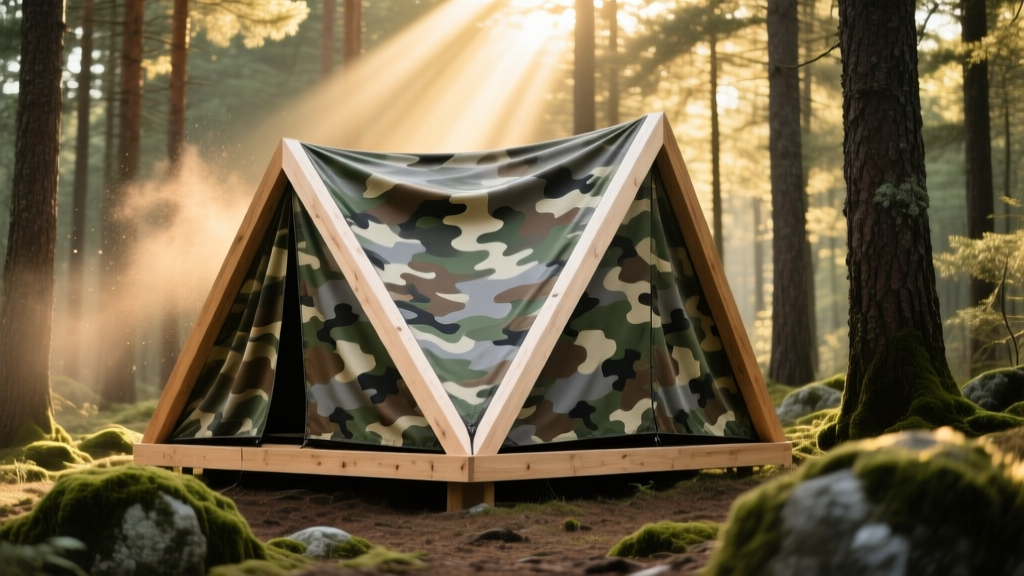
Material Comparison Matrix: PVC vs. TPU vs. Multi-Spectral
Before examining specific product applications, it is critical to understand the baseline performance metrics of the three primary waterproof camouflage material categories. The following matrix outlines the physical properties tested under standard ASTM textile standards for coated and laminated fabrics.
| Material Class | Base Fabric | Hydrostatic Head (HH) | Weight (oz/yd²) | UV Resistance (Hours) | 2026 Avg. Cost (Sq Yd) |
|---|---|---|---|---|---|
| PVC-Coated Camo Tarp | 1000D Polyester | 10,000mm+ | 18 - 22 oz | 1,500 - 2,000 | $4.50 - $7.00 |
| TPU-Laminated Ripstop | 210D - 420D Nylon | 3,000 - 5,000mm | 4 - 7 oz | 800 - 1,200 | $12.00 - $18.00 |
| Multi-Spectral NIR Netting | PU-Backed Polyethylene | 2,000 - 4,000mm | 12 - 15 oz | 2,500+ | $45.00 - $85.00 |
Product Review: 1000D PVC-Coated Camouflage Tarpaulins
Heavy-duty Polyvinyl Chloride (PVC) coated polyester remains the workhorse for permanent wildlife blinds and semi-permanent tactical shelters. The 1000-denier (1000D) base cloth provides exceptional grab tensile strength (typically exceeding 400 lbs in the warp direction per ASTM D5034), while the PVC coating delivers a hydrostatic head rating well over 10,000mm. This makes it completely impervious to driving rain and hydrostatic pressure buildup in low-slope roof applications.
Failure Modes and Edge Cases
The primary vulnerability of PVC-coated camouflage fabric is plasticizer migration and UV degradation. In high-UV environments (e.g., desert or high-altitude builds), cheap PVC formulations will become brittle and crack within 24 months. Specify PVC treated with UV-inhibitor packages rated for a minimum of 1,500 hours of continuous xenon arc exposure. Additionally, PVC is highly susceptible to cold-cracking; it should not be deployed or tensioned in environments where ambient temperatures drop below 10°F (-12°C) without specialized cold-weather plasticizer blends.
Product Review: TPU-Laminated Ripstop Camo Membranes
Thermoplastic Polyurethane (TPU) laminated fabrics represent the premium tier for lightweight, deployable concealed structures. Unlike PVC coatings which are applied as a liquid paste, TPU is extruded as a solid film and thermally bonded to the base ripstop nylon or polyester. This results in a waterproof camouflage material that is significantly lighter (often under 6 oz per square yard) while maintaining excellent abrasion resistance and elasticity.
Hydrolysis Resistance and Cold-Weather Performance
Early generations of TPU laminates suffered from hydrolysis—a chemical breakdown caused by prolonged exposure to high humidity and heat, resulting in the film peeling from the base fabric. Modern 2026 formulations utilize polyether-based TPU rather than polyester-based TPU. Polyether TPU is virtually immune to hydrolysis, making it the superior choice for tropical eco-resorts or humid coastal observation hides. Furthermore, TPU retains its flexibility down to -40°F, allowing for winter deployment in alpine or arctic environments without the risk of the coating shattering under structural wind loads.
Product Review: Multi-Spectral NIR-Defeating Architectural Netting
For applications requiring defeat of night vision and near-infrared (NIR) sensors, standard printed camouflage is useless. Multi-spectral camouflage netting incorporates specialized pigments that mimic the NIR reflectance curve of natural chlorophyll, combined with a 3D textured surface to break up thermal signatures. When paired with a waterproof polyurethane (PU) backing, this material serves as both a primary weather barrier and an advanced concealment system.
Testing protocols outlined by Intertek's textile division frequently highlight the importance of verifying the NIR reflectance spectrum (typically 600nm to 900nm) against local foliage baselines. A woodland-patterned NIR fabric will stand out starkly against arid scrubland when viewed through Gen 3 night vision devices. Always procure region-specific spectral data sheets from the manufacturer.
Structural Tensioning and Seam Sealing Framework
The most advanced waterproof camouflage material will fail if the structural tensioning and seam sealing are executed improperly. Water pooling (ponding) on low-slope camouflage roofs will eventually overwhelm the hydrostatic head rating and degrade the coating. Follow this framework for structural deployment:
- Perimeter Tensioning: Apply a continuous tension of 15 to 20 lbs per linear foot along all load-bearing edges. Use ratcheting tie-downs rather than static bungee cords, which lose tension over time and allow fabric flutter that fatigues the coating.
- Grommet Reinforcement: Standard stamped brass grommets will tear through 1000D PVC under high wind loads. Specify welded D-rings or webbing loops spaced every 18 inches along the perimeter. If grommets must be used, require double-reinforced patching with a 3-inch diameter backing washer.
- Seam Sealing Protocol: Sewn seams puncture the waterproof membrane. All structural seams must be sealed using a 0.75-inch wide thermoplastic urethane seam tape applied at exactly 300°F (149°C) with a hot-air wedge welder. Liquid seam sealers (like silicone or polyurethane caulks) are unacceptable for permanent structural joins as they will peel under UV exposure and fabric flexing.
- Slope Minimums: Maintain a minimum roof pitch of 3:12 (14 degrees) for PVC and Multi-Spectral materials to ensure rapid water shedding. TPU laminates can tolerate slightly lower slopes (2:12) due to their superior elasticity and resistance to localized stretching.
2026 Procurement and Cost Analysis
Sourcing authentic, spec-grade waterproof camouflage material requires navigating a market flooded with substandard consumer-grade tarps. Recent Techtextil industry reports indicate a 14% increase in raw polymer costs for architectural textiles over the past 18 months, driving up the baseline prices for engineered membranes.
For budget-constrained projects such as temporary hunting blinds or basic equipment covers, 1000D PVC-coated tarpaulins remain the most cost-effective solution at $4.50 to $7.00 per square yard. However, the weight (up to 22 oz/yd²) necessitates heavier, more expensive timber or steel framing to support the dead load and wind shear.
For high-end eco-tourism glamping tents, mobile tactical command posts, or permanent wildlife research stations, TPU-laminated ripstop membranes justify their $12.00 to $18.00 per square yard price tag through weight savings, superior cold-weather durability, and extended service life. Multi-spectral NIR netting, priced between $45.00 and $85.00 per square yard, should be strictly reserved for government, defense, or high-security commercial applications where sensor defeat is a primary operational requirement. Always request a 1-yard sample and conduct a localized hydrostatic head test and NIR verification before committing to bulk procurement.
Written by
Elena RodriguezElena Rodriguez is a civil engineer and technical writer specializing in concrete technology, masonry systems, and ASTM/ACI compliance. She earned her B.S. in Civil Engineering from Texas A&M University and spent a decade at a materials testing laboratory, performing over 2,000 concrete compressive strength tests and masonry prism evaluations. Elena is an ACI-certified Field Testing Technician (Grade I) and a member of ASTM Committee C12 on Natural Building Stone. She currently consults on forensic engineering cases involving concrete failures and moisture intrusion. Based in San Antonio, TX, Elena is a proud member of the Society of Women Engineers (SWE) and coaches her daughter's FIRST Robotics team.
More from Elena Rodriguez
View all
Walls & Panels
Cost Analysis: Light Gauge Steel Framing Advantages and Disadvantages
Evaluate light gauge steel framing advantages and disadvantages through a strict cost analysis lens, comparing material, labor, and lifecycle expenses.
Aug 4, 2026

Walls & Panels
Gypsum Board Types: Exact Specifications, Thickness & Dimensions
Compare standard, Type X, and moisture-resistant gypsum board types. Get exact specifications, thicknesses, dimensions, and ASTM standards for your project.
Aug 4, 2026

Fire Resistance
Best Fire-Resistant Outdoor Decking Materials: 2026 Buyer Guide
Discover the best fire-resistant outdoor decking materials for 2026. Compare Class A PVC, aluminum, and hardwood options for WUI compliance and safety.
Aug 4, 2026