Best Exterior Basement Waterproofing Membranes Compared
Compare top exterior basement waterproofing membranes from Tremco, EPRO, and Carlisle. Get 2026 pricing, specs, and failure mode analysis for deep builds.
The Physics of Below-Grade Moisture Management
Selecting the right exterior basement waterproofing system is not merely a code-compliance exercise; it is a critical structural intervention. Below-grade concrete is inherently porous. When backfilled, foundation walls are subjected to hydrostatic pressure, soil-borne chemicals, and capillary action. According to the International Building Code (IBC) Chapter 18, dampproofing is sufficient only where hydrostatic pressure is absent. Where water tables fluctuate or soil drainage is poor, a continuous, high-performance waterproofing membrane is legally and structurally mandated.
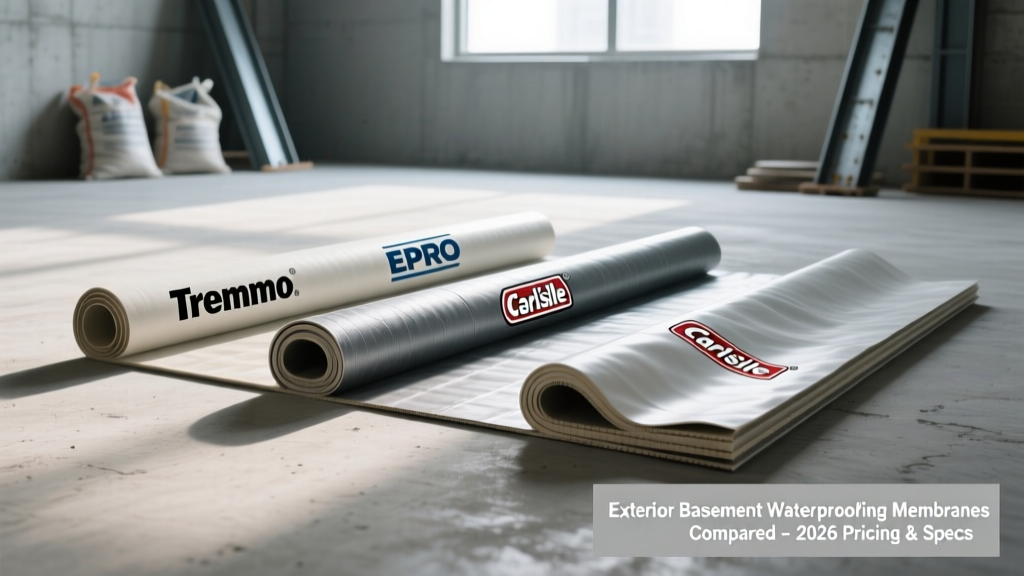
As of 2026, the commercial and high-end residential markets have largely moved away from basic asphalt emulsions toward composite sheet membranes and fluid-applied elastomeric systems. This deep-dive analyzes the three dominant product lines in the exterior basement waterproofing sector: Tremco Paraseal, Carlisle CCW, and EPRO E-Series.
Brand Deep-Dive: Composite & Fluid-Applied Systems
1. Tremco Paraseal GM (Bentonite/HDPE Composite)
Tremco Paraseal GM represents the industry standard for blindside and post-applied composite waterproofing. The membrane consists of a 60-mil high-density polyethylene (HDPE) layer laminated to a 3/4 lb per square foot layer of sodium bentonite clay. When exposed to moisture, the bentonite swells up to 15 times its original volume, creating an impenetrable gel that self-seals minor concrete cracks and membrane punctures.
- Hydrostatic Head Rating: Withstands up to 231 feet of hydrostatic pressure.
- Substrate Tolerance: Can be applied to damp, green concrete (no curing time required) and even compacted shotcrete.
- Installation Method: Mechanically fastened or adhered. The bentonite side faces the concrete substrate.
2. Carlisle CCW 705 (Self-Adhered Rubberized Asphalt)
Carlisle Coated Products’ CCW 705 is a 56-mil self-adhering sheet membrane composed of rubberized asphalt laminated to a cross-laminated polyethylene film. It relies on a continuous, aggressive adhesive bond to the concrete substrate to prevent lateral water migration.
- Hydrostatic Head Rating: Rated for standard deep-foundation hydrostatic loads.
- Substrate Tolerance: Requires a dedicated primer (CCW 702) and completely dry, cured concrete. Applying to damp substrates will result in catastrophic adhesive failure.
- Installation Method: Roll-applied with heavy pressure rolling to ensure continuous adhesion and eliminate fishmouths.
3. EPRO E-Series (Fluid-Applied Composite)
The EPRO E-Series utilizes a fluid-applied rubberized asphalt emulsion that cures to form a monolithic, fully adhered elastomeric membrane, which is then reinforced with an HDPE sheet. This system excels in complex geometries where sheet membranes are difficult to detail.
- Hydrostatic Head Rating: Exceptional elasticity allows it to bridge dynamic structural cracks up to 1/16 inch.
- Substrate Tolerance: Requires dry substrates but can be applied in temperatures as low as 25°F with specialized winter-grade formulations.
- Installation Method: Spray-applied or trowel-applied fluid layer, followed by immediate embedding of the HDPE reinforcement sheet.
Material Performance & Cost Matrix
Material costs fluctuate based on regional distribution and project volume. The 2026 pricing below reflects national averages for commercial-scale purchases (excluding labor and primer).
| Product Line | Thickness / Composition | Min. Temp Limit | Primer Required? | Est. Material Cost (per sq ft) |
|---|---|---|---|---|
| Tremco Paraseal GM | 60-mil HDPE + Bentonite | 25°F (-4°C) | No (on damp concrete) | $2.60 - $3.15 |
| Carlisle CCW 705 | 56-mil Rubberized Asphalt | 40°F (4°C) | Yes (CCW 702) | $2.10 - $2.75 |
| EPRO E-Series | 90-mil Fluid + HDPE | 25°F (-4°C) | Yes (Conditioner) | $3.20 - $3.90 |
Critical Field Failure Modes & Edge Cases
Even premium membranes fail when installation protocols are violated. Based on forensic analysis of below-grade leaks, the following edge cases account for over 80% of warranty claims.
The 'Fishmouth' and Lateral Migration Problem
Self-adhered sheets like Carlisle CCW 705 are highly vulnerable to 'fishmouths'—small, unsealed wrinkles at overlaps. If water breaches a fishmouth, it can travel laterally between the membrane and the concrete substrate, making the interior leak source impossible to locate. Tremco's below-grade technical bulletins emphasize that composite bentonite systems (like Paraseal) mitigate this risk because the bentonite swells to seal the substrate interface, preventing lateral water tracking.
Blindside Application Substrate Risks
In blindside applications (where the membrane is applied to the soil retention system before the concrete is poured), the membrane must withstand the physical impact of concrete placement and rebar tying. Fluid-applied systems without a heavy protection course are frequently punctured during blindside pours. Paraseal GM’s 60-mil HDPE layer provides the necessary tensile strength to survive the pour, but it must be securely fastened to the lagging to prevent displacement from the hydrostatic weight of wet concrete.
The Missing Link: Drainage Board Integration
A waterproofing membrane is only one half of a functional below-grade system. Without a drainage mat to relieve hydrostatic pressure, the membrane is subjected to continuous, maximum stress.
For 2026 builds, pairing your membrane with a dimpled HDPE drainage board (such as Tremco Drain Mat 600 or Carlisle Drain Board) is non-negotiable for habitable below-grade spaces. The drainage mat serves three functions:
- Pressure Relief: Channels water down to the footing drain, reducing hydrostatic head pressure to near zero.
- Protection: Shields the primary membrane from backfill abrasion and sharp aggregate puncture.
- Vapor Buffer: Creates an air gap that reduces the thermal gradient and condensation potential on the interior side of the wall.
Decision Framework: Selecting Your System
Use this conditional framework to specify the correct exterior basement waterproofing membrane for your specific site constraints:
Scenario A: Fast-Track Schedule with Green Concrete
Condition: The schedule demands waterproofing immediately after form stripping; concrete has not fully cured and is off-gassing moisture.
Specification: Tremco Paraseal GM. It bonds to damp, green concrete without primer, eliminating the 7-to-14-day curing wait time required by asphalt-based adhesives.
Scenario B: Complex Geometries and Numerous Penetrations
Condition: The foundation features multiple curved radius walls, stepped footings, and dense pipe penetrations.
Specification: EPRO E-Series. The fluid-applied base coat seamlessly encapsulates complex details without the need for cutting, folding, or sealing hundreds of sheet membrane patches.
Scenario C: Budget-Constrained Post-Applied Standard Build
Condition: Standard rectangular foundation, dry weather forecast, fully cured concrete, and strict material budget constraints.
Specification: Carlisle CCW 705. Offers the lowest baseline material cost and rapid roll-out installation, provided the substrate is meticulously prepped, primed, and dry.
Proper exterior basement waterproofing requires treating the membrane, the drainage plane, and the substrate preparation as an interdependent assembly. Specifying the right chemistry for the specific site conditions ensures the structural longevity and indoor air quality of the below-grade environment.