Sourcing Waterproof Canvas Material by the Yard in 2026
Expert guide to sourcing waterproof canvas material by the yard. Compare cotton, poly-blends, and synthetics, with 2026 pricing and coating specs.

The Anatomy of Waterproof Canvas: Weights, Weaves, and Coatings
When sourcing waterproof canvas material by the yard, buyers frequently conflate 'water-resistant' with 'waterproof.' True waterproofing requires a hydrostatic head rating exceeding 1,000mm, meaning the fabric can withstand a 1,000-millimeter column of water before leaking. Water-resistant fabrics, conversely, rely on surface tension and Durable Water Repellent (DWR) coatings that eventually wet out under sustained hydrostatic pressure. Understanding this distinction is the first step in selecting the right textile for awnings, marine enclosures, truck tarps, or architectural tension structures.
Canvas weight is measured in ounces per square yard (osy). The structural integrity and drape of the material scale directly with this metric. A 10oz canvas is highly pliable, making it ideal for equipment covers and light-duty tents. For structural awnings, marine biminis, and permanent architectural shading, 12oz to 15oz materials provide the necessary tear strength (typically exceeding 150 lbs in the warp direction). Heavy-duty industrial applications, such as flatbed truck tarps or mining enclosures, demand 18oz to 24oz PVC-laminated polyesters.
- 8oz - 10oz: Light duty, high drape. Best for dust covers, light tarps, and craft projects.
- 11oz - 14oz: Medium duty, structural balance. Best for awnings, marine canvas, and wall tents.
- 15oz - 18oz: Heavy duty, high abrasion resistance. Best for truck tarps, industrial curtains, and ground covers.
Material Breakdown: Cotton vs. Poly-Blend vs. 100% Synthetic
The base fiber dictates the fabric's breathability, UV resistance, and seam-sealing requirements. According to Sailrite's comprehensive fabric selection guide, the market is currently dominated by three distinct categories, each with specific 2026 pricing and performance profiles.
| Fabric Type | Base Material | Avg Cost/Yard (2026) | Hydrostatic Head | Breathability |
|---|---|---|---|---|
| Treated Army Duck (e.g., Sunforger) | 100% Cotton | $11 - $15 | ~400mm (swells to seal) | High |
| Poly-Cotton Blend (65/35) | Poly/Cotton | $14 - $19 | ~600mm | Medium |
| Marine Polyester (e.g., Top Gun 1S) | 100% Polyester | $22 - $28 | >1,200mm | Zero |
| PVC Laminated (e.g., Weblon Coastline) | $18 - $24 | >3,000mm | Zero |
The Cotton Swelling Mechanism
Treated cotton canvas, such as the industry-standard Sunforger, utilizes a unique mechanical waterproofing method. The fabric is woven using an 'Army Duck' weave (a tight, plain weave where two yarns are twisted together). When exposed to rain, the cotton fibers absorb moisture and physically swell, closing the microscopic interstices between the yarns and sealing the needle holes created during sewing. However, this swelling requires the fabric to get wet first, meaning initial light drizzles may pass through until the fibers fully expand.
Decoding the Coatings: Fluorocarbon, PU, and Wax
The base weave is only half the equation. The chemical treatment applied to the canvas determines its long-term viability in harsh environments.
The Shift to C0 (PFC-Free) DWRs in 2026
Historically, canvas manufacturers relied on C8 and C6 fluorocarbon (PFC) DWR treatments to achieve high contact angles for water beading. Due to stringent 2026 EPA and EU regulations regarding 'forever chemicals,' the industry has aggressively pivoted to C0 (PFC-free) DWRs, often based on dendrimer or silicone chemistries. While C0 treatments provide excellent initial water repellency, they lack the oil-repellency of their fluorocarbon predecessors. This means C0-treated canvas is more susceptible to staining from dirt, body oils, and tree sap, which can degrade the surface tension and cause the fabric to 'wet out.' Frequent cleaning with specialized, non-detergent soaps (like Iosso Mold & Mildew Stain Remover) is now mandatory to maintain the hydrophobic surface.
Polyurethane (PU) and PVC Laminates
For applications requiring absolute waterproofing without relying on fiber swelling, PU and PVC backings are mandatory. Top Gun 1S features a breathable PU coating on the underside, providing a 1,200mm hydrostatic head while remaining lightweight (8.5oz). PVC laminates, like Weblon Coastline, sandwich a high-tenacity polyester scrim between two layers of PVC, yielding a completely impermeable 18oz material. PVC laminates are heat-weldable, eliminating the needle-hole problem entirely, but they are heavy, stiff, and prone to plasticizer migration if stored improperly.
The Needle Hole Problem: Seaming and Assembly
When you sew waterproof canvas, the sewing machine needle punctures the coating and the yarns, creating a direct channel for water ingress. How you manage these needle holes dictates the success of your project.
Critical Assembly Rule: Never use standard cotton-wrapped polyester thread on synthetic waterproof canvas. The cotton wicking effect will draw water straight through the needle holes. Use 100% bonded polyester thread (e.g., V-92 or V-138) and apply a liquid seam sealer or basting tape to every stitch line.
For PU-coated synthetics and PVC laminates, liquid seam sealers like HH-66 Vinyl Cement or specialized urethane seam grip are required. Apply the sealer to the underside of the seam allowance immediately after stitching. For cotton and poly-cotton blends, the physical swelling of the yarn usually seals the holes, but applying a wax-based seam rub or a liquid acrylic sealer provides a necessary fail-safe for high-tension seams. For detailed application techniques, refer to Sailrite's seam sealing tutorial, which outlines the precise brush and curing methods for marine-grade textiles.
Calculating Yardage: Widths, Selvedge, and Shrinkage
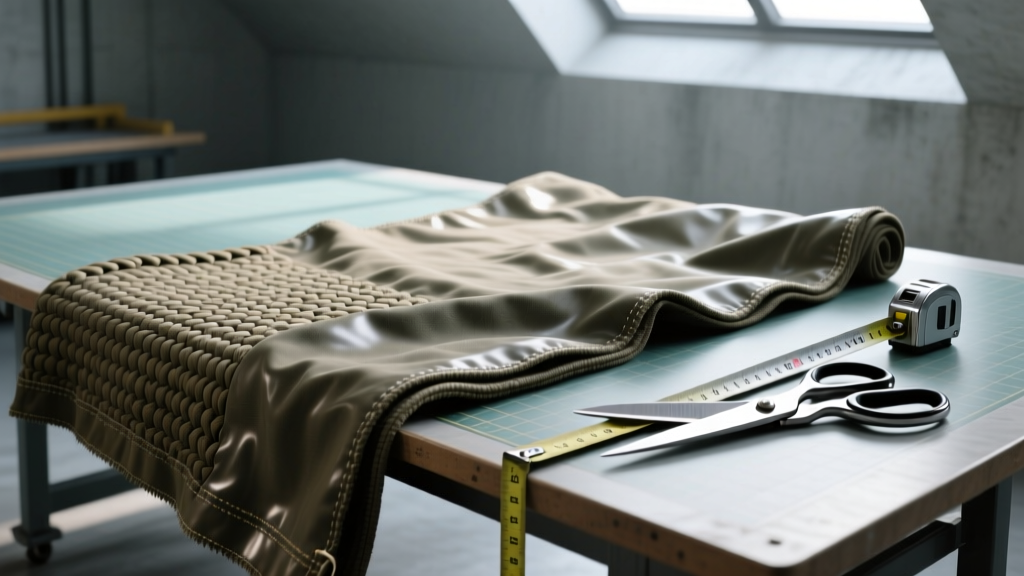
Ordering waterproof canvas material by the yard requires precise mathematical adjustments. A common error is calculating the exact square footage of the finished product and ordering that exact yardage, which inevitably results in material shortages.
- Standard Widths: Canvas is typically milled in 54-inch, 60-inch, or 72-inch widths. Always factor in the usable width, not the total width.
- Selvedge Loss: The factory edges (selvedge) are often tightly woven, uneven, or marked with pin holes from the tenter frame. You must deduct 1.5 to 2 inches from the total width for selvedge removal.
- Cotton Shrinkage: Untreated or lightly treated cotton canvas will shrink 2% to 5% upon its first exposure to heavy moisture. If you are building a rigid frame enclosure, you must either pre-shrink the canvas by soaking and air-drying it before cutting, or add a 5% overage to your yardage calculations and design adjustable tensioning hardware into the final assembly.
- Pattern Repeats and Matching: If you are using striped or printed waterproof canvas, you must calculate the vertical and horizontal pattern repeat. A 12-inch repeat means you may lose up to a full foot of material per panel just to align the seams aesthetically.
Real-World Failure Modes and Prevention
Even premium waterproof canvas materials fail prematurely if deployed outside their engineered parameters. Understanding these failure modes allows you to specify the correct material from the start.
Hydrolysis in PU Coatings
Polyurethane coatings are highly susceptible to hydrolysis—a chemical breakdown caused by prolonged exposure to high humidity and heat. In tropical or coastal environments, PU coatings can become tacky, peel, and delaminate from the polyester base within 3 to 5 years. To prevent this, specify PVC laminates or solution-dyed acrylics (which rely on tight weaves and DWR rather than back-coatings) for permanent installations in high-humidity zones.
UV Degradation of DWRs vs. Base Yarns
It is vital to distinguish between the UV degradation of the water-repellent coating and the UV degradation of the structural yarns. A C0 DWR coating may lose its beading capability after 200 hours of direct UV exposure, making the fabric appear to 'leak.' However, the base polyester yarn may still retain 90% of its tensile strength. In these cases, the fabric is not structurally compromised; it simply requires a wash and a reapplication of an aftermarket DWR spray (such as 303 Fabric Guard or Star brite Waterproofing Spray) to restore surface tension.
Mildew and Biological Growth
While 100% synthetic canvases are immune to rot, they are not immune to mildew. Mildew feeds on organic debris (dirt, pollen, bird droppings) that accumulates on the surface of the fabric, not the fabric itself. However, on poly-cotton blends, the mildew will actively consume the cellulose in the cotton fibers, leading to catastrophic tensile failure and black staining that cannot be washed out. For shaded, damp environments where organic debris accumulation is high, 100% synthetic materials with smooth, non-porous surfaces (like PVC laminates) are the only viable choice to ensure a 10-year lifespan.
Written by
David NakamuraDavid Nakamura is a licensed architect (AIA) and construction technology writer focused on sustainable building methods, mass timber engineering, and high-performance building envelopes. He holds a Master of Architecture from the University of Washington and is a certified Passive House Consultant (CPHC). David spent eight years at the Seattle firm Mithun, where he led the design of three LEED Platinum projects, before founding his own practice specializing in net-zero residential design. He serves on the editorial advisory board of GreenBuilder Magazine and has authored peer-reviewed papers on cross-laminated timber (CLT) connections for the Journal of Structural Engineering. In his spare time, David teaches woodworking at Pratt Fine Arts Center and kayaks the Puget Sound.
More from David Nakamura
View all
Construction Cost
Labor Cost to Build a Deck Per Sq Ft: 2026 Installation Guide
Discover the exact labor cost to build a deck per sq ft in 2026. This installation guide breaks down contractor rates, complexity factors, and hidden fees.
Aug 4, 2026

Construction Cost
How Much Does It Cost to Build a 3 Bedroom House? Financing Guide
Learn exactly how much it costs to build a 3 bedroom house and explore 2026 financing options, construction loan types, and budget frameworks for your build.
Aug 4, 2026

Construction Cost
Cost to Build a Tennis Court: 2026 Guide
How much does it cost to build a tennis court in 2026? Breakdowns for asphalt, concrete, and synthetic surfaces plus fencing and lighting.
Jul 30, 2026