Heavy Duty Waterproof Canvas Material vs PVC Tarps: 2026 Guide
Compare heavy duty waterproof canvas material against PVC tarpaulins for construction enclosures. Analyze tear strength, UV resistance, and 2026 costs.

When selecting temporary enclosures, equipment covers, or weather barriers for construction sites, facility managers routinely debate the merits of heavy duty waterproof canvas material versus standard PVC tarpaulins. While PVC dominates the low-cost segment, premium treated cotton duck canvas (often branded as Sunforger® or marine-grade canvas) offers distinct mechanical advantages in high-wind, high-abrasion environments. This guide provides a technical and economic comparison of these two membrane systems for 2026 procurement cycles, focusing on hydrostatic pressure resistance, tear propagation, and lifecycle costing.
Material Composition and Waterproofing Mechanisms
Heavy Duty Waterproof Canvas (Treated Cotton Duck)
True heavy duty waterproof canvas material is not inherently waterproof; raw cotton duck is highly absorbent. The waterproofing is achieved through chemical impregnation. The industry standard for heavy-duty applications is 18 oz. to 24 oz. per square yard cotton duck treated with a paraffin wax, mineral oil, or modern fluorocarbon (DWR) finish. When exposed to moisture, the cotton fibers swell, tightening the weave, while the chemical treatment lowers the surface energy, causing water to bead and roll off. This creates a hydrostatic head rating typically between 800mm and 1,200mm, sufficient for heavy rain but vulnerable to prolonged standing water.
PVC-Coated Polyester Tarpaulins
PVC (Polyvinyl Chloride) tarps utilize a high-tenacity polyester scrim coated on both sides with plasticized PVC, often finished with an acrylic or polyurethane topcoat for UV stabilization and anti-fungal properties. Because the waterproofing is a continuous polymer film rather than a treated weave, PVC tarps possess a hydrostatic head exceeding 3,000mm, making them completely impervious to standing water and hydrostatic pressure. However, this continuous film eliminates breathability, trapping ambient moisture beneath the membrane.
Technical Specification Matrix
Procurement specifications must align with the physical demands of the site. The following matrix compares standard 18 oz. wax-treated canvas against a mid-tier 18 oz. PVC-coated polyester tarpaulin.
| Metric (ASTM Standard) | 18 oz. Treated Canvas | 18 oz. PVC-Polyester |
|---|---|---|
| Tear Strength (ASTM D1424) | 65 lbs (Warp) / 45 lbs (Fill) | 40 lbs (Warp) / 35 lbs (Fill) |
| Tensile Strength (ASTM D5034) | 425 lbs x 350 lbs | 380 lbs x 320 lbs |
| Hydrostatic Resistance (AATCC 127) | ~1,000 mm | > 3,000 mm |
| Breathability / MVTR | High (Allows vapor transmission) | Zero (Total moisture barrier) |
| Cold Crack Resistance (ASTM D2136) | Excellent (Remains pliable to -40°F) | Poor (Stiffens and cracks below 10°F) |
| Flame Retardancy (NFPA 701) | Available (Must specify FR treatment) | Inherent (Standard in most commercial grades) |
Environmental Performance and Failure Modes
Wind Load and Scaffolding Enclosures
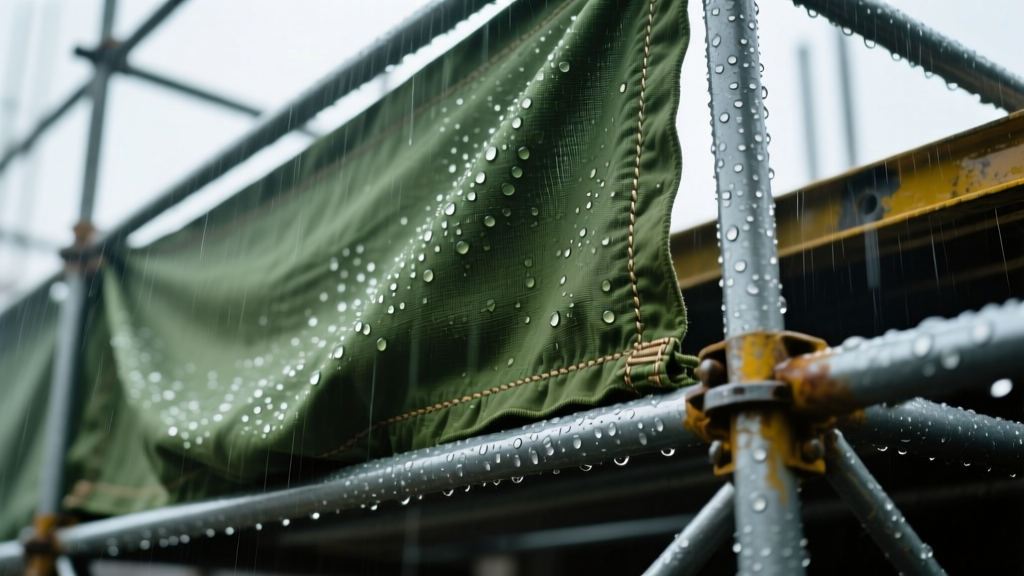
In scaffolding applications, membranes act as sails, subjecting grommets and seams to immense dynamic loads. OSHA guidelines for scaffolding emphasize secure tie-ins, but the material's tear propagation resistance dictates survival during microbursts. Heavy duty waterproof canvas material excels here. The interlocking woven structure of cotton duck dissipates point loads across multiple yarns. If a canvas tarp is punctured by a rogue piece of rebar, the tear is unlikely to propagate beyond the immediate puncture site.
Conversely, PVC tarps rely on a polymer coating. Once the PVC film is breached, the underlying polyester scrim is exposed to UV degradation, and the tear can unzip rapidly under wind tension. For high-wind scaffolding wraps in coastal or high-altitude zones, 24 oz. marine-grade canvas outlasts standard 18 oz. PVC by an estimated 3:1 margin.
Temperature Extremes and Cold Cracking
Winter construction introduces severe thermal cycling. Plasticizers in PVC membranes migrate and evaporate over time, leading to cold-cracking. According to material testing data from the ASTM D2136 standard, standard PVC-coated fabrics become brittle and shatter under impact when temperatures drop below 15°F (-9°C). Heavy duty treated canvas contains no plasticizers; the paraffin or fluorocarbon treatments remain flexible in sub-zero environments, making canvas the mandatory choice for winter enclosures, concrete curing blankets, and arctic equipment covers.
The Condensation Trap
When covering sensitive building materials (e.g., drywall, unsealed hardwood, or electrical switchgear), the breathability of the membrane is critical. PVC tarps create an impermeable vapor barrier. Diurnal temperature swings cause ambient moisture trapped beneath the PVC to condense on the underside of the tarp, dripping onto the protected assets and causing mold or warping. Heavy duty waterproof canvas material allows water vapor to escape (Moisture Vapor Transmission Rate) while blocking liquid precipitation, maintaining a stable microclimate beneath the cover.
2026 Procurement Economics and Lifecycle Costing
While PVC holds a distinct advantage in initial capital expenditure, evaluating the Total Cost of Ownership (TCO) reveals a different hierarchy for long-term asset protection.
- Economy Blue Poly/PVC Tarps: $1.80 - $2.50 (Lifespan: 3-6 months)
- Commercial 18 oz. PVC-Polyester: $6.50 - $9.00 (Lifespan: 2-4 years)
- Heavy Duty 18 oz. Treated Cotton Canvas: $11.50 - $16.00 (Lifespan: 4-8 years)
- Premium 24 oz. Marine Canvas (Sunbrella/Top Gun): $28.00 - $42.00 (Lifespan: 10+ years)
Maintenance and Re-treatment
The primary economic drawback of heavy duty waterproof canvas material is maintenance. UV radiation and physical abrasion slowly strip the DWR or wax coating. To maintain hydrostatic resistance, canvas used in continuous outdoor exposure requires re-treatment with a fluorocarbon spray or wax emulsion every 18 to 24 months. Products like 303 Fabric Guard or specialized canvas re-waxing compounds cost approximately $0.40 per square foot per application. PVC requires zero chemical maintenance, needing only occasional washing with mild detergent to remove plasticizer-attracting dirt and biological growth.
Repairability in the Field
Canvas is highly repairable. A tear in a heavy duty canvas tarp can be field-repaired using a heavy-duty needle, waxed polyester thread, and a canvas patch, restoring up to 80% of the original tensile strength. PVC repairs require specialized RF (Radio Frequency) welding equipment or solvent-based PVC cements that often fail under UV exposure, meaning a damaged PVC tarp is frequently relegated to secondary uses or discarded.
Decision Framework: Specifying the Right Membrane
Use the following operational parameters to finalize your 2026 material specifications:
Specify Heavy Duty Waterproof Canvas Material When:
- Winter Curing & Enclosures: Ambient temperatures will routinely drop below 20°F, eliminating the risk of PVC cold-cracking.
- High-Wind Scaffolding: The membrane will be subjected to high dynamic wind loads where tear propagation resistance is paramount.
- Moisture-Sensitive Asset Protection: Covering timber, masonry, or machinery where trapped condensation (sweating) causes more damage than minor water ingress.
- Spark/Slag Environments: Working near welding or grinding; heavy canvas is naturally resistant to brief exposure to hot slag, whereas PVC will instantly melt and ignite.
Specify PVC-Coated Polyester When:
- Flat Surface Water Containment: Using the membrane for temporary pond liners, concrete water-curing blankets, or flat roof material staging where standing water will exceed 48 hours.
- Chemical Exposure: The site involves exposure to alkaline runoff (fresh concrete) or mild industrial solvents that would degrade natural cotton fibers and wax treatments.
- Zero-Maintenance Mandates: The project budget favors lower upfront CAPEX and the operational schedule does not allow for periodic re-treatment of fabric covers.
Installation and Hardware Compatibility
The failure of heavy-duty membranes rarely occurs in the field of the fabric; it occurs at the attachment points. When specifying heavy duty waterproof canvas material, standard stamped-brass grommets are insufficient for construction loads.
Require spur grommets (which feature teeth that bite into the fabric weave) or, ideally, webbing-reinforced hems with D-rings or sewn-in rope edges. According to testing by the Industrial Fabrics Association International (IFAI), distributing the load across a sewn nylon webbing hem increases the pull-out strength of the attachment point by over 400% compared to standard perimeter grommets. For PVC tarps, heat-welded webbing hems with D-rings remain the gold standard, as sewing punctures the waterproof PVC film and requires subsequent taping to prevent leaks.
By aligning the material's physical properties—breathability, cold-crack resistance, and tear strength—with the specific environmental stressors of the job site, project managers can eliminate premature membrane failures and reduce secondary damage to high-value construction assets.
Written by
Priya KapoorPriya Kapoor is a real estate market analyst and construction economics researcher with expertise in housing affordability, development feasibility, and infrastructure investment. She holds a Master of Regional Planning from Cornell University and previously worked as a senior analyst at CBRE's Investment Properties group, where she modeled returns for $4B in mixed-use development pipelines. Priya now runs an independent research practice advising developers, municipalities, and REITs on construction cost forecasting and market timing. She publishes the quarterly "BuildMat Market Pulse" report tracking material price indices across 12 commodity categories. Based in Austin, TX, Priya serves on the board of Habitat for Humanity Austin and is a marathon runner.
More from Priya Kapoor
View all
Construction Cost
Cost to Build a 1600 Sq Ft Home in 2026: Full Breakdown
Accurate 2026 cost to build a 1600 sq ft home—material, labor, and regional pricing breakdowns included. Plan your budget with real-time estimates.
Aug 11, 2026

Wood & Lumber
Name the Types of Wood for Pressure Treatment and Preservation
Learn how to name the types of wood best suited for pressure treatment. Compare species treatability, chemical retention levels, and 2026 preservation costs.
Aug 4, 2026

Stone & Masonry
Stone Veneer Suppliers Lindenhurst: 2026 Cost Analysis
Analyze 2026 stone veneer costs in Lindenhurst, NY. Compare local supplier pricing, delivery fees, and Suffolk County installation labor rates.
Aug 4, 2026