Polyester Waterproof Material Review: Best Membranes for 2026
We review top polyester waterproof material options for 2026, comparing reinforced membranes, tensile strength, UV resistance, and real-world costs.

The Engineering Reality: Polyester as a Reinforcement Scrim
When industry professionals search for polyester waterproof material, they are often operating under a slight misconception. Pure polyester fabric is not inherently waterproof; it is hydrophobic but porous. In modern commercial and high-end residential waterproofing, polyester is utilized as the critical reinforcement scrim embedded within Thermoplastic Polyolefin (TPO), Polyvinyl Chloride (PVC), and liquid-applied polyurethane systems.
The polymer matrix (TPO or PVC) provides the actual hydrostatic barrier and UV resistance, while the woven polyester scrim provides dimensional stability, bi-directional tensile strength, and puncture resistance. Without this polyester backbone, single-ply membranes would suffer from excessive thermal expansion, shrinking, and tearing under wind uplift loads. According to the National Roofing Contractors Association (NRCA), polyester-reinforced membranes consistently outperform unreinforced variants in high-wind and high-thermal-shock environments.
2026 Product Review: Leading Polyester-Reinforced Systems
We evaluated the top-performing polyester-reinforced waterproofing membranes on the market in 2026, focusing on material science, field installability, and long-term weathering data.
1. Sika Sarnafil G 410 (Polyester-Reinforced PVC)
The Sarnafil G 410 is a premium, polyester-reinforced PVC membrane designed for mechanically attached roof systems. The proprietary polyester scrim is encapsulated between two layers of PVC that include a built-in UV stabilizer and plasticizer migration inhibitor.
- Scrim Technology: Heavy-duty knitted polyester with a high denier count, offering exceptional tear resistance (ASTM D5602).
- Best Application: High-wind uplift zones (FM 1-90 ratings) and structures with significant thermal movement.
- Drawback: PVC requires strict adherence to hot-air welding parameters; ambient temperature drops below 40°F (4°C) can compromise seam integrity if the scrim retains moisture.
- Estimated Installed Cost: $8.50 – $10.20 per square foot.
2. Elevate UltraPly TPO 115 Mil (Polyester-Reinforced TPO)
Formerly Firestone, Elevate’s 115-mil TPO utilizes a robust, anti-wicking polyester scrim. The thicker 115-mil profile (compared to the industry-standard 60-mil) provides a massive buffer against puncture while the polyester grid prevents the membrane from stretching out of shape during installation.
- Scrim Technology: Woven polyester with an anti-wicking coating that prevents water from traveling laterally through the scrim if the membrane is accidentally punctured.
- Best Application: Highly reflective cool roofs. The Department of Energy notes that reinforced white TPO systems can reduce peak cooling demand by 10-15%.
- Drawback: TPO seams require higher heat input than PVC, demanding skilled welders to fuse the polymer without scorching the internal polyester.
- Estimated Installed Cost: $7.25 – $8.90 per square foot.
3. Mapei Purtop 1000 with Polyester Fleece (Liquid-Applied PU)
For complex geometries where sheet goods fail, Mapei’s Purtop 1000 is a two-component, solvent-free polyurethane liquid membrane applied over a non-woven polyester fleece mat. The fleece acts as a bridge over cracks and joints, while the PU cures into a seamless, elastomeric waterproof shell.
- Scrim Technology: Non-woven, needle-punched polyester fleece (100 g/m²) that allows the liquid resin to fully encapsulate the fibers, creating a composite monolithic layer.
- Best Application: Plaza decks, podiums, and roofs with extreme penetration density (HVAC units, pipes, skylights).
- Drawback: Highly sensitive to application thickness; requires wet-mil gauge checks during installation to ensure the polyester is fully saturated and not exposed.
- Estimated Installed Cost: $11.50 – $14.00 per square foot.
Technical Comparison Matrix
| Product | Base Polymer | Polyester Scrim Type | Total Thickness | Puncture Resistance (ASTM D4833) | Welding Method |
|---|---|---|---|---|---|
| Sika Sarnafil G 410 | PVC | Knitted, high-denier | 60 mil (1.5 mm) | 45 lbf | Hot Air (400°C - 500°C) |
| Elevate UltraPly TPO | TPO | Woven, anti-wicking | 115 mil (2.9 mm) | 75 lbf | Hot Air (500°C - 600°C) |
| Mapei Purtop 1000 | Polyurethane | Non-woven fleece | 80 mil (2.0 mm) cured | 60 lbf (composite) | Chemical Cure (No heat) |
Installation Failure Modes & Edge Cases
Understanding the interaction between the polymer matrix and the polyester scrim is where most field failures originate. Here are the critical edge cases contractors must manage:
Polyester is hygroscopic. If a reinforced PVC or TPO roll is stored in a humid environment and the edges of the scrim absorb ambient moisture, hot-air welding will instantly vaporize that trapped water. This creates steam pockets inside the seam, resulting in microscopic blisters that eventually delaminate. Fix: Always field-test weld a 12-inch scrap piece and perform a peel test before commencing full seaming, especially during early morning high-humidity windows.
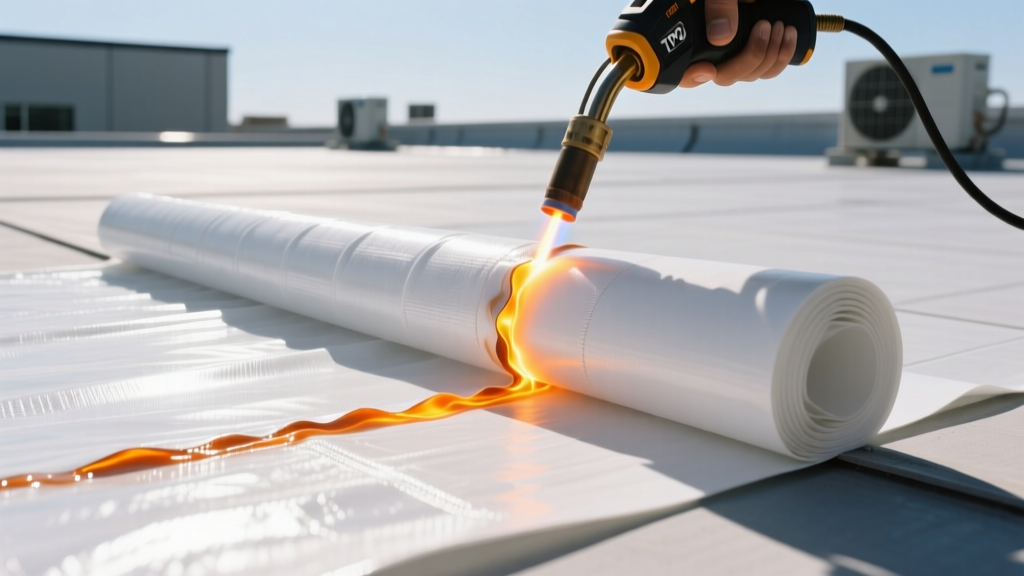
TPO polymers melt at roughly 160°C (320°F), while the internal polyester scrim has a melting point of approximately 250°C (482°F). Welding tools are set between 500°C and 600°C to transfer heat rapidly through the top ply. If the welder moves too slowly, the heat transfers through the TPO and scorches or melts the polyester scrim, destroying the membrane's tensile strength at the seam. A scorched seam will snap during a wind-uplift event.
Project Cost & ROI Analysis
When budgeting for a polyester waterproof material system in 2026, material costs represent only 35-40% of the total project expense. The GSA Sustainable Facilities Tool highlights that life-cycle cost analysis must factor in maintenance and energy savings.
- Material Cost: $2.50 – $4.50 per sq. ft. for the membrane rolls or liquid kits.
- Labor & Fasteners: $3.50 – $6.00 per sq. ft., heavily dependent on roof complexity and local union labor rates.
- Insulation & Vapor Barriers: $2.00 – $4.00 per sq. ft. (Polyisocyanurate boards are standard beneath these membranes).
- ROI Timeline: A properly installed 115-mil polyester-reinforced TPO system typically yields a 20- to 25-year lifecycle, with energy savings from high solar reflectance (SR > 0.80) paying for the premium material upgrade within 4 to 6 years compared to dark, unreinforced EPDM systems.
Frequently Asked Questions
Can polyester fabric be used alone as a waterproofing layer?
No. Woven or non-woven polyester must be fully encapsulated in a waterproof resin (like polyurethane, acrylic, or bitumen) to function as a waterproofing barrier. On its own, it will wick water.
Does the polyester scrim degrade under UV exposure?
The scrim is entirely encapsulated within the UV-stabilized top ply of TPO or PVC. As long as the top polymer layer is not worn away or punctured, the polyester is completely shielded from UV degradation.
How do I repair a puncture in a polyester-reinforced membrane?
Clean the area with a dedicated membrane cleaner, score the surface lightly to remove oxidation, and apply a 6-inch patch of the same material using hot-air welding (for TPO/PVC) or a liquid PU patch kit (for liquid systems), ensuring the new patch overlaps the damaged scrim grid by at least 2 inches on all sides.
Written by
Marcus ChenMarcus Chen is a licensed structural engineer (PE) and building materials analyst with over 12 years of experience across residential, commercial, and industrial construction. He holds a Master of Science in Civil Engineering from UC Berkeley and spent six years at Thornton Tomasetti before transitioning to independent consulting and technical writing. Marcus specializes in material selection for seismic-prone regions, concrete reinforcement strategies, and lifecycle cost analysis. His work has been cited by the American Concrete Institute (ACI) and the Structural Engineers Association of California (SEAOC). When he is not on a job site or at his desk, you will find him hiking the Sierra Nevada or restoring a 1920s craftsman bungalow in Oakland, CA.
More from Marcus Chen
View all
Construction Cost
How Much Did the Eiffel Tower Cost to Build?
How much did the Eiffel Tower cost to build in 1889? We adjust for inflation and compare its budget to modern skyscraper construction.
Aug 4, 2026

Fire Resistance
What Is a Fire Resistant Material? Testing & Certification Guide
Discover what is a fire resistant material through ASTM and UL testing. Learn how fire ratings, certifications, and assemblies work in construction.
Aug 4, 2026

Construction Cost
How Much Did the Burj Khalifa Cost to Build?
How much did the Burj Khalifa cost to build? We break down the $1.5B project and extract 5 money-saving strategies for your next build.
Jul 30, 2026