Lippert Tablecloth Material: Waterproof & Stain Resistant Troubleshooting
Troubleshoot common failures in Lippert tablecloth material. Learn how to restore waterproof and stain-resistant properties on RV and marine vinyl fabrics.

Understanding Lippert Fabric Degradation and Failure Modes
Lippert (LCI Industries) manufactures a wide array of RV dinette table covers, outdoor patio mats, and marine-grade upholstery fabrics. These materials are typically engineered from 1000-denier polyester with a PVC backing or expanded marine vinyl, designed to provide an impermeable barrier against moisture and organic stains. However, owners frequently report that their Lippert tablecloth material loses its waterproof and stain-resistant properties after 12 to 18 months of use. Liquids begin to pool and absorb, while coffee, grease, and sunscreen leave permanent blemishes.
This degradation is rarely a manufacturing defect. Instead, it is the result of chemical stripping, UV-induced plasticizer migration, and mechanical abrasion that compromise the polyurethane (PU) topcoat and the Durable Water Repellent (DWR) finish. This troubleshooting guide isolates the exact failure points of RV and marine vinyl fabrics and provides chemical and mechanical restoration protocols to return the material to its original hydrophobic state.
Diagnostic Matrix: Identifying Your Fabric Failure
Before applying any restorative chemicals, you must accurately diagnose why the stain resistance or waterproofing has failed. Use the matrix below to match your symptoms to the underlying chemical or structural breakdown.
| Symptom | Root Cause | Immediate Fix | Long-Term Solution |
|---|---|---|---|
| Water absorbs, leaving dark spots | DWR topcoat depletion or micro-abrasions in the PU layer | Clean thoroughly and apply a fluoropolymer-based fabric guard | Reapply UV-blocking water repellent every 6 months |
| Surface feels tacky; dust and lint stick | Plasticizer migration caused by extreme heat and UV exposure | Wipe down with a 50/50 isopropyl alcohol and water solution | Apply a dedicated marine vinyl UV protectant monthly |
| Grease and oil stains won't lift with standard soap | Micro-pore saturation from prior use of abrasive or alkaline cleaners | Use a marine-grade vinyl degreaser and a soft-bristle detailing brush | Switch to pH-neutral cleaners; avoid ammonia entirely |
| White powdery residue transfers to clothing | UV chalk (severe degradation of the polyurethane topcoat) | Buff with a marine vinyl restorer containing conditioning oils | Install UV-blocking window films or use physical table covers when parked |
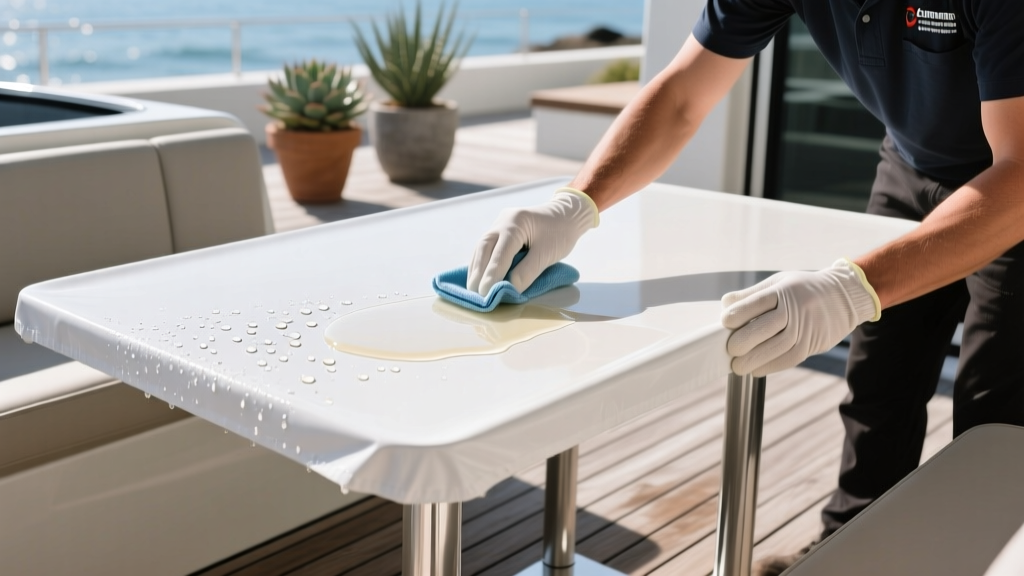
Troubleshooting Stain Penetration on PVC and Vinyl
When a material marketed as "stain resistant" suddenly absorbs a spill, the protective topcoat has been compromised. Expanded vinyl and PVC-coated polyesters rely on a microscopic polyurethane layer to prevent organic compounds from binding to the substrate.
The Ammonia and Bleach Mistake
According to the Marine Fabricators Association, improper cleaning agents account for the majority of premature marine vinyl failures. Many RV owners use household glass cleaners (which contain ammonia) or diluted bleach to wipe down dinette tables. Ammonia aggressively strips the PU topcoat, while bleach breaks down the PVC polymer chains, causing the material to become porous. Once porous, the material will absorb tannins (from coffee or wine) and lipids (from cooking grease) permanently.
Step-by-Step Stain Extraction Protocol
If a stain has already penetrated the compromised surface, standard wiping will only push it deeper. Follow this extraction sequence:
- Dry Absorption: Immediately blot (do not rub) liquid spills with a high-GSM microfiber towel to pull moisture out of the micro-pores.
- Solvent Lift: For grease or sunscreen, apply a small amount of isopropyl alcohol (70% concentration) to a clean cloth and dab the stain. The alcohol breaks down the lipid bonds without dissolving the PVC base.
- Enzymatic Treatment: For organic food stains, use an enzymatic cleaner designed for marine upholstery. Allow it to sit for 5 to 10 minutes to break down the proteins.
- Agitation and Extraction: Gently agitate with a horsehair detailing brush, then wipe away the residue with a damp cloth. Dry immediately.
Restoring Hydrophobic Properties: When Water Stops Beading
True waterproofing in solid PVC vinyl comes from the material's non-porous nature. However, woven polyester table covers with a PVC backing rely on a DWR (Durable Water Repellent) treatment on the top face to cause water to bead and roll off. When the DWR fails, water wets out the fabric, leading to heavy, sagging covers and potential mold growth on the underside.
Never use cheap silicone-based waterproofing sprays on Lippert fabrics or any marine-grade vinyl. Silicone creates a temporary hydrophobic layer but traps moisture underneath, accelerates UV degradation, and creates a slippery residue that makes future re-treatments impossible because new coatings cannot adhere to silicone.
Re-treating Woven Polyester and Blends
For woven materials, you must restore the DWR using a fluoropolymer or advanced water-based repellent. Manufacturers like 303 Products recommend applying their Fabric Guard to clean, completely dry fabric. Spray the material evenly until it is thoroughly wet, allow it to cure for 12 to 24 hours in a shaded, well-ventilated area, and test the hydrophobic response by sprinkling water on the surface. If the water beads at a contact angle greater than 90 degrees, the treatment is successful.
Restoring Solid PVC Vinyl
Solid vinyl does not need a DWR spray; it needs surface slickness and UV protection. Use a dedicated marine vinyl cleaner and protectant that contains UV blockers and light conditioning agents. This restores the surface tension, allowing liquids to bead up and roll off rather than gripping the micro-texture of the vinyl.
Seam and Edge Delamination: The Hidden Moisture Pathway
A perfectly waterproof table cover will still fail if the seams are compromised. Lippert utilizes both high-frequency (RF) welding and traditional sewn seams with bonded polyester thread depending on the specific product line.
- RF Welded Seams: These are inherently waterproof as the PVC is melted together. If you see peeling at a welded seam, it is a sign of hydrolysis (breakdown from trapped moisture and heat). Clean the area with isopropyl alcohol and apply a flexible, clear PVC adhesive to re-bond the flap.
- Sewn Seams: Every needle puncture creates a capillary pathway for water to wick through to the substrate. If your sewn table cover is leaking at the edges, apply a urethane-based seam sealer (such as Gear Aid Seam Grip) along the interior stitch lines. Allow 24 hours to cure before exposing the cover to moisture.
2026 Maintenance Schedule for Long-Term Resistance
Preventative maintenance is significantly more cost-effective than replacing custom-fit RV dinette tables or marine covers. Adhere to this schedule to maintain the waterproof and stain-resistant integrity of your Lippert materials:
- Weekly: Wipe down surfaces with a damp microfiber cloth and a pH-neutral marine soap. Never allow bird droppings, tree sap, or sunscreen to sit on the material for more than 24 hours.
- Monthly: Apply a UV-blocking vinyl protectant. This prevents the plasticizers from migrating to the surface and stops the polyurethane topcoat from chalking.
- Bi-Annually: Inspect all sewn seams for thread fraying or wicking. Re-seal with urethane seam grip if necessary. For woven fabrics, reapply DWR fabric guard before the peak summer and winter seasons.
- Annually: Perform a deep clean using a dedicated marine vinyl degreaser to remove embedded body oils and environmental pollutants that break down the material's chemical structure over time.
When to Abandon Restoration and Replace
Not all fabric failures can be reversed. If your Lippert tablecloth material exhibits deep structural cracking (where the white polyester scrim is visible through the colored PVC), or if the material has become stiff and brittle to the touch, the PVC has suffered irreversible plasticizer loss. At this stage, no topical conditioner or waterproofing spray will restore flexibility or hydrophobicity. Consult Lippert Components (LCI) or an authorized RV upholstery dealer to source exact-match replacement fabric or order a new OEM table assembly to ensure continued moisture protection in your rig.
Written by
Priya KapoorPriya Kapoor is a real estate market analyst and construction economics researcher with expertise in housing affordability, development feasibility, and infrastructure investment. She holds a Master of Regional Planning from Cornell University and previously worked as a senior analyst at CBRE's Investment Properties group, where she modeled returns for $4B in mixed-use development pipelines. Priya now runs an independent research practice advising developers, municipalities, and REITs on construction cost forecasting and market timing. She publishes the quarterly "BuildMat Market Pulse" report tracking material price indices across 12 commodity categories. Based in Austin, TX, Priya serves on the board of Habitat for Humanity Austin and is a marathon runner.
More from Priya Kapoor
View all
Construction Cost
Cost to Build a 1600 Sq Ft Home in 2026: Full Breakdown
Accurate 2026 cost to build a 1600 sq ft home—material, labor, and regional pricing breakdowns included. Plan your budget with real-time estimates.
Aug 11, 2026

Wood & Lumber
Name the Types of Wood for Pressure Treatment and Preservation
Learn how to name the types of wood best suited for pressure treatment. Compare species treatability, chemical retention levels, and 2026 preservation costs.
Aug 4, 2026

Stone & Masonry
Stone Veneer Suppliers Lindenhurst: 2026 Cost Analysis
Analyze 2026 stone veneer costs in Lindenhurst, NY. Compare local supplier pricing, delivery fees, and Suffolk County installation labor rates.
Aug 4, 2026