Why Your Durable Waterproof Material Fails: Troubleshooting Guide
Diagnose why your durable waterproof material is failing. Expert troubleshooting for membrane blisters, delamination, and concrete sealer degradation.

The Anatomy of a Waterproofing Failure
When a durable waterproof material fails, the damage is rarely uniform. Water intrusion follows the path of least resistance, exploiting microscopic vulnerabilities in the substrate or membrane transitions. Understanding the specific failure mode is the first step toward a permanent repair. Industry forensic data consistently shows that the majority of waterproofing breaches are not caused by material degradation in the field, but by installation errors at critical junctions.
Symptom 1: Blistering in Liquid-Applied Polyurethane Membranes
Liquid-applied polyurethane systems, such as Sika Sikalastic or Tremco Vulkem, are highly regarded as a durable waterproof material for plaza decks and balconies. However, they are notoriously sensitive to substrate moisture during the curing phase. Blisters typically appear 24 to 72 hours after application, ranging from pinhead-sized bubbles to large, fluid-filled domes.
Root Cause Analysis: Vapor Drive and Moisture Entrapment
Polyurethane membranes cure by reacting with ambient moisture. However, when applied over a concrete slab with high internal relative humidity, the vapor drive pushes moisture upward. The rapid surface cure traps the vapor, which reacts with the uncured polyurethane to release carbon dioxide gas. This gas expansion creates the blister. According to American Concrete Institute (ACI) guidelines, applying moisture-sensitive coatings over concrete exceeding 75% Relative Humidity (RH) or 3 lbs/1000 sq. ft./24 hours (via calcium chloride test) guarantees vapor-related failures.
The Fix: Pinhole Venting vs. Full Tear-Off
The repair strategy depends on the blister density and adhesion integrity:
- Isolated Blisters (Less than 5% of surface area): Slice an 'X' across the blister, peel back the membrane, and allow the substrate to dry for 48 hours. Prime the exposed concrete with a moisture-tolerant epoxy primer (e.g., Tremco Vulkem 116 Primer) and patch with the original liquid membrane, feathering the edges to a minimum 60-mil thickness.
- Systemic Blistering (Dense clustering): This indicates a fundamental substrate moisture issue. The membrane must be completely removed via mechanical grinding. Install a dedicated moisture vapor barrier (MVB) rated for 100% RH, such as a two-part epoxy moisture mitigation system, before reapplying the polyurethane topcoat.
Symptom 2: Delamination of Self-Adhered Sheet Membranes
Self-adhered bituminous and synthetic sheet membranes (e.g., Henry Pro-Grade, Sika Sarnafil) rely on intimate contact with the substrate to form a continuous seal. Delamination usually manifests as 'fishmouths' (open laps) or large unbonded zones that allow lateral water migration beneath the membrane.
Root Cause Analysis: Solvent Entrapment and Temperature Thresholds
The most common cause of delamination in self-adhered systems is improper primer flashing. If the membrane is rolled onto the primer before the solvents have fully evaporated, the trapped solvents break down the adhesive backing. Additionally, applying these membranes when the ambient or surface temperature is below 40°F (4°C) prevents the adhesive from achieving initial tack, leading to cohesive failure under thermal expansion.
| Failure Type | Visual Evidence | Primary Cause | Corrective Action |
|---|---|---|---|
| Adhesive Failure | Membrane peels away cleanly; substrate is bare or has residual primer. | Dust, form release agents, or inadequate primer application. | Mechanically abrade substrate to CSP 3, re-prime, and apply mastic to seams. |
| Cohesive Failure | Membrane tears; adhesive remains on both the substrate and the sheet backing. | Solvent entrapment from rushing the primer flash-off time. | Remove affected sections, allow solvents to off-gas for 72 hours, and reinstall. |
| Thermal Shrinkage | Membrane pulls away from vertical terminations or inside corners. | Installed below 40°F; lacks proper termination bar or mastic seal. | Heat-weld or apply compatible flashing tape with heavy mastic at terminations. |
Symptom 3: Crystalline Sealer Efflorescence and Spalling
Crystalline waterproofing materials (e.g., Xypex Concentrate, Penetron) are designed to penetrate concrete capillaries and form insoluble needle-like crystals. When this durable waterproof material fails, it typically presents as a white, powdery efflorescence on the surface, or worse, localized concrete spalling.
Decision Tree: Reapply or Strip?
Crystalline sealers do not form a surface film; they become part of the concrete matrix. Therefore, troubleshooting requires diagnosing the substrate preparation:
- Check Surface Profile: Did the installer use a Concrete Surface Profile (CSP) of 3 to 5? If the concrete was merely acid-etched or left with a smooth trowel finish, the crystals cannot penetrate. Action: Shot-blast the surface to CSP 3 and reapply the crystalline slurry coat.
- Check for Curing Compounds: Were acrylic or resin-based curing compounds used on the fresh concrete? These act as a barrier. Action: The surface must be aggressively scarified or ground to remove the curing membrane before reapplication.
- Evaluate Hydrostatic Pressure: Is the efflorescence accompanied by active weeping? Crystalline materials require a continuous moisture source to continue growing. If the substrate dried out prematurely after application (failure to mist-cure for 48-72 hours), the crystallization process halted. Action: Re-wet the surface and apply a secondary coat to reactivate the chemistry.
2026 Material-Specific Troubleshooting Matrix
The cost and methodology of repairing a failing waterproofing system vary drastically by material chemistry. The following matrix outlines current 2026 market rates and diagnostic standards for commercial and high-end residential applications.
| Material Class | Primary Failure Mode | Diagnostic ASTM Standard | Avg. Repair Cost (2026) |
|---|---|---|---|
| Liquid Polyurethane | Osmotic Blisters / Pinholes | ASTM F2170 (In-situ RH Probe) | $6.50 - $9.20 / sq. ft. |
| Self-Adhered Bitumen | Fishmouths / Delamination | ASTM D412 (Tensile Properties) | $4.80 - $7.50 / sq. ft. |
| Crystalline Capillary | Surface Efflorescence | ASTM C1583 (Pull-off Strength) | $3.20 - $5.50 / sq. ft. |
| HDPE Blind-Side | Punctures at Rebar Ties | ASTM D4833 (Puncture Resistance) | $12.00 - $18.50 / sq. ft. |
Advanced Diagnostic Tools for Hidden Moisture
Visual inspection is insufficient for diagnosing failures in fully adhered or buried waterproofing systems. Modern forensic troubleshooting relies on non-destructive testing (NDT) to map moisture migration without tearing out the assembly.
- Impedance Scanners (e.g., Tramex CME Pro): These devices measure electrical impedance to map relative moisture content in concrete and masonry up to 2 inches deep. They are ideal for identifying the outer boundaries of a leak plume beneath plaza pavers.
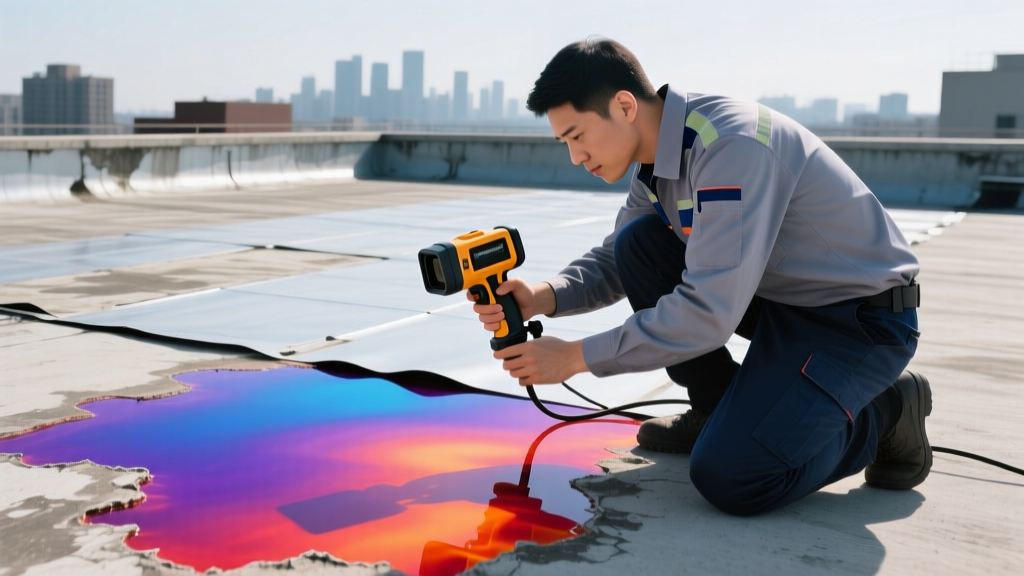
- Infrared Thermography (FLIR): Because water retains heat longer than dry concrete, thermal imaging at dusk (during the cooling cycle) will reveal trapped moisture as warm anomalies. This is highly effective for locating breaches in inverted roof membrane assemblies (IRMA).
- Electronic Field Vector Mapping (EFVM): Specifically used for single-ply and hot-fluid applied membranes, EFVM applies a low-voltage electrical charge to the membrane surface. Any breach in the durable waterproof material completes the circuit, allowing technicians to pinpoint pinhole leaks with millimeter accuracy.
Expert Insight: Never rely solely on a flood test to diagnose a below-grade waterproofing failure. Hydrostatic pressure changes dynamically with the water table. A membrane that holds water during a 48-hour flood test may still fail under the lateral pressure of saturated backfill. Always cross-reference flood tests with substrate RH readings and structural deflection data, as detailed in the Whole Building Design Guide (WBDG) below-grade design protocols.
Preventative Maintenance Protocols
Troubleshooting is reactive; maintenance is proactive. To extend the service life of any durable waterproof material, facility managers must implement a bi-annual inspection schedule focusing on the structural transitions that bear the highest mechanical stress.
Clear all debris from drain flanges and scuppers. Inspect termination bars for signs of pull-out or sealant degradation. Where membranes transition from horizontal to vertical planes, ensure that cant strips or chamfers are intact; a sharp 90-degree bend will eventually cause stress-cracking in liquid membranes and sheet goods alike. Finally, re-apply UV-protective topcoats or sacrificial wear courses every 5 to 7 years, depending on pedestrian traffic volume and local UV index ratings. By addressing minor wear before it compromises the primary waterproofing layer, you eliminate the need for catastrophic tear-offs and preserve the structural integrity of the building envelope.
Written by
David NakamuraDavid Nakamura is a licensed architect (AIA) and construction technology writer focused on sustainable building methods, mass timber engineering, and high-performance building envelopes. He holds a Master of Architecture from the University of Washington and is a certified Passive House Consultant (CPHC). David spent eight years at the Seattle firm Mithun, where he led the design of three LEED Platinum projects, before founding his own practice specializing in net-zero residential design. He serves on the editorial advisory board of GreenBuilder Magazine and has authored peer-reviewed papers on cross-laminated timber (CLT) connections for the Journal of Structural Engineering. In his spare time, David teaches woodworking at Pratt Fine Arts Center and kayaks the Puget Sound.
More from David Nakamura
View all
Construction Cost
Labor Cost to Build a Deck Per Sq Ft: 2026 Installation Guide
Discover the exact labor cost to build a deck per sq ft in 2026. This installation guide breaks down contractor rates, complexity factors, and hidden fees.
Aug 4, 2026

Construction Cost
How Much Does It Cost to Build a 3 Bedroom House? Financing Guide
Learn exactly how much it costs to build a 3 bedroom house and explore 2026 financing options, construction loan types, and budget frameworks for your build.
Aug 4, 2026

Construction Cost
Cost to Build a Tennis Court: 2026 Guide
How much does it cost to build a tennis court in 2026? Breakdowns for asphalt, concrete, and synthetic surfaces plus fencing and lighting.
Jul 30, 2026