IRC Code Requirements for Waterproof and Breathable Material WRBs
Navigate IRC and IECC code requirements for waterproof and breathable material. Learn ASTM testing standards, perm ratings, and WRB installation rules.

The Dual Mandate: Liquid Water Resistance and Vapor Diffusion
In modern building enclosure design, the exterior wall assembly must manage two distinct forms of moisture: bulk liquid water (wind-driven rain, hydrostatic pressure) and water vapor (diffusion and air-transported moisture). Selecting a waterproof and breathable material to serve as the Weather-Resistive Barrier (WRB) resolves this paradox. The material must block liquid intrusion while possessing sufficient vapor permeability to allow the wall assembly to dry outward, preventing interstitial condensation and mold growth.
As of 2026, the widespread adoption of the 2024 International Residential Code (IRC) and International Energy Conservation Code (IECC) has tightened the requirements for both water shedding and continuous air/vapor control. Understanding the precise code thresholds, ASTM testing standards, and climate-zone-specific perm ratings is critical for passing inspections and ensuring long-term structural durability.
IRC Section R703.2: The Baseline for Water-Resistive Barriers
IRC Section R703.2 explicitly mandates that a water-resistive barrier be installed behind the exterior veneer to prevent water from reaching the structural sheathing. The prescriptive baseline remains one layer of No. 15 asphalt-saturated felt (complying with ASTM D226). However, modern construction heavily favors synthetic sheet membranes and fluid-applied systems due to their superior tear resistance, UV stability, and integrated air-barrier capabilities.
While a waterproof and breathable material satisfies the WRB requirement for liquid water, the 2024 IECC (Section C402.5.1) also requires a continuous air barrier in most climate zones. If the WRB is designated as the air barrier, all seams, penetrations, and transitions must be sealed with compatible tapes or fluid flashings. A shingle-lapped, untaped WRB sheds water but fails the air-barrier code requirement.
For synthetic sheet WRBs to be code-compliant as an alternative to #15 felt, they must meet ASTM E2556 (Standard Specification for Sheet Water-Resistive Barriers). This standard tests the material's resistance to water penetration and its structural integrity under wind loads.
Vapor Permeability: Defining 'Breathable' Under the IECC
The term 'breathable' in building science refers to a material's water vapor transmission rate, measured in perms (1 perm = 1 grain of water vapor per hour, per square foot, per inch of mercury pressure difference). The IECC categorizes vapor retarders into three classes based on ASTM E96 testing:
- Class I (Vapor Impermeable): ≤ 0.1 perms (e.g., polyethylene sheeting, rubberized asphalt).
- Class II (Vapor Semi-Impermeable): > 0.1 and ≤ 1.0 perms (e.g., foil-faced polyiso, some self-adhered membranes).
- Class III (Vapor Semi-Permeable): > 1.0 and ≤ 10 perms (e.g., latex paints, #15 felt).
A truly breathable WRB falls outside these retarder classes, typically exhibiting a permeance greater than 10 perms. According to the U.S. Department of Energy's vapor retarder guidelines, using a highly vapor-permeable WRB is essential in cooling-dominated climates (IECC Zones 1, 2, and 3) and mixed-humid climates (Zone 4) to allow inward-driven solar moisture to dry to the exterior.
Material Perm Ratings and Code Compliance Matrix
| Material Type | Brand Example | Permeance (Perms) | ASTM Standard | Code Application |
|---|---|---|---|---|
| Spunbonded Polyolefin | DuPont Tyvek HomeWrap | ~ 58 | ASTM E2556 | All Zones (High outward drying) |
| Non-Woven Polypropylene | HydroGap SA | ~ 44 | ASTM E2556 | All Zones (Drainage gap integrated) |
| Fluid-Applied Silane-Polyether | Prosoco R-Guard FastFlash | ~ 16 | AATCC 127 / ASTM E96 | All Zones (Seamless detailing) |
| Self-Adhered Modified Bitumen | Henry Blueskin VP100 | ~ 25 | ASTM D1970 / E96 | Zones 4-8 (High wind/rain exposure) |
| Asphalt-Saturated Felt (#15) | Generic #15 Felt | 12 - 15 (Variable) | ASTM D226 | Prescriptive IRC Baseline |
Flashing Integration: IRC Section R703.4
The most common point of failure—and the primary focus of municipal code inspectors—is not the field of the waterproof and breathable material, but its integration with rough openings, penetrations, and transitions. IRC Section R703.4 dictates that flashing must be installed in a manner that prevents water from entering the wall cavity.
Required Flashing Locations
- Head and Sill of Openings: Flashing must extend beyond the rough opening and integrate with the WRB. The head flashing must lap over the WRB, while the sill flashing must lap under the WRB (shingle fashion).
- Kick-out Flashing: Where a roof slope intersects an exterior wall, kick-out flashing is strictly required to divert water into the gutter, preventing it from tracking behind the WRB.
- Weep Holes: For masonry and stucco veneers, IRC R703.7.4.1 requires weep holes at a maximum spacing of 33 inches (838 mm) directly above the flashing to allow trapped water to drain.
- Deck-to-Wall Transitions: Ledger boards and deck attachments require continuous flashing integrated with the WRB, often necessitating fluid-applied membranes or specialized self-adhered tapes to seal around the lag bolts.
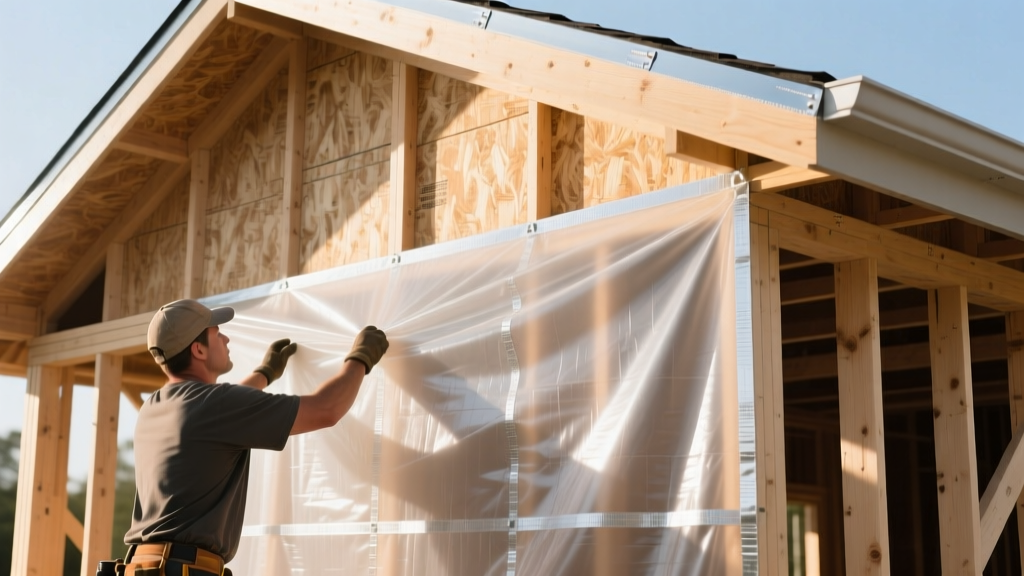
If the upper course of a sheet WRB is tucked behind the lower course, water will be directed directly into the sheathing joints. Code requires a minimum 2-inch (51 mm) horizontal lap and a 6-inch (152 mm) vertical lap, with the upper layer always overlapping the lower layer to shed water outward.
Testing Standards: Proving Material Performance
Manufacturers cannot simply claim a product is a waterproof and breathable material; they must submit to rigorous third-party testing. According to the Pacific Northwest National Laboratory's Building America Solution Center, code officials look for specific evaluation reports (such as ICC-ES ESRs) that verify the following metrics:
- Water Resistance (ASTM D226 / AATCC 127): Measures the material's ability to resist water penetration under hydrostatic pressure. Fluid-applied membranes are often tested to AATCC 127 to ensure they do not leak when subjected to a 55-inch water column for 5 hours.
- Vapor Transmission (ASTM E96): Conducted using both the Desiccant Method (dry cup) and Water Method (wet cup) to establish the material's perm rating under varying humidity conditions.
- Tensile and Tear Strength (ASTM D5034 / ASTM D1004): Ensures the membrane will not rip during the installation of cladding fasteners or under high wind loads before the siding is applied.
- UV Exposure Limits: Synthetic WRBs degrade under ultraviolet light. Code evaluation reports will specify a maximum UV exposure window (typically 120 to 180 days). Exceeding this timeframe voids the warranty and violates the approved installation parameters.
Common Code Violations and Remediation
Even when the correct waterproof and breathable material is specified, installation errors frequently lead to failed inspections and subsequent moisture damage. Avoid these prevalent field errors:
- Unsealed Air Barrier Joints: If the WRB is functioning as the IECC-mandated air barrier, all horizontal and vertical seams must be taped with manufacturer-approved acrylic or butyl tape. Staples alone do not create an air seal.
- Missing Sill Pan Flashing: Relying solely on the WRB wrap at the bottom of window rough openings is a violation. A sloped sill pan (either fluid-applied or rigid) with end dams is required to catch and redirect water that breaches the window frame.
- Fastener Penetrations in Drainage Planes: When installing furring strips over the WRB for a rain screen gap, thousands of fasteners puncture the membrane. Code requires that these penetrations be sealed, either by using self-sealing membranes, applying fluid flashing over the fastener heads, or relying on the compression seal of thick, self-adhered WRB tapes.
Summary of Compliance Requirements
To ensure full compliance with 2026 building codes, specify a WRB that holds a current ICC-ES Evaluation Report. Verify that the material's perm rating aligns with the IECC climate zone requirements for your specific geography. Finally, enforce strict site supervision regarding shingle lapping, rough opening integration, and air-barrier seam sealing to bridge the gap between material science and code-mandated execution.
Written by
Elena RodriguezElena Rodriguez is a civil engineer and technical writer specializing in concrete technology, masonry systems, and ASTM/ACI compliance. She earned her B.S. in Civil Engineering from Texas A&M University and spent a decade at a materials testing laboratory, performing over 2,000 concrete compressive strength tests and masonry prism evaluations. Elena is an ACI-certified Field Testing Technician (Grade I) and a member of ASTM Committee C12 on Natural Building Stone. She currently consults on forensic engineering cases involving concrete failures and moisture intrusion. Based in San Antonio, TX, Elena is a proud member of the Society of Women Engineers (SWE) and coaches her daughter's FIRST Robotics team.
More from Elena Rodriguez
View all
Walls & Panels
Cost Analysis: Light Gauge Steel Framing Advantages and Disadvantages
Evaluate light gauge steel framing advantages and disadvantages through a strict cost analysis lens, comparing material, labor, and lifecycle expenses.
Aug 4, 2026

Walls & Panels
Gypsum Board Types: Exact Specifications, Thickness & Dimensions
Compare standard, Type X, and moisture-resistant gypsum board types. Get exact specifications, thicknesses, dimensions, and ASTM standards for your project.
Aug 4, 2026

Fire Resistance
Best Fire-Resistant Outdoor Decking Materials: 2026 Buyer Guide
Discover the best fire-resistant outdoor decking materials for 2026. Compare Class A PVC, aluminum, and hardwood options for WUI compliance and safety.
Aug 4, 2026