Waterproof Material Shoes: 2026 Membrane & Treatment Costs
Analyze the true cost of waterproof material shoes in 2026. We break down membrane prices, DWR treatments, and manufacturing expenses for work footwear.

The True Cost of Waterproof Material Shoes: Beyond the Retail Price
The retail price of waterproof footwear obscures a complex supply chain of specialized polymers, chemical treatments, and precision assembly labor. For construction specifiers, safety managers, and footwear manufacturers, understanding the raw material costs of waterproof material shoes is critical for budgeting bulk procurement and evaluating product longevity. In 2026, the transition toward PFC-free (perfluorocarbon-free) chemistries and advanced hydrophilic laminates has fundamentally altered the factory floor economics of industrial and outdoor footwear.
- ePTFE Membrane: $18.00 - $24.00 per linear meter (1.5m width)
- Hydrophilic PU Membrane: $6.00 - $9.00 per linear meter
- PFC-Free (C0) DWR Treatment: $0.62 per pair (application cost)
- Hot-Melt PU Seam-Sealing Tape: $0.04 per linear foot
Core Membrane Technologies: ePTFE vs. Hydrophilic PU
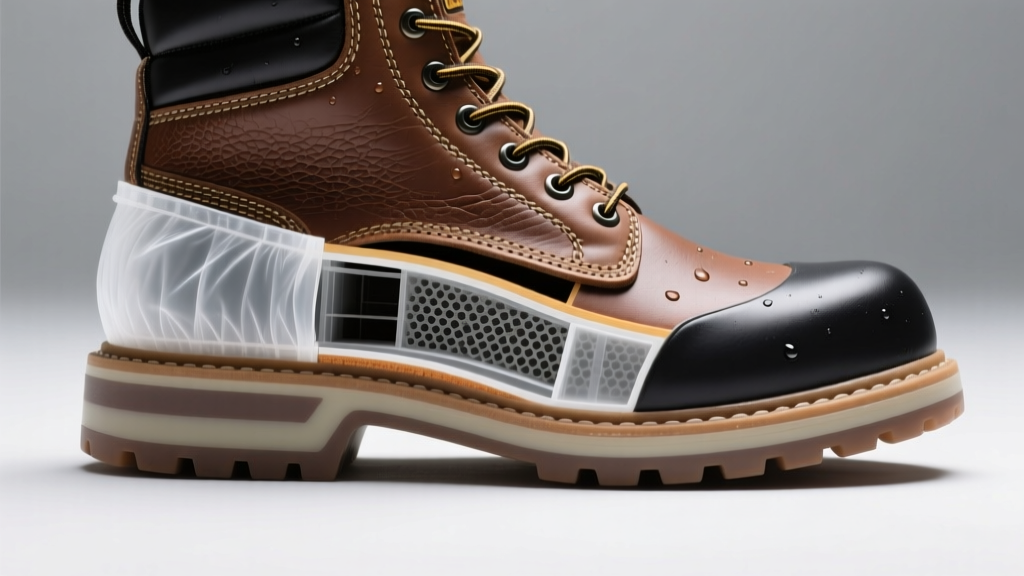
The primary waterproof barrier in modern footwear is a micro-porous or monolithic membrane sandwiched between the outer upper material and the inner textile lining. The choice of membrane dictates both the hydrostatic head (water pressure resistance) and the MVTR (Moisture Vapor Transmission Rate), directly impacting the unit cost.
Expanded Polytetrafluoroethylene (ePTFE)
ePTFE membranes, popularized by Gore-Tex and eVent, rely on a physical structure containing approximately 9 billion microscopic pores per square inch. Each pore is roughly 0.2 microns—small enough to block liquid water molecules but large enough to allow water vapor (sweat) to escape. In 2026, B2B pricing for high-grade ePTFE laminates engineered for heavy-duty work boots ranges from $18.00 to $24.00 per linear meter. These membranes routinely achieve hydrostatic head ratings exceeding 20,000mm and MVTR values above 15,000 g/m²/24h. The primary cost driver is the complex biaxial stretching process required/1910.136'>OSHA standard 1910.136 requires protective footwear in environments with foot hazards, though specific waterproofing is dictated by site conditions rather than federal mandate.
Hydrophilic Polyurethane (PU) Laminates
Hydrophilic PU membranes are monolithic (solid-state) films with no physical pores. They transfer moisture via molecular chain diffusion, absorbing sweat on the inside and pushing it to the outside through a chemical gradient. These are significantly cheaper to manufacture, costing between $6.00 and $9.00 per linear meter. While they offer excellent hydrostatic resistance (often >10,000mm), their MVTR is generally lower (5,000 - 8,000 g/m²/24h). Furthermore, PU membranes are highly susceptible to surfactant contamination; oils, sweat salts, and detergents can alter the polymer's surface tension, causing the membrane to leak prematurely.
DWR Treatments and the PFC-Free Mandate
A waterproof membrane is the secondary line of defense. The primary line is the Durable Water Repellent (DWR) treatment applied to the exterior leather, nylon, or synthetic upper. DWR causes water to bead up and roll off, preventing the outer material from 'wetting out,' which would otherwise trap vapor and halt the membrane's breathability.
Historically, the industry relied on C6 fluorocarbons for DWR. However, following strict environmental regulations and EPA guidelines on PFAS phase-outs, the footwear industry has rapidly transitioned to C0 (PFC-free) alternatives, such as paraffin-based or dendrimer chemistries.
Manufacturing Cost Impact: PFC-free C0 treatments lack the inherent oleophobic (. This means sweat and oils can clog the pores, reducing breathability by up to 70% over the boot's lifespan if not cleaned regularly.Hydrophilic PU 10k+ mm Hydrostatic Head $6.00 - $9.00 / linear meter Hydrolysis and surfactant contamination (wetting out)
Assembly and Seam Sealing Economics
Purchasing waterproof material for shoes is only half the equation; assembling it without compromising the barrier is where labor costs spike. Every needle puncture through the membrane creates a potential leak path.
Hot-Melt PU Seam Tape
To seal stitch lines, factories apply hot-melt polyurethane tape over the interior seams using specialized heated air machines. The tape costs approximately $0.04 per linear foot. A standard 6-inch construction boot requires roughly 14 linear feet of tape. While the material cost is negligible ($0.56 per pair), the automated taping machinery and the skilled labor required to navigate complex 3D curves (like the instep and toe box) add an estimated $2.50 to $3.50 in direct labor per pair.
Bootie Construction vs. Direct-Attach
Most premium waterproof work boots utilize a 'bootie' construction, where the membrane is formed into a sock-like shape and Strobel-stitched to the insole board before the upper is lasted. This guarantees 360-degree waterproofing. Cheaper alternatives use a cemented membrane lining that stops short of the sole, leaving the bottom vulnerable to water ingress once the midsole foam degrades. Specifiers should always verify full bootie construction in procurement sheets.
Lifecycle Costs: Maintenance and Retreatment
The total cost of ownership for waterproof work shoes extends beyond the initial purchase. Because C0 DWR treatments degrade faster under the abrasive conditions of a construction site (mud, concrete dust, friction), end-users must budget for aftermarket retreatments.
- Initial Factory DWR Application: $0.62 per pair (amortized into retail price).
- Aftermarket Spray/Wash-in (e.g., Nikwax, Grangers): $12.00 - $18.00 per 10oz bottle, yielding approximately 4 to 6 applications per bottle ($2.00 - $4.50 per retreatment).
- Retreatment Frequency: For daily wear in abrasive environments, C0 DWR requires reapplication every 45 to 60 days to maintain adequate beading and prevent upper saturation.
Failing to retreat the exterior material forces the ePTFE membrane to work at maximum capacity, accelerating interior lining wear and increasing the likelihood of delamination.
Procurement Decision Matrix for 2026
Use this framework to specify the correct waterproof materials based on the exact operational environment and budget constraints.
- If the environment involves constant submersion or deep mud: Specify ePTFE membranes with fully gusseted tongues and welded rubber lower shells (vulcanized construction). Avoid PU membranes, which will eventually suffer hydrolysis in continuous wet environments.
- If the primary hazard is chemical exposure (oils, solvents): Avoid standard ePTFE. Specify specialized oleophobic membranes (like Gore-Tex Duratherm or equivalent chemical-resistant laminates) which cost 30-40% more but resist surfactant penetration.
- If the budget is constrained and exposure is limited to light rain/splash: Hydrophilic PU membranes paired with a high-quality C0 DWR on a full-grain leather upper provide the best cost-to-performance ratio, keeping factory FOB costs below $45 per pair.
- If high-exertion breathability is the priority (e.g., summer roofing): Prioritize direct-venting ePTFE membranes (like eVent) which lack the solid PU protective layer found in standard 3-layer laminates, offering 30% higher MVTR at a slight premium to the membrane cost.
Understanding the precise material costs and failure modes of waterproof material shoes allows safety managers and buyers to move beyond marketing claims, ensuring that PPE budgets are allocated toward footwear that will actually perform in the field.
Written by
Elena RodriguezElena Rodriguez is a civil engineer and technical writer specializing in concrete technology, masonry systems, and ASTM/ACI compliance. She earned her B.S. in Civil Engineering from Texas A&M University and spent a decade at a materials testing laboratory, performing over 2,000 concrete compressive strength tests and masonry prism evaluations. Elena is an ACI-certified Field Testing Technician (Grade I) and a member of ASTM Committee C12 on Natural Building Stone. She currently consults on forensic engineering cases involving concrete failures and moisture intrusion. Based in San Antonio, TX, Elena is a proud member of the Society of Women Engineers (SWE) and coaches her daughter's FIRST Robotics team.
More from Elena Rodriguez
View all
Walls & Panels
Cost Analysis: Light Gauge Steel Framing Advantages and Disadvantages
Evaluate light gauge steel framing advantages and disadvantages through a strict cost analysis lens, comparing material, labor, and lifecycle expenses.
Aug 4, 2026

Walls & Panels
Gypsum Board Types: Exact Specifications, Thickness & Dimensions
Compare standard, Type X, and moisture-resistant gypsum board types. Get exact specifications, thicknesses, dimensions, and ASTM standards for your project.
Aug 4, 2026

Fire Resistance
Best Fire-Resistant Outdoor Decking Materials: 2026 Buyer Guide
Discover the best fire-resistant outdoor decking materials for 2026. Compare Class A PVC, aluminum, and hardwood options for WUI compliance and safety.
Aug 4, 2026