Top Waterproofing Material for Roof in 2026: EPDM vs TPO vs PVC
Compare the top waterproofing material for roof systems in 2026. We break down EPDM, TPO, and PVC membranes by cost, lifespan, and installation.

The Polymer Divide: Thermoset vs. Thermoplastic Membranes
Selecting the correct waterproofing material for roof applications on low-slope and flat commercial structures dictates the 20-to-30-year lifecycle of the building envelope. The single-ply membrane market is fundamentally divided into two chemical categories: thermoset and thermoplastic. Understanding this distinction is the first critical step in material selection, as it governs seam methodology, repair protocols, and long-term weathering characteristics.
Thermoset membranes, primarily EPDM (Ethylene Propylene Diene Monomer), undergo a chemical vulcanization process during manufacturing. Once cured, the polymer chains are permanently cross-linked. This means EPDM cannot be melted or heat-welded; seams must be joined using specialized liquid adhesives, primers, or vulcanized seam tapes. Conversely, thermoplastic membranes like TPO (Thermoplastic Polyolefin) and PVC (Polyvinyl Chloride) soften when heated and harden when cooled. This allows their seams to be thermally fused using hot-air welding equipment, creating a monolithic, continuous bond that is often stronger than the membrane itself.
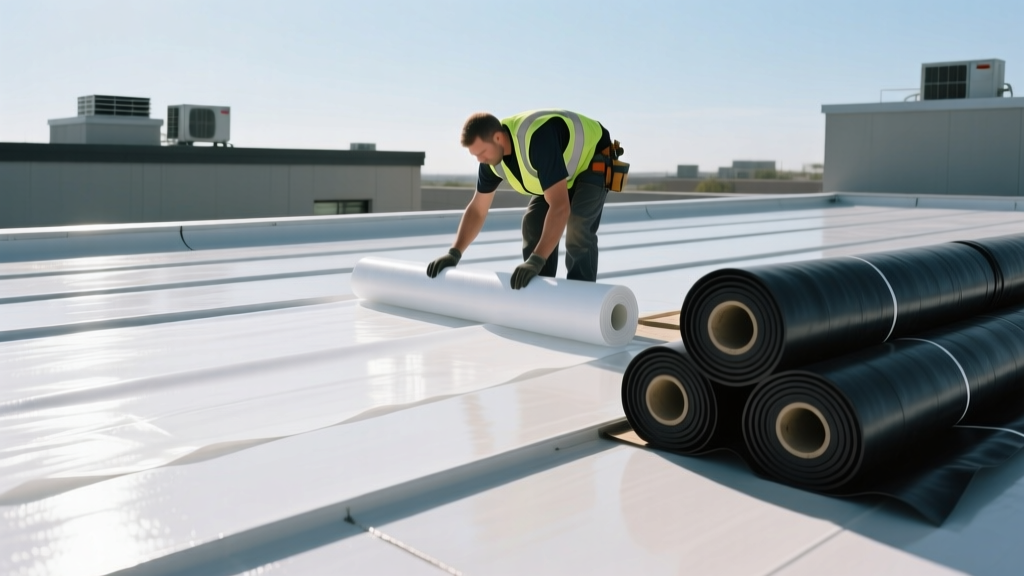
Material Profiles and 2026 Specifications
EPDM (Ethylene Propylene Diene Monomer)
EPDM remains a dominant force in northern climates due to its exceptional cold-weather flexibility and proven multi-decade track record. For commercial applications in 2026, the industry standard has shifted heavily toward 60-mil reinforced EPDM (such as Carlisle SynTec's Sure-Seal line), which incorporates an internal polyester scrim for dimensional stability and puncture resistance. While black EPDM is traditional and offers slight advantages in snow-melt and heating cost reduction in cold zones, white-on-black EPDM is increasingly specified to meet modern cool-roof energy codes without sacrificing the underlying UV stability of the black polymer base.
TPO (Thermoplastic Polyolefin)
TPO is the most widely installed commercial waterproofing material for roof systems in North America, prized for its balance of cost, heat-reflectivity, and environmental profile (it contains no chlorine). Modern TPO formulations have addressed early-generation issues with UV degradation and seam delamination. Current best practices mandate a minimum of 60-mil thickness, with 80-mil specified for roofs with high foot traffic or severe hail exposure. Products like GAF EverGuard Extreme utilize advanced polymer blends that maintain weldability and flexibility even after prolonged thermal shock cycles. TPO seams are welded using automatic hot-air welders calibrated between 800°F and 1,100°F, depending on ambient wind and temperature conditions.
PVC (Polyvinyl Chloride)
PVC is the premium thermoplastic option, distinguished by its inherent chemical resistance and exceptional fire performance. It is the undisputed choice for facilities that exhaust airborne oils, fats, or hydrocarbons onto the roof surface, such as commercial kitchens and manufacturing plants. A leading specification in 2026 is the Sika Sarnafil G 410 (50-mil or 60-mil), which features a proprietary polyester reinforcement and a lacquer surface coating that resists dirt pickup and plasticizer migration. For retrofits over existing substrates like asphalt or polystyrene insulation, fleece-backed PVC is required to prevent chemical incompatibility and plasticizer leaching.
Head-to-Head Comparison Matrix
| Feature | EPDM (Reinforced) | TPO (Standard) | PVC (Premium) |
|---|---|---|---|
| Polymer Type | Thermoset Rubber | Thermoplastic | Thermoplastic |
| Primary Seam Method | Tape / Liquid Adhesive | Hot-Air Welding | Hot-Air / Solvent Welding |
| Standard Thickness | 60-mil | 60-mil to 80-mil | 50-mil to 60-mil |
| Chemical/Grease Resistance | Poor (Degrades rapidly) | Moderate | Excellent |
| Puncture Resistance | High (with scrim) | Moderate to High | High |
| ASTM Standard | ASTM D4637 | ASTM D6878 | ASTM D4434 |
2026 Installed Cost Analysis and ROI
Pricing for single-ply membranes fluctuates based on petrochemical feedstock costs, insulation requirements, and regional labor rates. The following ranges reflect fully installed costs (material, insulation, fasteners/adhesives, and labor) for a standard 20,000 sq. ft. commercial roof in 2026:
- EPDM (Mechanically Attached): $5.50 – $7.50 per sq. ft. Fully adhered systems add approximately $1.50 – $2.00 per sq. ft. due to bonding adhesive costs.
- TPO (Mechanically Attached): $6.00 – $8.50 per sq. ft. TPO requires a higher initial capital outlay for welding equipment and certified technicians, but offers lower lifetime maintenance costs due to welded seam reliability.
- PVC (Fully Adhered/Fleece-Backed): $8.50 – $11.50 per sq. ft. PVC commands a premium, but its lifecycle cost is often justified by its 25-to-30-year lifespan and resistance to costly chemical damage repairs.
For a comprehensive breakdown of energy savings associated with reflective thermoplastic membranes, facility managers should consult the U.S. Department of Energy's Cool Roofs guide, which details how high-albedo surfaces can reduce peak cooling demand by up to 15%.
Failure Modes and Edge Cases
While EPDM is highly resistant to water absorption, prolonged ponding water (standing water for more than 48 hours) accelerates the degradation of the liquid adhesives and seam tapes used to join the sheets. If your roof design lacks adequate taper or drainage, EPDM is a high-risk choice. Opt for heat-welded TPO or PVC, which maintain monolithic watertight integrity even under constant submersion.
The TPO 'Zippering' Phenomenon
The most common catastrophic failure in TPO installations is seam 'zippering'—a progressive peeling of the heat-welded lap. This rarely stems from material defect; rather, it is an installation error. If the automatic hot-air welder is driven too fast, or if the ambient temperature drops below 40°F without adjusting the heat output and pressure roller, the weld achieves a 'cold bond.' In 2026, rigorous quality control mandates daily test welds and destructive peel testing (using a seam probe) to verify weld shear strength before proceeding with the day's production.
EPDM Shrinkage and Flashing Pull
Unreinforced EPDM is prone to thermal shrinkage over time, which can pull the membrane taut and tear it away from perimeter flashings or penetrations. Always specify reinforced EPDM for the field of the roof, and utilize uncured EPDM flashing laminates for complex penetrations to ensure the material can stretch and conform without storing internal tension.
Decision Framework: Which Membrane Fits Your Building?
Use this operational framework to finalize your specification:
- Is there airborne grease, oil, or chemical exhaust?
→ Select PVC. TPO and EPDM will blister, swell, and dissolve when exposed to animal fats or hydrocarbon oils vented from HVAC or kitchen exhaust systems. - Is the building located in a severe hail zone (e.g., Texas, Colorado)?
→ Select 80-mil TPO or a heavy-gauge PVC with a thick fleece backing. The thicker thermoplastic top ply absorbs impact energy better than standard 60-mil options, preventing micro-fractures that lead to leaks. - Is this a cold-climate retrofit over an existing BUR (Built-Up Roof) or asphalt substrate?
→ Select Fleece-Backed PVC or EPDM. Direct contact between asphalt and standard TPO/PVC causes plasticizer migration, making the thermoplastic brittle. A fleece backing acts as a necessary separation layer. - Is the primary goal minimizing initial capital expenditure on a simple warehouse?
→ Select 60-mil Mechanically Attached EPDM. It offers the lowest installed cost per square foot while providing reliable, code-compliant waterproofing for non-complex geometries.
Industry Standards and Sourcing
Regardless of the membrane selected, ensure the specification mandates compliance with the latest National Roofing Contractors Association (NRCA) guidelines and relevant ASTM standards. In 2026, building codes increasingly require third-party quality assurance (QA) inspections during the installation phase to verify fastener pull-out resistance, adhesive coverage rates, and weld integrity. Partnering with a manufacturer-certified contractor who can provide a 20-year No Dollar Limit (NDL) warranty remains the most effective strategy for mitigating long-term envelope risk.
Written by
James ThorntonJames Thornton is a construction industry veteran with 25 years of hands-on experience in wood framing, lumber grading, and residential building codes. He started as a framing carpenter in rural Oregon, earned his ICC Residential Building Inspector certification, and eventually became a senior plan reviewer for the City of Portland Bureau of Development Services. James holds a B.S. in Wood Science & Technology from Oregon State University and is a certified lumber grader through the West Coast Lumber Inspection Bureau (WCLIB). He has inspected over 3,000 residential construction sites and authored the city's internal guide on advanced framing techniques (2x6 at 24" O.C.). James lives in Bend, OR, where he builds custom timber-frame cabins and competes in lumberjack sports.
More from James Thornton
View all
Insulation
Best Home Insulation Materials: Complete 2026 Guide
Compare top home insulation materials for 2026. Find R-values, installed costs per square foot, and best uses for fiberglass, spray foam, and mineral wool.
Aug 4, 2026

Sustainable Building
Certify Your Green Building Material for LEED and WELL
Step-by-step guide to certifying a green building material for LEED v5 and WELL v2. Master EPDs, HPDs, and VOC limits for 2026 project specifications.
Aug 4, 2026

Stone & Masonry
Veneer Stacked Stone Panels: Interior Design & Style Showcase
Discover how veneer stacked stone panels transform interiors. Explore modern design profiles, material pairings, and technical installation specs.
Aug 4, 2026