Waterproof Paper Material Selection Guide: Felt, Kraft, and Synthetics
Compare asphalt felt, kraft, and synthetic waterproof paper materials. Learn how to select the right moisture barrier for roofing, walls, and concrete.

Defining Waterproof Paper in Modern Construction
When architects and contractors specify a waterproof paper material, they are rarely referring to standard office paper treated with a sealant. In the building envelope industry, 'waterproof paper' encompasses a specific class of cellulosic, asphalt-impregnated, or poly-coated sheet goods designed to manage liquid water, water vapor, and air infiltration. While synthetic polyolefin wraps have captured significant market share, traditional paper-based membranes remain the code-mandated standard for specific high-risk applications, particularly behind stucco, under slate roofing, and as concrete curing blankets.
Selecting the correct waterproof paper material requires balancing liquid water resistance with vapor permeability. A misapplication can trap moisture inside wall cavities, leading to structural rot and mold proliferation. This guide breaks down the exact material specifications, ASTM standards, and application-specific decision matrices required to choose the right membrane for your 2026 building projects.
Primary Categories of Waterproof Paper Materials
1. Asphalt-Saturated Felt (Tar Paper)
Manufactured from organic rag fibers or fiberglass mats saturated with asphalt, this is the original waterproof paper material. It is categorized by weight per 100 square feet:
- #15 Felt: Weighs approximately 8 lbs per 100 sq ft. Used primarily as a secondary weather barrier under asphalt shingles or as a slip sheet under hardwood flooring. It offers a vapor permeance of roughly 5 to 10 perms when dry, but drops to sub-1 perm when wet, acting as a 'smart' vapor retarder.
- #30 Felt: Weighs approximately 16 lbs per 100 sq ft. Thicker and more puncture-resistant, it is specified for low-slope roofs, under heavy tile/slate, and as a weather-resistive barrier (WRB) in high-wind coastal zones.
2. Grade D Building Paper (Kraft)
Grade D paper is an asphalt-impregnated kraft paper. Unlike felt, which uses a thick mat, Grade D relies on the chemical treatment of the paper pulp for its water resistance. It is classified by its water-resistance rating in minutes (e.g., 30-minute or 60-minute paper), tested via the 'boat test' where a folded paper boat holds dry sand and floats on water. Sixty-minute Grade D paper is the absolute minimum requirement behind traditional three-coat stucco in the International Building Code (IBC).
3. Polyethylene-Coated Kraft Paper
Often called 'curing paper' or ' SisalKraft', this material features a heavy kraft paper base laminated to a woven fiberglass scrim and coated with polyethylene. The white side reflects UV rays and heat, while the black side absorbs water to keep concrete surfaces continuously moist during the 28-day hydration cycle. It serves as a Class I vapor retarder (less than 0.1 perms).
4. Synthetic 'Paper' Membranes
While technically non-woven polyolefins (like Tyvek or Typar), these materials are frequently cross-shopped against traditional paper. They offer high liquid water resistance and high vapor permeability (typically 30-50 perms) but lack the thickness and 'bond-break' properties of asphalt-impregnated paper required for cementitious claddings.
A common failure in building envelope design is confusing a water-resistive barrier (WRB) with a vapor retarder. Grade D waterproof paper material and #15 felt are excellent WRBs that allow water vapor to pass through (vapor open). Poly-coated kraft paper is a Class I vapor retarder (vapor closed). Installing a vapor-closed paper on the exterior of a wall in a cooling-dominated climate (like Florida) will trap interior condensation inside the wall cavity, destroying the sheathing. Always verify the ASTM E96 perm rating before specifying.
Application-Specific Selection Matrix
Use the following matrix to match the waterproof paper material to your specific construction assembly. Data aligns with current IBC and IRC code requirements.
| Application | Recommended Material | Key Specification / Standard | Minimum Lap Joint Requirement |
|---|---|---|---|
| Behind Traditional Stucco | Grade D 60-min Paper (Two Layers) | ASTM D779; IBC Section 2510.6 | 6 inches vertical, 2 inches horizontal |
| Asphalt Shingle Roof Underlayment | #15 Asphalt Felt | ASTM D226 Type I | 2 inches horizontal, 6 inches end-laps |
| Tile / Slate Roof Underlayment | #30 Asphalt Felt | ASTM D226 Type II | 2 inches horizontal, 6 inches end-laps |
| Hardwood Flooring Underlayment | #15 Asphalt Felt or Rosin Paper | NOFMA Guidelines | 2 to 4 inches overlap; taped seams optional |
| Concrete Slab Curing | Poly-Coated Kraft Curing Paper | ASTM C171 | 6 inches overlap; weighted or taped edges |
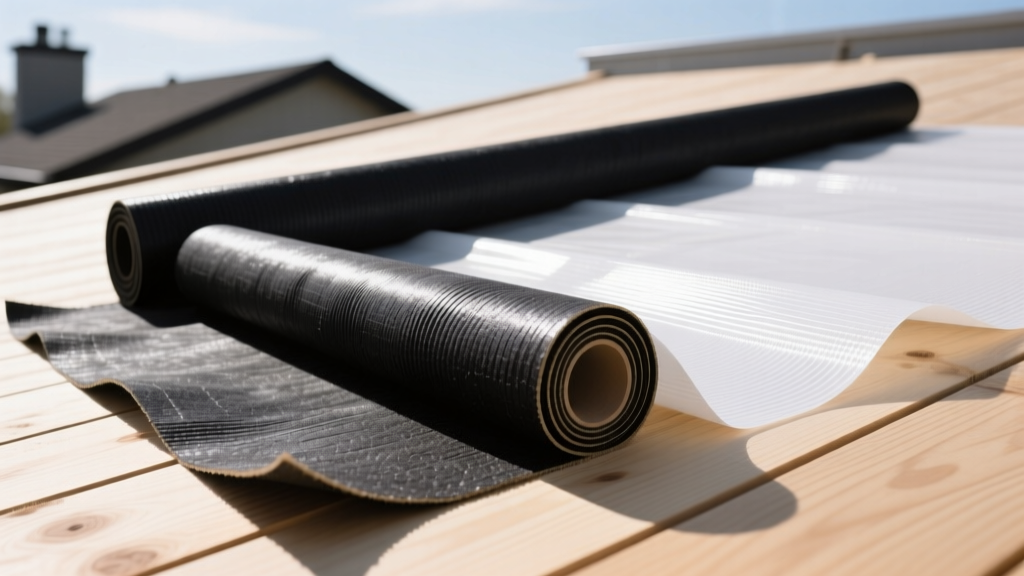
The Stucco Exception: Why Synthetics Fail Where Paper Succeeds
According to extensive building envelope diagnostics published by the PNNL Building America Solution Center, synthetic house wraps frequently fail when used directly behind traditional portland cement stucco. Stucco is highly alkaline (pH 12-13) during application and curing. This alkalinity chemically degrades the surfactants in synthetic wraps, destroying their water-repellency and causing them to bond permanently to the stucco scratch coat.
When the stucco cures and shrinks, it pulls on the bonded synthetic wrap, tearing it away from the sheathing. Grade D waterproof paper material acts as a necessary 'bond break.' The paper absorbs the alkaline moisture, swells slightly, and creates a microscopic capillary break that allows the stucco to drain without adhering to the WRB. For this reason, building codes in California, Nevada, and Arizona strictly mandate Grade D paper or asphalt felt behind cementitious claddings.
Real-World Failure Modes and Edge Cases
Even when the correct waterproof paper material is selected, installation errors lead to moisture intrusion. Watch for these specific failure modes:
- UV Degradation Timelines: Asphalt-saturated felt and Grade D paper have very low UV resistance. If left exposed to direct sunlight for more than 30 to 60 days, the asphalt volatilizes, the paper becomes brittle, and water resistance drops by up to 70%. If construction delays are expected, specify a UV-stabilized synthetic wrap or cover the paper with siding immediately.
- Fastener Tearing in High Wind: Grade D paper lacks the tensile strength of woven synthetics. When fastened with standard cap nails in high-wind zones (110+ mph), the paper can tear around the fastener head during wind-load deflection. Solution: Use 2-inch diameter plastic cap washers or switch to #30 felt, which has higher tear resistance.
- Reverse Shingling at Penetrations: A common error is lapping the waterproof paper *over* the window flange at the top, but *under* the flange at the bottom. The paper must always shingle downwards (upper layers overlapping lower layers) to direct water out. The Whole Building Design Guide (WBDG) provides critical detailing diagrams for integrating paper WRBs with flashing tapes at rough openings.
2026 Material Cost and Coverage Breakdown
Pricing for building papers fluctuates with crude oil and pulp markets. Below are the average contractor costs for Q1 2026. Note that 'Installed Cost' includes standard cap-nail fastening and labor for a 2,000 sq ft commercial or residential exterior.
| Material Type | Roll Size & Coverage | Material Cost per Roll | Installed Cost per Sq Ft |
|---|---|---|---|
| #15 Asphalt Felt | 3' x 72' (216 sq ft) | $18.00 - $24.00 | $0.35 - $0.45 |
| #30 Asphalt Felt | 3' x 72' (216 sq ft) | $32.00 - $40.00 | $0.55 - $0.70 |
| Grade D 60-min Kraft | 3' x 140' (420 sq ft) | $28.00 - $35.00 | $0.30 - $0.42 |
| Poly-Coated Curing Paper | 12' x 200' (2400 sq ft) | $140.00 - $180.00 | $0.12 - $0.18 (Horizontal) |
Final Specification Checklist
Before finalizing your submittals, verify the following criteria with your supplier:
- Verify the ASTM Stamp: Ensure the packaging explicitly prints ASTM D226 (for felt) or ASTM D779 (for Grade D paper). Generic 'builder's paper' sold at big-box stores often lacks certified water-resistance ratings and will fail municipal inspections.
- Check the Perm Rating: Request the manufacturer's ASTM E96 test data. If applying over OSB sheathing in a mixed-humid climate, ensure the paper's dry perm rating is above 5.0 to allow outward drying.
- Confirm Compatibility with Flashing Tapes: Asphalt-saturated papers can bleed oils that degrade the acrylic adhesives on certain flexible flashing tapes (like Zip System tape). Use butyl-based flashing tapes or prime the paper surface before taping to ensure a permanent air seal.
By matching the exact physical properties of the waterproof paper material to the hygrothermal demands of your specific climate zone and cladding type, you eliminate the root causes of envelope failure and ensure long-term structural durability.
Written by
Marcus ChenMarcus Chen is a licensed structural engineer (PE) and building materials analyst with over 12 years of experience across residential, commercial, and industrial construction. He holds a Master of Science in Civil Engineering from UC Berkeley and spent six years at Thornton Tomasetti before transitioning to independent consulting and technical writing. Marcus specializes in material selection for seismic-prone regions, concrete reinforcement strategies, and lifecycle cost analysis. His work has been cited by the American Concrete Institute (ACI) and the Structural Engineers Association of California (SEAOC). When he is not on a job site or at his desk, you will find him hiking the Sierra Nevada or restoring a 1920s craftsman bungalow in Oakland, CA.
More from Marcus Chen
View all
Construction Cost
How Much Did the Eiffel Tower Cost to Build?
How much did the Eiffel Tower cost to build in 1889? We adjust for inflation and compare its budget to modern skyscraper construction.
Aug 4, 2026

Fire Resistance
What Is a Fire Resistant Material? Testing & Certification Guide
Discover what is a fire resistant material through ASTM and UL testing. Learn how fire ratings, certifications, and assemblies work in construction.
Aug 4, 2026

Construction Cost
How Much Did the Burj Khalifa Cost to Build?
How much did the Burj Khalifa cost to build? We break down the $1.5B project and extract 5 money-saving strategies for your next build.
Jul 30, 2026