Why Waterproof Construction Materials Fail: A Troubleshooting Guide
Diagnose and repair failures in waterproof construction materials. Expert troubleshooting for membranes, coatings, and substrate moisture issues.
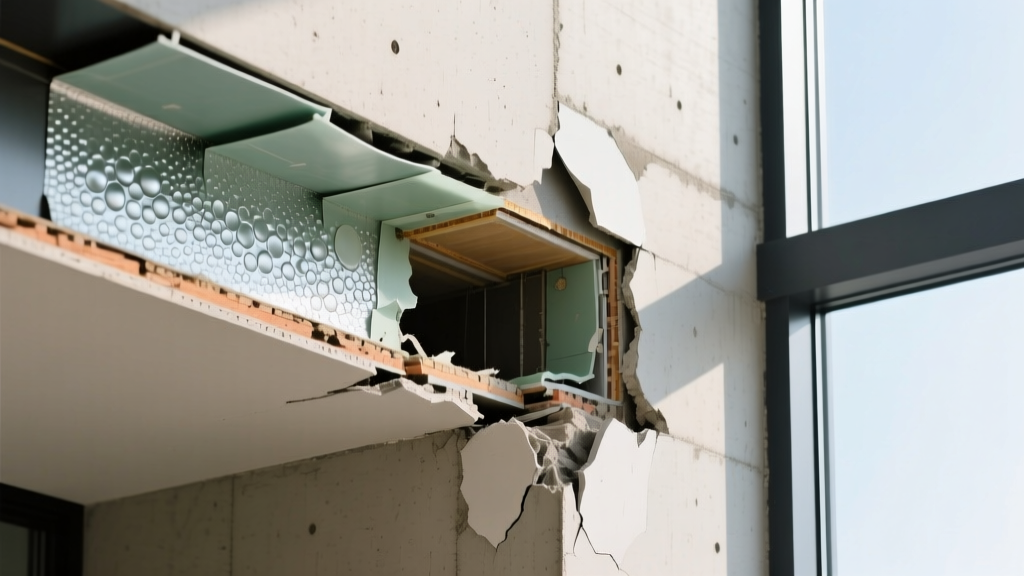
The Physics of Enclosure Failure: Beyond the Material Data Sheet
Waterproof construction materials are engineered to resist hydrostatic pressure, capillary action, and vapor diffusion. Yet, field failures in below-grade foundations, plaza decks, and low-slope roofs remain a leading cause of construction defect litigation. The root cause is rarely a manufacturing defect in the membrane itself. According to building enclosure forensics, over 85% of waterproofing failures stem from improper substrate preparation, incompatible material transitions, or a fundamental misunderstanding of the assembly's hygrothermal dynamics. As building envelopes become tighter and more insulated, the margin for error in moisture management has effectively vanished.
Troubleshooting these assemblies requires moving beyond surface-level symptom patching. A water stain on an interior foundation wall is not the problem; it is the final symptom of a systemic breakdown in the drainage plane, structural confinement, or material continuity. This guide provides a forensic framework for diagnosing failures across the three most common categories of waterproof construction materials: bentonite clay panels, liquid-applied polyurethanes, and thermoplastic sheet membranes.
Symptom-to-Cause Diagnostic Matrix
Before deploying invasive destructive testing, map the visible symptoms to their most probable systemic causes using the matrix below. This triage step prevents unnecessary tear-offs and focuses diagnostic efforts on the actual failure mechanism.
| Visible Symptom | Material Type | Probable Root Cause | Primary Diagnostic Test |
|---|---|---|---|
| Localized blistering / outgassing | Liquid Polyurethane | Substrate moisture >5% CM reacting with isocyanates | ASTM F2170 (In-situ RH probe) |
| Seam separation / false welds | TPO / PVC Sheets | Surface contamination or incorrect thermal welder calibration | Field peel test (destructive) |
| Continuous weeping at cold joints | Sodium Bentonite | Insufficient confinement pressure (<45 psf) or premature hydration | Electronic Field Vector Mapping (EFVM) |
| Pinhole leaks in monolithic coatings | PMMA / Polyurea | Substrate porosity outgassing or insufficient wet-mil thickness | Wet/dry mil gauge verification & spark testing |
Material-Specific Troubleshooting Protocols
1. Sodium Bentonite Panels (e.g., CETCO Voltex DS)
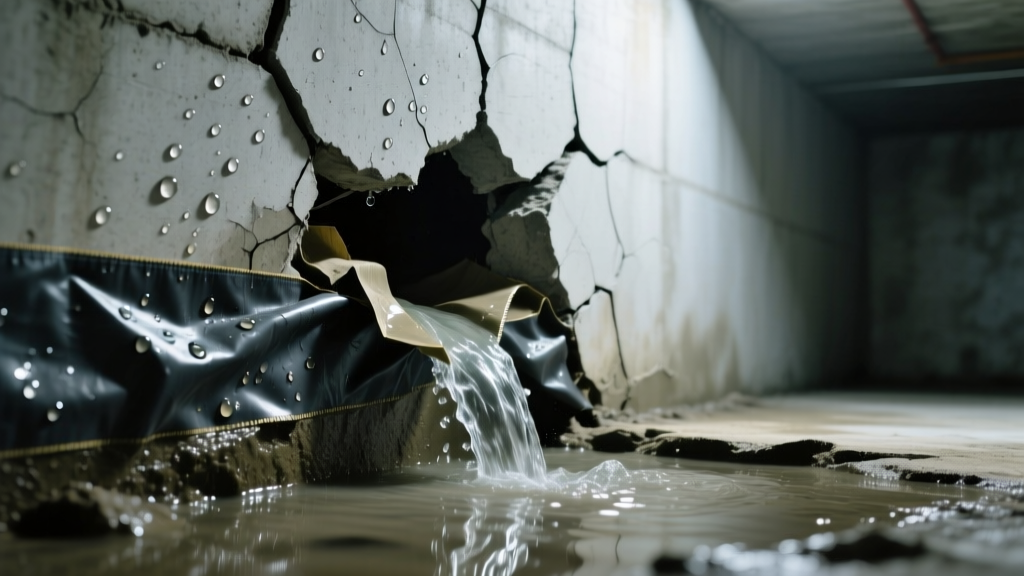
Sodium bentonite relies on a specific physical reaction to function: when exposed to water, the clay swells up to 15 times its dry volume, forming an impermeable gel. However, this swelling requires confinement. If the hydrostatic pressure pushes the clay into a void rather than compressing it against the concrete substrate, the gel will wash away, resulting in a continuous leak.
- The Confinement Rule: Bentonite requires a minimum of 45 pounds per square foot (psf) of uniform confinement pressure. This is typically achieved by the weight of the backfill soil against the foundation wall.
- The Failure Mode: Using highly compressible drainage mats (e.g., low-density dimpled boards) or backfilling with loose, uncompacted gravel creates voids. The bentonite swells into the void instead of sealing the concrete.
- Corrective Action: If a below-grade bentonite assembly fails due to lack of confinement, exterior excavation is rarely cost-effective. The standard repair protocol involves interior injection of acrylate chemical grout (such as Avanti AV-100) directly into the concrete cold joints and cracks. The grout polymerizes, creating a flexible, watertight seal that mimics the intended function of the bentonite gel.
2. Liquid-Applied Polyurethane Membranes (e.g., Tremco Vulkem 116)
Liquid-applied membranes offer seamless continuity, making them ideal for complex plaza decks and podiums with numerous penetrations. However, polyurethane chemistry is highly sensitive to moisture during the curing phase.
- The Failure Mode: Blistering and delamination. Polyurethanes are moisture-cured. If applied over a concrete substrate with high internal moisture, the trapped water vapor reacts with the isocyanate components in the coating, generating carbon dioxide gas. This gas becomes trapped beneath the curing film, creating blisters that eventually rupture and allow water ingress.
- The Diagnostic Threshold: Never rely on surface-dry visual inspections. Concrete must be tested using in-situ relative humidity probes per ASTM F2170. The internal RH must be below 75%, and surface moisture must be below 5% by weight (Calcium Chloride test or CM method).
- Corrective Action: Cut out all blistered areas down to the concrete. Allow the exposed substrate to dry (use forced-air dehumidifiers if necessary). Apply a moisture-mitigating epoxy primer (e.g., Tremco Vulkem 171 Primer) rated for high-RH substrates, followed by a detail coat and a full 60 wet-mil topcoat of the aliphatic polyurethane.
3. Thermoplastic Polyolefin (TPO) & PVC Sheet Membranes
TPO and PVC dominate the commercial low-slope roofing and above-grade plaza deck markets. Their waterproofing integrity relies entirely on the strength of the heat-welded seams.
- The Failure Mode: 'False welds' or 'cold welds'. The top ply of the membrane melts, but the bottom ply does not achieve the necessary thermal fusion. The seam holds under initial tension but fails under thermal cycling or wind uplift.
- The 2026 Calibration Reality: While modern automated hot-air welders feature digital feedback loops, ambient temperature, wind speed, and substrate thermal mass drastically alter the required heat and speed settings. A welder set to 1,050°F at 12 feet per minute in July will produce a cold weld in October without recalibration.
- Quality Assurance Protocol: Perform a destructive peel test on a sample weld at the start of every shift, after every equipment change, and whenever ambient temperatures shift by more than 10°F. The membrane must tear (flock failure) before the weld separates.
⚠️ Critical Warning: The Vapor Drive Reversal Trap
When troubleshooting moisture in insulated roof decks or below-slab assemblies, always calculate the vapor drive direction. Installing a Class I vapor retarder on the warm-in-winter side of an assembly that experiences 'vapor drive reversal' in the summer (common in humid climates with interior AC) will trap moisture inside the assembly, rotting the deck from the inside out. Consult the hygrothermal analysis principles outlined by Building Science Corporation before specifying vapor barriers.
Substrate Preparation: The Hidden Culprit in 80% of Failures
The most advanced waterproof construction materials will fail if the substrate is compromised. Substrate preparation is not merely about cleaning; it is about achieving the correct surface profile and moisture equilibrium.
- Surface Profiling (CSP): Liquid-applied membranes and cementitious coatings require a specific Concrete Surface Profile (CSP). For most heavy-duty polyurethanes, a CSP-3 to CSP-4 (achieved via shot blasting or scarification) is mandatory. A smooth trowel finish (CSP-1) provides insufficient mechanical tooth, leading to shear delamination under hydrostatic load.
- Bugholes and Voids: Form-tied concrete walls are riddled with surface bugholes. If a liquid membrane bridges a bughole, hydrostatic pressure will push the membrane into the void, causing it to stretch and eventually puncture. All voids larger than 1/16 inch must be pre-filled with a cementitious patching compound or a flexible mastic before the primary membrane is applied.
- Chemical Contaminants: Concrete form release agents, curing compounds, and efflorescence act as bond-breakers. Efflorescence must be removed via mechanical abrasion or mild acid washing (followed by thorough neutralization and rinsing). Never apply a membrane over a substrate that has not passed the water-break test (water should sheet evenly, not bead).
Advanced Diagnostic Testing Protocols
When visual inspection and the symptom matrix fail to isolate the breach, deploy non-destructive and quantitative testing methods. The days of relying solely on 48-hour flood testing are evolving, supplemented by precise electronic diagnostics.
Electronic Field Vector Mapping (EFVM)
EFVM is the gold standard for locating pinhole breaches in non-conductive membranes (like TPO, PVC, and modified bitumen) over conductive substrates (like concrete or steel decking). A low-voltage electrical field is applied across the membrane surface. If a breach exists, the current flows through the pinhole to the grounded substrate, and the technician uses a handheld sensor to pinpoint the exact location of the leak. This eliminates the need for destructive core sampling and allows for targeted, micro-repairs.
Flood Testing (ASTM D5957)
While EFVM finds the holes, flood testing proves the assembly's overall integrity. Per EPA moisture control guidelines and ASTM standards, horizontal plaza decks and podiums should be flood-tested prior to the installation of overburden (pavers, soil, or topping slabs). The test requires damming the drains, flooding the area with a minimum of 2 inches of water, and monitoring the underside for 48 hours. Note: Ensure the structural engineer has verified the deck's live-load capacity to support the immense weight of the test water (approx. 10.4 lbs per square foot per inch of water depth).
Corrective Action Framework: Targeted Repair vs. Full Tear-Off
Once the failure mechanism is isolated, the final decision is whether to execute a localized repair or mandate a full system replacement. Use this decision framework to guide the scope of work:
- Opt for Targeted Repair When: The failure is isolated to specific penetrations, transitions, or seams; the primary field membrane passes EFVM or adhesion pull-tests; and the substrate moisture levels are currently within manufacturer tolerances. Repairs should utilize compatible, high-grade flashing liquids (e.g., PMMA or silyl-terminated polyethers) that bridge dissimilar materials.
- Mandate Full Tear-Off When: The membrane exhibits widespread adhesion loss (>20% of the field area fails pull-tests); the substrate is saturated with chlorides or sulfates that will continue to degrade the bond; or the assembly suffers from systemic vapor entrapment that will cause new blisters to form immediately after localized patches are applied.
Troubleshooting waterproof construction materials is an exercise in building physics and forensic discipline. By respecting substrate moisture limits, ensuring proper confinement and thermal calibration, and utilizing advanced electronic diagnostics, building professionals can transition from reactive leak-chasing to proactive enclosure management.
Written by
David NakamuraDavid Nakamura is a licensed architect (AIA) and construction technology writer focused on sustainable building methods, mass timber engineering, and high-performance building envelopes. He holds a Master of Architecture from the University of Washington and is a certified Passive House Consultant (CPHC). David spent eight years at the Seattle firm Mithun, where he led the design of three LEED Platinum projects, before founding his own practice specializing in net-zero residential design. He serves on the editorial advisory board of GreenBuilder Magazine and has authored peer-reviewed papers on cross-laminated timber (CLT) connections for the Journal of Structural Engineering. In his spare time, David teaches woodworking at Pratt Fine Arts Center and kayaks the Puget Sound.
More from David Nakamura
View all
Construction Cost
Labor Cost to Build a Deck Per Sq Ft: 2026 Installation Guide
Discover the exact labor cost to build a deck per sq ft in 2026. This installation guide breaks down contractor rates, complexity factors, and hidden fees.
Aug 4, 2026

Construction Cost
How Much Does It Cost to Build a 3 Bedroom House? Financing Guide
Learn exactly how much it costs to build a 3 bedroom house and explore 2026 financing options, construction loan types, and budget frameworks for your build.
Aug 4, 2026

Construction Cost
Cost to Build a Tennis Court: 2026 Guide
How much does it cost to build a tennis court in 2026? Breakdowns for asphalt, concrete, and synthetic surfaces plus fencing and lighting.
Jul 30, 2026