Waterproof Lining Material Cost Breakdown & Pricing 2026
Compare 2026 costs for EPDM, HDPE, and PVC waterproof lining materials. Get exact per-square-foot pricing, installation rates, and hidden expenses.
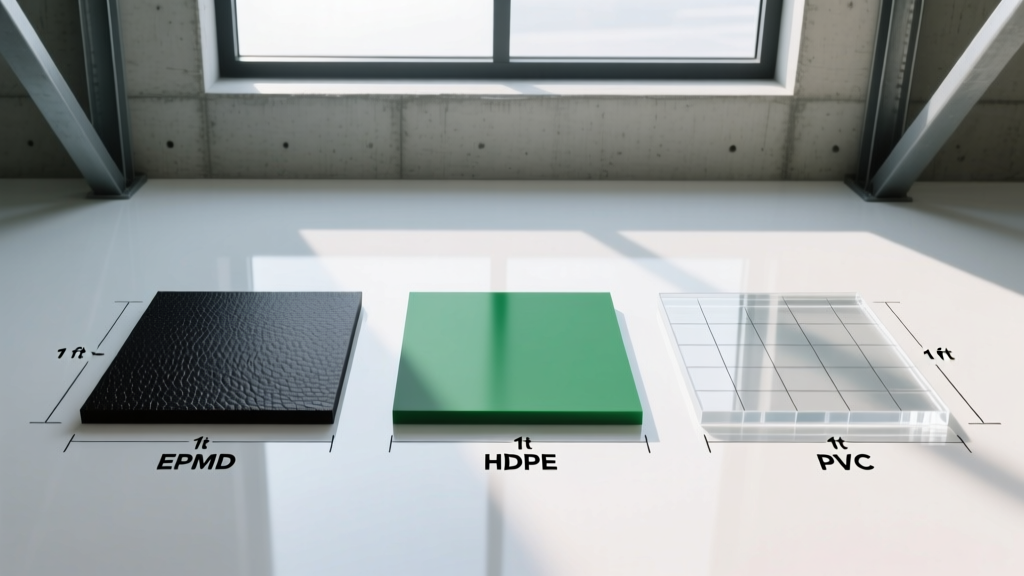
The True Economics of Waterproof Lining Material
Specifying the correct waterproof lining material requires looking far beyond the initial per-square-foot material quote. In 2026, supply chain stabilization has normalized base polymer prices, but specialized labor for seam welding and subgrade preparation now accounts for up to 65% of total project costs. Whether you are lining a commercial retention pond, a subterranean foundation, or an agricultural reservoir, understanding the granular cost drivers prevents catastrophic budget overruns and premature membrane failure.
This guide deconstructs the exact material, labor, and hidden costs associated with the most common commercial and industrial lining systems, providing a procurement framework for contractors and facility managers.
- Most Cost-Effective: 40-mil HDPE ($0.85/sq ft material)
- Most Versatile: 60-mil EPDM ($1.75/sq ft material)
- Highest Labor Cost: PVC (requires extensive solvent welding and plasticizer management)
- Average Fully Installed Cost: $5.50 to $11.00 per square foot
2026 Material Cost Matrix: EPDM, HDPE, PVC, and TPO
The table below outlines current market rates for primary lining polymers. Note that material costs fluctuate based on roll width (wider rolls reduce seam labor but increase shipping weight) and specific mil thickness.
| Material Type | Standard Thickness | Material Cost (per sq ft) | Estimated Labor (per sq ft) | Primary Application |
|---|---|---|---|---|
| HDPE (High-Density Polyethylene) | 40 - 60 mil | $0.85 - $1.40 | $3.50 - $5.50 | Containment, landfills, reservoirs |
| EPDM (Ethylene Propylene Diene Monomer) | 45 - 60 mil | $1.55 - $2.40 | $2.80 - $4.50 | Roofing, decorative ponds, foundations |
| PVC (Polyvinyl Chloride) | 30 - 60 mil | $1.10 - $1.90 | $3.00 - $5.00 | Temporary containment, flexible tanks |
| TPO (Thermoplastic Polyolefin) | 45 - 60 mil | $1.60 - $2.80 | $3.20 - $5.10 | Potable water, commercial roofing |
| Bentonite (Sodium Clay Panels) | 1/4 inch panels | $2.50 - $3.80 | $1.50 - $2.50 | Subgrade foundation waterproofing |
Deep Dive: High-Density Polyethylene (HDPE)
HDPE is the undisputed standard for chemical resistance and tensile strength. However, its rigidity demands a highly specialized installation crew. HDPE cannot be glued; it requires double-track hot wedge welding or extrusion welding for penetrations. In 2026, certified geomembrane welders command $85 to $125 per hour. While the material itself is cheap, the mandatory non-destructive testing (air lance or vacuum box testing) on every single seam adds approximately $0.40 per linear foot to the final invoice.
Deep Dive: Ethylene Propylene Diene Monomer (EPDM)
EPDM remains the most forgiving material for complex geometries due to its high elasticity (up to 300% elongation). For below-grade foundation waterproofing, 60-mil reinforced EPDM is the minimum recommendation. Installation typically utilizes water-based contact adhesives and seam tape. The primary cost variable here is the primer and adhesive consumption; expect to budget an additional $0.35 per square foot purely for consumable adhesives and splice tapes.
Installation Variables That Destroy Budgets
Contractors frequently underbid lining projects by ignoring the auxiliary requirements of the subgrade and perimeter termination. Factor these specific line items into your 2026 estimates:
- Geotextile Underlayment: Never install a polymer liner directly on compacted soil or concrete without a cushion. An 8 oz to 16 oz non-woven geotextile costs $0.35 to $0.85 per square foot. Skipping this on rocky subgrades guarantees puncture failure under hydrostatic load.
- Perimeter Trenching and Anchor Trenches: HDPE and TPO require anchor trenches at the crest of slopes to prevent wind uplift and hydrostatic slippage. Excavating and backfilling 2-foot deep anchor trenches costs $8.00 to $14.00 per linear foot.
- Pipe Boot Flashings: Pre-fabricated EPDM or TPO pipe boots for penetrations cost $45 to $85 each, plus 45 minutes of skilled labor per penetration to ensure watertight clamping and sealing.
- Batten Bar Termination: For vertical foundation applications, terminating the top edge requires aluminum batten bar, masonry anchors, and polyurethane caulking. Budget $6.50 per linear foot for a complete termination assembly.
While PVC waterproof lining material often appears cheaper upfront, it relies on chemical plasticizers for flexibility. When PVC comes into continuous contact with expanded polystyrene (EPS) insulation or certain geotextiles, the plasticizers migrate out of the PVC, causing the liner to become brittle and crack within 3 to 5 years. Always specify a separation layer or opt for TPO/EPDM if EPS is present in the assembly.
Regional Labor Rate Variations
Material costs for waterproof lining material are relatively uniform nationally due to bulk freight logistics, but labor rates introduce massive regional variance. In the Pacific Northwest and Northeast corridors, prevailing wage requirements and high union density push fully burdened installation labor to $7.50 - $11.00 per square foot. Conversely, in the Southeast and Midwest, non-union specialized crews can execute identical HDPE wedge-welding scopes for $4.00 - $6.00 per square foot. Always adjust your baseline labor multiplier based on the specific county's construction labor index.
Lifecycle Cost Analysis (LCCA) Framework
Evaluating waterproof lining material strictly on day-one capital expenditure is a fundamental error in facility management. A proper Lifecycle Cost Analysis must account for maintenance, UV degradation, and replacement intervals.
For example, a 30-mil PVC liner might cost $4.50/sq ft installed, but its functional lifespan in exposed, high-UV environments is rarely more than 12 years before plasticizer loss necessitates replacement. A 60-mil HDPE liner, costing $7.50/sq ft installed, offers a proven service life exceeding 40 years with zero maintenance. When discounted over a 40-year facility lifecycle, the HDPE system yields a 45% lower total cost of ownership. For authoritative guidelines on evaluating long-term containment and waterproofing integrity, facility managers should consult the environmental durability frameworks published by the EPA Water Research division.
'The cheapest liner is the one you never have to excavate and replace. Subgrade preparation and seam testing are not optional line items; they are the only things standing between your capital and a catastrophic leak.' — Senior Geosynthetics Engineer, 2025 Infrastructure Summit
Sourcing and Quality Verification
When procuring waterproof lining material, demand mill certificates and verify compliance with relevant ASTM standards. For elastomeric membranes, ensure the product meets ASTM standards for tensile strength and elongation (such as ASTM D412). For below-grade applications subject to hydrostatic pressure, cross-reference the material's puncture resistance against ASTM D4833. Furthermore, local building codes and FEMA floodplain management guidelines often dictate specific material thresholds for structures located in Special Flood Hazard Areas (SFHAs). Always require the manufacturer to provide a project-specific warranty that explicitly covers hydrostatic head pressure, not just material defects.
Final Procurement Strategy
To optimize your 2026 budget, lock in material pricing 90 days prior to deployment to avoid seasonal polymer surcharges. Bundle your primary membrane, geotextile underlayment, and termination flashings through a single distributor to negotiate a 10% to 15% volume discount. Finally, mandate that the installation contract includes a third-party destructive seam test every 500 linear feet, shifting the financial risk of failed welds entirely onto the subcontractor.
Written by
Priya KapoorPriya Kapoor is a real estate market analyst and construction economics researcher with expertise in housing affordability, development feasibility, and infrastructure investment. She holds a Master of Regional Planning from Cornell University and previously worked as a senior analyst at CBRE's Investment Properties group, where she modeled returns for $4B in mixed-use development pipelines. Priya now runs an independent research practice advising developers, municipalities, and REITs on construction cost forecasting and market timing. She publishes the quarterly "BuildMat Market Pulse" report tracking material price indices across 12 commodity categories. Based in Austin, TX, Priya serves on the board of Habitat for Humanity Austin and is a marathon runner.
More from Priya Kapoor
View all
Construction Cost
Cost to Build a 1600 Sq Ft Home in 2026: Full Breakdown
Accurate 2026 cost to build a 1600 sq ft home—material, labor, and regional pricing breakdowns included. Plan your budget with real-time estimates.
Aug 11, 2026

Wood & Lumber
Name the Types of Wood for Pressure Treatment and Preservation
Learn how to name the types of wood best suited for pressure treatment. Compare species treatability, chemical retention levels, and 2026 preservation costs.
Aug 4, 2026

Stone & Masonry
Stone Veneer Suppliers Lindenhurst: 2026 Cost Analysis
Analyze 2026 stone veneer costs in Lindenhurst, NY. Compare local supplier pricing, delivery fees, and Suffolk County installation labor rates.
Aug 4, 2026