Waterproof Material for Clothes: ePTFE vs Polyurethane Guide
Compare ePTFE, PU, and TPU waterproof materials for clothes. Discover hydrostatic head ratings, breathability metrics, and DWR coatings.

The Physics of Apparel Waterproofing: Hydrostatic Head vs. MVTR
Selecting the optimal waterproof material for clothes requires moving beyond marketing terms and examining the polymer science governing moisture management. True waterproofness in technical textiles is dictated by two competing metrics: Hydrostatic Head (HH) and Moisture Vapor Transmission Rate (MVTR). Understanding the inverse relationship between these metrics is critical for material specification.
Hydrostatic head, measured in millimeters (mm) per ISO 811 standards, indicates the water pressure a fabric can withstand before leaking. A baseline waterproof material for clothes requires a minimum 10,000mm HH rating. However, for alpine environments or high-abrasion applications (like kneeling on wet snow), the mechanical pressure exerted on the fabric easily exceeds 15,000mm. Premium membranes now routinely achieve 28,000mm to 40,000mm HH ratings.
Conversely, breathability is quantified by MVTR, typically measured in grams per square meter over 24 hours (g/m²/24h) using the ASTM E96 testing protocol. While a waterproof barrier must block liquid water (which has a surface tension that holds droplets together), it must simultaneously allow water vapor (individual gas molecules) to escape. The challenge lies in the fact that increasing the density of a polymer matrix to boost HH inherently restricts the pathways for vapor transmission.
Microporous Membranes: ePTFE and Electrospun Matrices
Microporous technology relies on physical holes in the membrane that are smaller than a liquid water droplet but larger than a water vapor molecule. This category dominates the high-end outdoor apparel market.
Expanded Polytetrafluoroethylene (ePTFE)
ePTFE is created by biaxially stretching heated PTFE resin, resulting in a matrix with approximately 9 billion pores per square inch. Each pore is roughly 20,000 times smaller than a water droplet but 700 times larger than a water vapor molecule. Gore-Tex Pro and eVent are the industry benchmarks for ePTFE membranes.
Electrospun Polyurethane (Nanospinning)
A newer evolution in microporous materials is electrospun PU, pioneered by The North Face’s Futurelight technology. Instead of stretching a solid film, a liquid PU solution is subjected to a high-voltage electrical field, spinning it into a chaotic, nanoscale web of fibers. This creates a highly porous, fully waterproof matrix that offers superior mechanical stretch and air permeability compared to traditional ePTFE, entirely bypassing the environmental and manufacturing complexities associated with fluoropolymers.
Monolithic Membranes: Solid Polyurethane (PU) and TPU
Unlike microporous materials, monolithic membranes like Toray Dermizax and Pertex Shield contain zero physical pores. They are continuous, solid films of hydrophilic polyurethane or thermoplastic polyurethane (TPU). Waterproofness is absolute, as there are no holes for liquid water to penetrate, regardless of surface contamination or oil exposure.
Breathability in monolithic membranes is achieved through solid-state diffusion. The polymer chains contain hydrophilic (water-attracting) molecular sites. When the microclimate inside the garment becomes humid from perspiration, water vapor molecules adsorb onto the inner surface of the membrane, travel along the hydrophilic molecular chains via chemical bonding, and desorb on the drier exterior surface.
Material Comparison Matrix: Breathability, Durability, and Cost
The following matrix breaks down the technical specifications and commercial realities of the primary waterproof materials used in modern apparel manufacturing.
| Material Type | Brand Examples | Hydrostatic Head (mm) | MVTR (g/m²/24h) | Stretch & Drape | Oil/Salt Resistance | Approx. Cost (per yard) |
|---|---|---|---|---|---|---|
| ePTFE (with PU backer) | Gore-Tex Pro | 28,000+ | 25,000 - 30,000 | Low (Stiff) | High (Protected) | $35 - $55 |
| ePTFE (Oleophobic treated) | eVent Direct Vent | 15,000 - 20,000 | 18,000 - 22,000 | Low (Stiff) | Medium | $28 - $40 |
| Electrospun PU | Futurelight | 20,000+ | 30,000+ (Air Perm) | Very High | High | $45 - $65 |
| Monolithic Hydrophilic PU | Toray Dermizax EV | 20,000 - 28,000 | 20,000 - 35,000 | High (Stretchy) | Absolute (No pores) | $22 - $35 |
| Standard TPU Coating | Generic Rain Gear | 10,000 - 15,000 | 3,000 - 5,000 | Medium | Absolute (No pores) | $8 - $15 |
The Critical Role of DWR (Durable Water Repellent) Finishes
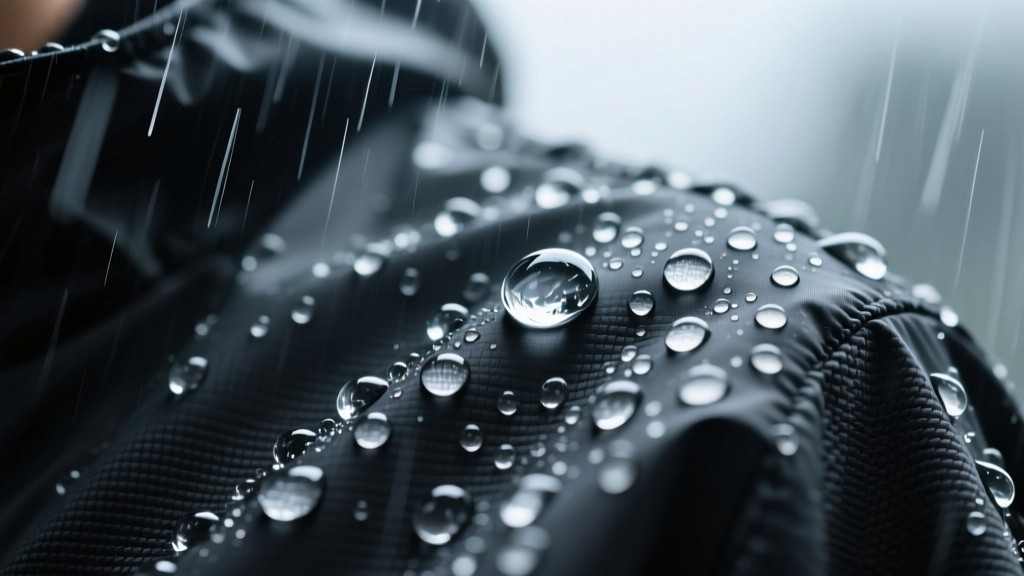
No waterproof membrane can function correctly if the face fabric saturates with water—a failure mode known as "wet-out." When the outer nylon or polyester layer absorbs water, it creates a continuous film that blocks vapor from escaping the membrane, effectively killing the garment's breathability and causing internal condensation. To prevent this, the face fabric is treated with a DWR finish, which lowers the surface energy of the yarns, causing water to bead up and roll off.
The Shift from C8 to C0 Chemistry
Historically, DWR finishes relied on long-chain (C8) perfluorocarbons (PFCs), which provided exceptional durability and oil resistance. However, C8 chemistry breaks down into PFOA, a highly persistent and toxic environmental contaminant. The industry subsequently shifted to short-chain (C6) PFAS, which, while less bioaccumulative, still pose environmental risks.
As of 2025 and moving into 2026, stringent regulations from the EPA and international environmental bodies have forced the textile industry to adopt C0 (PFC-free) DWR finishes. Modern C0 treatments, such as Teflon EcoElite (based on renewably sourced non-fluorinated polymers) and Rudolph Group’s Bionic Finish Eco, utilize dendrimer structures and paraffin-based chemistries to achieve high water contact angles without fluorocarbons.
Troubleshooting Membrane Failure and Delamination
Even the most advanced waterproof materials for clothes will fail if improperly maintained or subjected to incompatible chemical environments. Use this diagnostic framework to identify and resolve textile waterproofing failures.
- Symptom: Internal condensation and clamminess during rain.
Cause: Face fabric wet-out due to DWR degradation, dirt, or smoke particle accumulation.
Fix: Wash the garment with a technical, non-detergent cleaner (e.g., Nikwax Tech Wash) to strip contaminants. Tumble dry on medium heat for 20 minutes to thermally reactivate the C0 DWR. If beading does not return, apply a wash-in or spray-on PFC-free DWR reproofer. - Symptom: Bubbling, peeling, or a sticky interior lining.
Cause: Hydrolysis. The PU adhesive or monolithic PU membrane is breaking down chemically due to prolonged exposure to high humidity, UV radiation, or improper storage in damp environments.
Fix: Hydrolysis is irreversible. The polymer chains have physically severed. The garment must be replaced. To prevent this, store technical shells in a climate-controlled, low-humidity environment, never in a damp garage or car trunk. - Symptom: Localized leaking at high-friction zones (shoulders, knees).
Cause: Mechanical abrasion compromising the membrane, or seam tape degradation.
Fix: Inspect the interior seam tape. If peeling, apply a liquid seam sealer (like Gear Aid Seam Grip) to the stitching channels. If the membrane itself is abraded, apply a micro-patch of Tenacious Tape on the interior and exterior to bridge the breach.
Selecting the Right Textile for Specific Environments
Specifying the correct waterproof material for clothes depends entirely on the target use-case and the expected exertion-to-weather ratio.
For high-output alpine climbing or backcountry skiing, where continuous aerobic exertion generates massive amounts of water vapor, prioritize high-MVTR microporous materials like electrospun PU or oleophobic ePTFE. The immediate air permeability prevents sweat accumulation during rapid ascents.
For resort skiing, snowboarding, or heavy bushwhacking, where abrasion resistance and absolute waterproofness outweigh maximum breathability, specify a monolithic hydrophilic PU or a 3-layer ePTFE with a heavy denier face fabric (e.g., 80D nylon). The lack of pores ensures that tree sap, sunscreen, and mud cannot compromise the membrane's integrity.
For urban commuting and travel, where mechanical stretch, quiet drape, and packability are paramount, TPU and lightweight 2.5-layer monolithic membranes offer the best balance of weather protection and everyday comfort, provided the user accepts a lower MVTR ceiling during sudden exertion.
Written by
James ThorntonJames Thornton is a construction industry veteran with 25 years of hands-on experience in wood framing, lumber grading, and residential building codes. He started as a framing carpenter in rural Oregon, earned his ICC Residential Building Inspector certification, and eventually became a senior plan reviewer for the City of Portland Bureau of Development Services. James holds a B.S. in Wood Science & Technology from Oregon State University and is a certified lumber grader through the West Coast Lumber Inspection Bureau (WCLIB). He has inspected over 3,000 residential construction sites and authored the city's internal guide on advanced framing techniques (2x6 at 24" O.C.). James lives in Bend, OR, where he builds custom timber-frame cabins and competes in lumberjack sports.
More from James Thornton
View all
Insulation
Best Home Insulation Materials: Complete 2026 Guide
Compare top home insulation materials for 2026. Find R-values, installed costs per square foot, and best uses for fiberglass, spray foam, and mineral wool.
Aug 4, 2026

Sustainable Building
Certify Your Green Building Material for LEED and WELL
Step-by-step guide to certifying a green building material for LEED v5 and WELL v2. Master EPDs, HPDs, and VOC limits for 2026 project specifications.
Aug 4, 2026

Stone & Masonry
Veneer Stacked Stone Panels: Interior Design & Style Showcase
Discover how veneer stacked stone panels transform interiors. Explore modern design profiles, material pairings, and technical installation specs.
Aug 4, 2026