Waterproof Nylon Material vs PVC and TPU for Site Enclosures
Compare waterproof nylon material against PVC and TPU for construction enclosures. Analyze hydrostatic head, tear strength, and 2026 pricing data.

The Engineering Demands of Temporary Construction Fabrics
Specifying temporary enclosures, scaffolding wraps, and concrete curing blankets requires a precise understanding of synthetic textile mechanics. While traditional canvas and basic polyethylene tarps fail under sustained UV exposure and high wind loads, advanced synthetics dominate the modern job site. The decision typically narrows down to three primary substrates: polyamide (nylon), polyvinyl chloride (PVC), and thermoplastic polyurethane (TPU). Understanding the molecular and mechanical differences between these materials is critical for procurement managers and site engineers aiming to balance lifecycle costs with structural reliability.
Waterproof Nylon Material: Composition and Performance Metrics
When evaluating waterproof nylon material for construction applications, engineers are almost exclusively looking at Nylon 6,6 (polyhexamethylene adipamide). Unlike Nylon 6, the 6,6 variant features a tighter molecular chain structure, yielding higher melting points (approx. 507°F / 264°C) and superior tensile strength. In heavy-duty site enclosures, the base fabric is typically specified in 420-denier (420D) to 1000-denier (1000D) weaves, utilizing a ripstop grid to localize tear propagation.
Coating Technologies: Polyurethane vs. Silicone
Raw nylon is inherently hydrophilic; it absorbs up to 4% of its weight in water, which causes the fabric to sag and lose dimensional stability. Therefore, the waterproofing capability relies entirely on the applied coating:
- Polyurethane (PU) Coatings: The industry standard for construction nylons. A double-sided PU coating on 1000D nylon yields a hydrostatic head rating of 5,000mm to 8,000mm (tested via AATCC 127). PU coatings provide excellent flexibility in temperatures down to -20°F (-29°C) and allow for high-frequency (RF) welding of seams, eliminating needle holes.
- Silicone/PU Hybrids (Silnylon/Silpoly blends):strong> While dominant in the outdoor gear sector, pure silicone coatings are rarely used in heavy construction due to their inability to be heat-welded (seams must be sewn and taped). However, hybrid coatings are emerging in 2026, offering the UV stability of silicone with the weldability of PU.
Head-to-Head Matrix: Nylon vs. PVC vs. TPU
The following matrix compares 1000D PU-coated Nylon against standard 18oz PVC tarpaulin and 21oz Polyester-backed TPU. Data reflects 2026 commercial procurement averages for bulk construction orders.
| Metric | 1000D PU Nylon | 18oz PVC Tarp | 21oz TPU |
|---|---|---|---|
| Weight (oz/yd²) | 7.5 - 9.0 | 18.0 | 21.0 |
| Hydrostatic Head (mm) | 5,000 - 8,000 | 10,000+ | 10,000+ |
| Tear Strength (ASTM D5034) | 350 lbs (warp) | 220 lbs (warp) | 280 lbs (warp) |
| Cold Crack Temperature | -20°F (-29°C) | -10°F (-23°C) | -40°F (-40°C) |
| UV Resistance (HALS treated) | Excellent | Good | Moderate (requires topcoat) |
| Bulk Cost (per sq. yd.) | $5.80 - $7.50 | $2.90 - $4.20 | $13.50 - $17.00 |
Failure Modes and Edge Cases on the Job Site
Material selection is often dictated by how a fabric fails under stress. According to the OSHA scaffolding standards, enclosures must withstand specific wind loads without transferring catastrophic force to the scaffold ties. Fabric failure in high-wind events usually occurs at the grommets or seams, not the field of the fabric.
Nylon-Specific Failure Modes
- Hydrolysis: If the PU coating is punctured, the underlying nylon fibers absorb water. In high-heat, high-humidity environments (such as covering freshly poured concrete), this trapped moisture can degrade the PU bond from the inside out, leading to delamination.
- UV Degradation: Untreated nylon loses up to 50% of its tensile strength after 600 hours of UV exposure. Procurement specs must explicitly require Hindered Amine Light Stabilizers (HALS) integrated into the polymer matrix, not just applied as a topical spray.
PVC and TPU Edge Cases
PVC is highly susceptible to cold-cracking. When deployed in winter construction in northern climates, folding or dragging 18oz PVC at temperatures below 10°F will cause the plasticizers to fracture, creating micro-fissures that compromise waterproofing. Conversely, polyester-backed TPU is vulnerable to microbial attack. If TPU is used for ground-level moisture barriers in contact with organic soil, specific biocide additives must be specified to prevent the polyester scrim from rotting.
Engineering Note: Never specify sewn seams for waterproof nylon in high-tension scaffolding applications. Sewing introduces thousands of needle holes along the stress line. Always mandate high-frequency (RF) or hot-air welded seams with a minimum 1-inch overlap, tested to ASTM D751 standards for coated fabrics.
Application-Specific Decision Framework
Choosing between these synthetics requires mapping the material properties to the specific physical demands of the construction application. Use the following framework to finalize your material specification.
When to Specify Waterproof Nylon Material
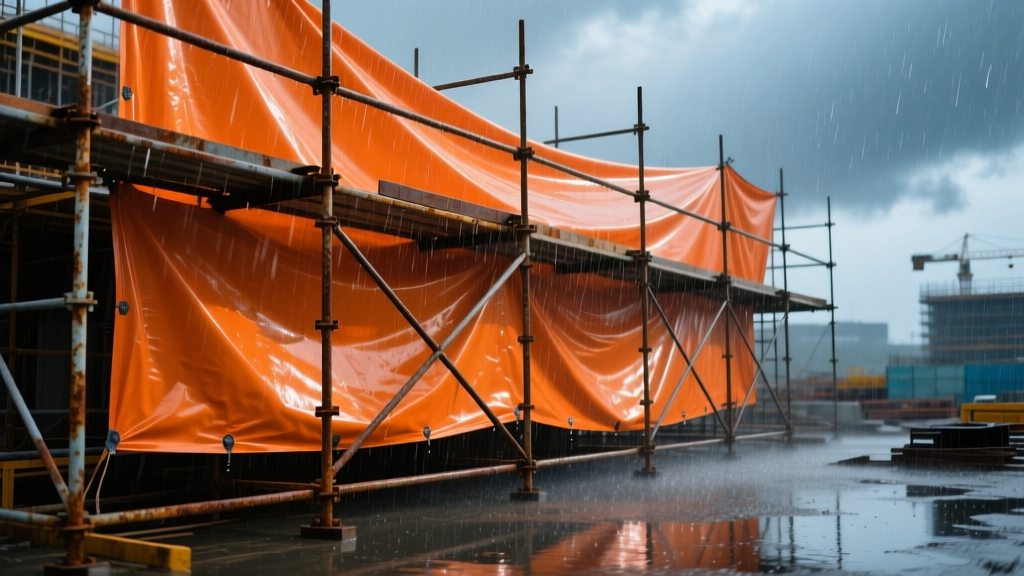
Specify 1000D PU-coated nylon when weight and tensile strength are the primary constraints. It is the mandatory choice for high-rise scaffolding wraps where the dead load of the fabric itself impacts the structural calculations of the scaffold ties. Because nylon weighs less than half of an equivalent PVC tarp, it drastically reduces the physical fatigue of the rigging crew and lowers the risk of wind-sail effect failures. It is also preferred for reusable concrete curing blankets where the fabric must be folded tightly and repeatedly without suffering from cold-crack damage.
When to Pivot to PVC
PVC is the correct specification for static, ground-level applications where weight is irrelevant and abrasion from heavy machinery is the primary threat. Heavy-duty 22oz PVC tarps excel as equipment covers, temporary flooring protectors, and excavation pit liners. The material is cheap to replace, highly resistant to alkaline environments (such as wet concrete runoff), and can be easily repaired in the field using standard PVC solvent cements and patches.
When to Invest in TPU
TPU is a premium material reserved for specialized containment and architectural tensioning. If the site requires temporary enclosures for chemical remediation, or if the fabric will be exposed to hydrocarbons, oils, and industrial solvents, TPU's chemical inertness justifies its $15+ per square yard cost. Furthermore, ether-based TPU remains entirely flexible at -40°F, making it the only viable synthetic for arctic or high-altitude winter construction enclosures where PVC would shatter and nylon coatings would stiffen.
Procurement Strategy and Lifecycle Cost Analysis
While the initial capital expenditure for waterproof nylon material is roughly 60% higher than PVC, the lifecycle cost often favors nylon in reusable applications. A high-quality 1000D nylon scaffold wrap, properly maintained and stored dry, will reliably last 4 to 5 years on active rotation. In contrast, standard PVC tarps typically suffer from plasticizer migration and edge-fraying after 18 to 24 months of continuous UV exposure and mechanical folding.
For 2026 procurement cycles, site managers should mandate third-party mill certificates verifying the denier count, the exact hydrostatic head rating, and the presence of UV inhibitors. Relying on generic 'heavy-duty tarp' designations without verifying the underlying polymer chemistry frequently results in catastrophic enclosure failures during unseasonal weather events, leading to project delays that far exceed the initial material savings.
Written by
James ThorntonJames Thornton is a construction industry veteran with 25 years of hands-on experience in wood framing, lumber grading, and residential building codes. He started as a framing carpenter in rural Oregon, earned his ICC Residential Building Inspector certification, and eventually became a senior plan reviewer for the City of Portland Bureau of Development Services. James holds a B.S. in Wood Science & Technology from Oregon State University and is a certified lumber grader through the West Coast Lumber Inspection Bureau (WCLIB). He has inspected over 3,000 residential construction sites and authored the city's internal guide on advanced framing techniques (2x6 at 24" O.C.). James lives in Bend, OR, where he builds custom timber-frame cabins and competes in lumberjack sports.
More from James Thornton
View all
Insulation
Best Home Insulation Materials: Complete 2026 Guide
Compare top home insulation materials for 2026. Find R-values, installed costs per square foot, and best uses for fiberglass, spray foam, and mineral wool.
Aug 4, 2026

Sustainable Building
Certify Your Green Building Material for LEED and WELL
Step-by-step guide to certifying a green building material for LEED v5 and WELL v2. Master EPDs, HPDs, and VOC limits for 2026 project specifications.
Aug 4, 2026

Stone & Masonry
Veneer Stacked Stone Panels: Interior Design & Style Showcase
Discover how veneer stacked stone panels transform interiors. Explore modern design profiles, material pairings, and technical installation specs.
Aug 4, 2026