Code-Compliant Waterproof Material for Sewing Tensile Structures
Navigate IBC and NFPA 701 code requirements for architectural sewing. Discover fire-rated, waterproof materials for sewing tensile structures and awnings.

While consumer searches for a waterproof material for sewing often yield results for DIY rain jackets and canvas tote bags, the construction and architectural fabric industry applies this phrase to a highly regulated domain. When sewn fabrics are used as structural building components—such as tensile membrane roofs, temporary construction enclosures, shade sails, and commercial awnings—they are no longer just textiles. They are regulated building materials subject to stringent fire, wind, and structural codes.
Selecting the correct waterproof material for sewing architectural fabrics requires navigating a complex matrix of International Building Code (IBC) mandates, fire safety standards, and structural load requirements. This guide details the code-compliant materials, seam engineering protocols, and inspection documentation required for architectural sewing projects in 2026.
The Regulatory Framework: IBC Chapter 31 and ASCE 7
In the context of building codes, sewn waterproof fabrics used as exterior canopies or roofs fall under IBC Chapter 31: Special Construction, specifically the sections governing Tensile Membrane Structures. The Authority Having Jurisdiction (AHJ) will evaluate your material choice based on two primary vectors: fire propagation and structural wind load resistance.
Under ASCE 7-22 (the current standard referenced by the 2024/2025 IBC editions adopted in most jurisdictions for 2026), tensile structures must withstand specific wind uplift and snow loads. The waterproof material you select for sewing must possess the tensile strength to handle these loads without tearing, and more importantly, the sewn seams must not experience structural slippage under peak stress.
Fire Code Hurdles: NFPA 701 vs. ASTM E84
The most common point of failure during municipal inspections for sewn fabric structures is the fire rating. The required standard depends on the structure's classification:
- NFPA 701 (Standard Methods of Fire Tests for Flame Propagation of Textiles and Films): Required for exterior awnings, tents, and open-air tensile structures. The NFPA 701 test measures how quickly a fabric burns and whether it continues to burn after the ignition source is removed.
- ASTM E84 (Surface Burning Characteristics): Required if the sewn waterproof membrane is used as an interior finish or within an enclosed transitional space (e.g., a sealed walkway or temporary indoor partition). This test evaluates flame spread and smoke development indices.
- ASTM E136 (Noncombustibility): The gold standard for materials that do not burn at all, typically required for permanent, large-span tensile roofs in high-density urban areas.
Code-Compliant Waterproof Materials Matrix
Not all waterproof fabrics pass municipal burn tests. Below is a comparison of the primary architectural-grade waterproof materials for sewing, categorized by their code compliance and structural properties.
| Material Type | Fire Standard Met | Weight (oz/sq yd) | Primary Sewing Requirement | Best Architectural Application |
|---|---|---|---|---|
| PTFE-Coated Fiberglass | ASTM E136 (Non-combustible) | 22 - 32 oz | Specialized Teflon feed dogs; ePTFE thread | Permanent stadium roofs, airport canopies |
| PVC-Coated High-Tenacity Polyester | NFPA 701 | 18 - 28 oz | Heavy-duty walking foot; hot-air seam taping | Commercial awnings, temporary enclosures |
| ePTFE Architectural Mesh | ASTM E84 (Class A) | 15 - 24 oz | Ultrasonic welding preferred; structural sewing for edges | Interior atrium shades, enclosed walkways |
| Silicone-Coated Fiberglass | NFPA 701 / ASTM E84 | 12 - 20 oz | Silicone-compatible needles; high SPI density | Fire-rated temporary construction partitions |
Material Deep-Dive: What Actually Passes Inspection?
PTFE-Coated Fiberglass (The Non-Combustible Standard)
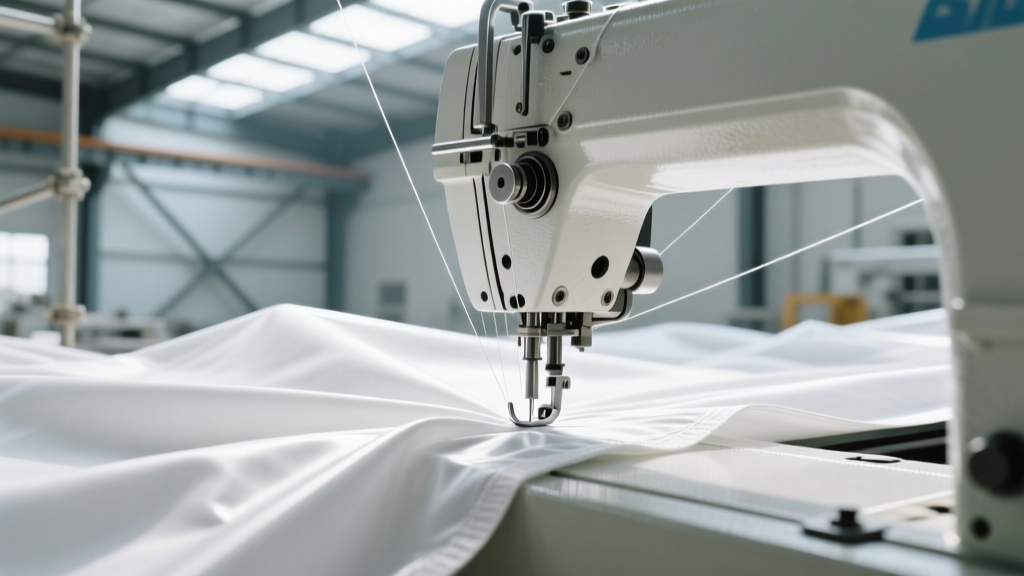
Polytetrafluoroethylene (PTFE) coated fiberglass is the premier waterproof material for sewing permanent tensile structures. Because its core is fiberglass, it is inherently non-combustible and easily passes ASTM E136. However, sewing PTFE is notoriously difficult. The material is stiff, prone to micro-cracking if folded improperly, and requires specialized sewing machines equipped with Teflon-coated presser feet to prevent the coating from stripping off during the feed cycle. Seams must be sealed with specialized PTFE dispersion coatings to maintain the waterproof envelope.
PVC-Coated High-Tenacity Polyester (The NFPA 701 Workhorse)
For 80% of commercial awning and temporary enclosure projects, PVC-coated polyester (such as Ferrari Précontraint or Heytex) is the standard. It is highly flexible, fully waterproof, and treated with fire retardants to pass NFPA 701. While high-frequency (HF) welding is the preferred joining method for PVC, structural sewing is still required for edge hems, kedar beading, and complex 3D corner reinforcements. When sewing PVC, the needle holes compromise the waterproofing and the fire-retardant chemical barrier, necessitating post-sew hot-air tape sealing.
A fabric may pass NFPA 701 in its raw state, but if you sew it with standard nylon or polyester thread, the entire assembled panel can fail the burn test. Nylon melts at 428°F (220°C), causing the seam to unzip during a fire and dropping the heavy membrane onto occupants. Code-compliant sewing mandates the use of ePTFE thread (e.g., Gore Tenara) or Kevlar/Aramid thread, which do not melt and maintain seam integrity during a fire event.
Seam Engineering and Structural Code Compliance
Under ASCE 7 wind load calculations, the seams of a tensile structure are considered the primary failure points. The AHJ will require structural calculations proving that your sewing methodology can withstand the calculated uplift forces. This is governed by several specific engineering metrics:
- Stitch Density (SPI): Stitches Per Inch must be carefully calibrated. Too few stitches concentrate the load on individual yarns, leading to tear-out. Too many stitches perforate the waterproof coating excessively, creating a "tear strip" effect. For 22 oz PVC, 5 to 6 SPI is the industry standard for structural seams.
- Seam Slippage (ASTM D434): This test measures the resistance of woven fabrics to the slippage of yarns at the needle holes. PVC-coated polyesters generally exhibit high resistance due to the coating locking the yarns in place, but uncoated architectural meshes require double-lapped seams with structural tape to pass code.
- Thread Tension and Ply: Structural seams typically require V-207 or V-277 bonded threads. Using a lighter V-92 thread on a commercial awning subjected to 110+ mph wind loads (common in 2026 coastal building codes) will result in catastrophic thread shear.
Waterproofing the Seam: Maintaining the Envelope
Sewing inherently destroys the waterproof nature of a membrane by punching thousands of needle holes through it. To meet building envelope codes for weather resistance, the sewn seams must be re-waterproofed. The acceptable methods include:
- Hot-Air Seam Taping: Applying a thermoplastic polyurethane (TPU) or PVC tape over the sewn seam using a hot-air wedge welder. This is mandatory for PVC structures to maintain both waterproofing and fire continuity.
- Liquid Seam Sealers: Brush-on polyurethane or silicone sealants. While acceptable for small awnings, liquid sealers are often rejected by inspectors for large-scale tensile roofs due to inconsistent application thickness and UV degradation over time.
- RF (Radio Frequency) Welding over Stitching: In high-end architectural sewing, the fabric is stitched for structural alignment, and then the entire seam is overlaid with a PVC batten strip and RF welded, encapsulating the thread and needle holes completely.
Permitting and Inspection Documentation
When submitting plans for a sewn fabric structure, the building department will not take your word that the waterproof material for sewing you selected is code-compliant. You must provide a comprehensive documentation package. According to guidelines from the Advanced Textiles Association, this package should include:
- Mill Certificates: Original batch testing reports from the fabric manufacturer proving the specific roll used meets NFPA 701 or ASTM E84.
- Thread Specifications: Data sheets for the exact thread used (e.g., Gore Tenara), proving its melting point and tensile strength.
- Seam Peel and Shear Test Reports: Laboratory results showing the structural integrity of the specific sewn and taped seam configuration submitted for the project.
- Engineering Stamps: A licensed structural engineer must stamp the tensile load calculations, verifying that the sewn seam spacing and fabric weight meet local ASCE 7 wind and snow load requirements.
By treating architectural sewing not as a textile craft but as a structural engineering discipline, contractors and fabricators can ensure their waterproof membrane structures pass municipal inspections, withstand extreme weather, and provide safe, durable enclosures for decades.
Written by
Sarah WhitfieldSarah Whitfield is a chartered quantity surveyor (MRICS) and construction cost analyst with 15 years of experience in material pricing, procurement strategy, and project budgeting. She earned her degree in Construction Management from the University of Reading (UK) and has worked on projects ranging from $2M custom homes to $180M mixed-use developments across North America and Europe. Sarah currently leads cost estimating for BuildMat Insight, maintaining a proprietary database of 4,000+ material price points updated quarterly. She is a frequent contributor to RSMeans cost data panels and has presented at the International Cost Engineering Council (ICEC) congress. Based in Denver, CO, Sarah is an avid trail runner and volunteer mentor for Women in Construction.
More from Sarah Whitfield
View all
Wood & Lumber
What Are the Different Types of Wood? A Builder's Guide
Compare structural softwoods, finish hardwoods, and engineered lumber. Analyze Janka ratings, MOE values, and 2026 pricing for construction.
Aug 4, 2026

Walls & Panels
Steel Framing vs Wood Framing: Corrosion and Moisture Defense
Compare steel framing vs wood framing for moisture resistance. Learn about galvanized coatings, condensation risks, and corrosion protection strategies.
Jul 21, 2026

Stone & Masonry
How to Cut Stone Veneer: Wet Saw vs Grinder Comparison
Compare the best tools for cutting stone veneer. We review wet saws, angle grinders, and chop saws to help you achieve clean, chip-free cuts.
Jul 21, 2026