Troubleshooting Leaks: What Material Is Waterproof for Repairs?
Discover what material is waterproof when standard barriers fail. This troubleshooting guide diagnoses leaks and specifies crystalline and bentonite fixes.

The 'Waterproof' vs. 'Water-Resistant' Diagnostic Divide
When a below-grade structure or flat roof begins weeping, the immediate question from property owners is often: what material is waterproof enough to stop this? The failure usually stems from a fundamental misclassification during the initial build or previous repair. The International Code Council (ICC) and building science professionals draw a strict line between dampproofing (resisting soil moisture vapor and surface runoff) and waterproofing (resisting liquid water under hydrostatic pressure).
Standard asphalt-based foundation coatings (often mistakenly called waterproofing paints) are merely dampproofing. They will blister, delaminate, and fail the moment the water table rises and exerts a hydrostatic head greater than 3 feet. To troubleshoot a persistent leak, you must first identify the pressure dynamics at play and then select a material engineered to withstand them.
Symptom-to-Solution Troubleshooting Matrix
Use the matrix below to diagnose the specific failure mode of your current barrier and identify the correct waterproofing material for the repair.
| Observed Symptom | Root Cause / Failure Mode | Required Waterproof Material |
|---|---|---|
| Blistering and peeling on interior (negative-side) coatings | Hydrostatic pressure pushing water vapor through the concrete, trapping it behind an impermeable film. | Crystalline capillary slurry (applied to positive or negative side). |
| Weeping at floor-to-wall cold joints | Differential settlement or concrete shrinkage opening a physical gap in the substrate. | Hydrophilic swellable waterstop combined with a polyurethane injection resin. |
| Membrane delamination on exterior plaza decks | Trapped substrate moisture vaporizing under solar heat (blistering) or high alkalinity destroying the primer bond. | Moisture-cured aliphatic polyurethane liquid membrane (e.g., 60+ mils DFT). |
| Efflorescence and damp spots on block walls | Capillary action drawing soil moisture through the porous CMU matrix (no hydrostatic head). | Silane/siloxane penetrating sealer or cementitious parge coat. |
Material Deep-Dive: What Material Is Waterproof Under Hydrostatic Load?
When standard bituminous or acrylic barriers fail, you must upgrade to advanced structural waterproofing systems. Here are the three industry-standard materials that genuinely resist hydrostatic pressure, along with current specifications and pricing.
1. Crystalline Capillary Systems (e.g., Xypex Concentrate)
Crystalline waterproofing does not sit on the surface; it becomes part of the concrete. When applied as a slurry, proprietary chemicals react with the free lime and moisture in the concrete to form an insoluble calcium silicate hydrate crystalline structure. This blocks capillary tracts and micro-cracks up to 0.4mm wide. According to Xypex's technical documentation, the crystalline growth remains dormant and will reactivate if new water enters a future crack, providing a self-sealing mechanism.
- Best For: Negative-side interior repairs, elevator pits, and water treatment tanks.
- Application Rate: 1.5 lbs per square yard (two coats).
- Current Material Cost: $4.50 – $6.00 per sq. ft.
- Crucial Constraint: The substrate must be saturated with water (SSD - saturated surface dry) prior to application, but free of standing water. It will not cure on dry concrete.
2. Bentonite Clay Panels (e.g., CETCO Voltex)
Sodium bentonite is a naturally occurring clay that swells to 15 times its dry volume when exposed to water, forming a dense, impermeable gel barrier. Modern bentonite waterproofing is encapsulated between geotextiles or corrugated cardboard, allowing for blind-side application (installed against the shoring before the foundation wall is poured). If the concrete shrinks away from the membrane, the bentonite swells to fill the void.
- Best For: Blind-side applications, deep foundations, and areas with high soil movement.
- Current Material Cost: $2.50 – $4.00 per sq. ft.
- Crucial Constraint: Standard sodium bentonite degrades in highly saline soils or environments with high calcium ion exchange. In these cases, polymer-modified or calcium bentonite variants must be specified.
3. Moisture-Cured Polyurethane Liquid Membranes
For above-grade or plaza deck applications where UV exposure and structural movement are factors, liquid-applied polyurethanes offer superior elastomeric properties. Products like those in the Sika concrete waterproofing lineup cure by reacting with ambient moisture, creating a seamless, fully adhered rubber-like membrane that can bridge dynamic cracks up to 2mm.
- Best For: Plaza decks, podiums, and exposed concrete roofs.
- Application Rate: Minimum 60 mils Dry Film Thickness (DFT), typically applied in two coats with a reinforcement fleece.
- Current Material Cost: $3.50 – $5.50 per sq. ft.
- Crucial Constraint: Aromatic polyurethanes will chalk and degrade under UV light and require a topcoat. Aliphatic polyurethanes are UV-stable but cost 20-30% more.
Step-by-Step Repair Protocol for Failed Below-Grade Barriers
If you are troubleshooting an active below-grade leak from the interior (negative side), follow this precise protocol to ensure the new material adheres and performs.
- Substrate Profiling: Remove all existing paint, efflorescence, and loose concrete. Shot-blast or grind the surface to achieve a Concrete Surface Profile (CSP) of 3 to 4. Crystalline materials require open pores to penetrate; a smooth trowel finish will cause delamination.
- Route and Seal Active Leaks: Crystalline slurries cannot stop running water. Use a chipping hammer to route active leaks into a 1-inch by 1-inch dovetail groove. Plug the groove with a rapid-setting hydraulic cement (e.g., Waterplug) that cures in under 3 minutes.
- Pre-Wetting: Soak the concrete substrate with clean water for 2 hours before application. Scrub off all pooling water immediately before mixing the slurry. The concrete must be damp, not wet.
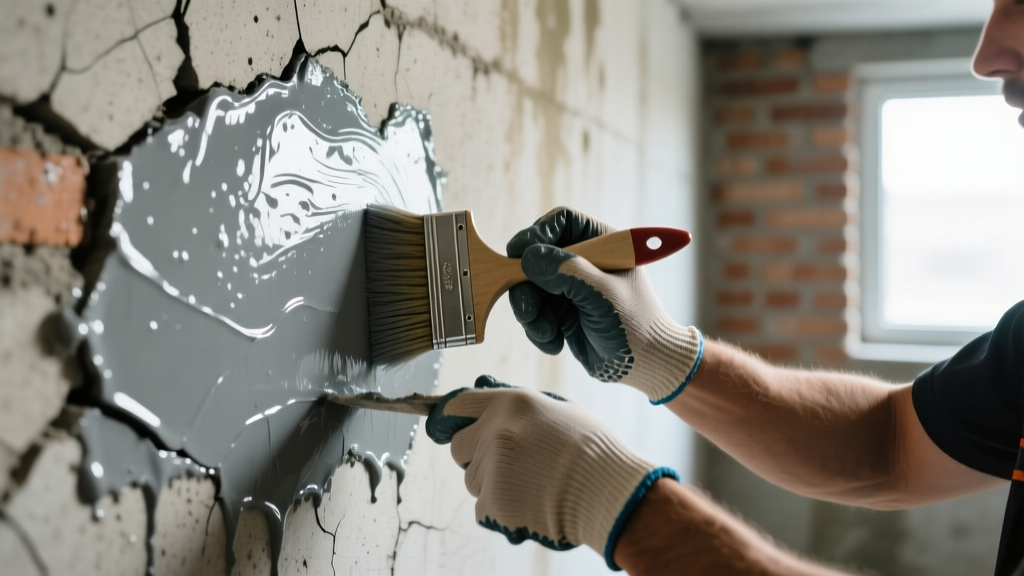
- Slurry Application: Mix the crystalline powder with clean water to a heavy cream consistency. Apply using a stiff masonry brush (not a roller) to force the material into the pores. Apply a minimum of two coats within 48 hours of each other.
- Curing: Mist the treated area with water twice daily for 3 to 5 days. Crystalline materials require continuous moisture to catalyze the chemical reaction deep within the concrete matrix.
Edge Cases: Environmental Saboteurs
When evaluating what material is waterproof for a specific site, environmental factors often dictate the failure of otherwise excellent products.
- High Alkalinity (pH > 12): Fresh concrete is highly alkaline. Standard acrylic and bituminous coatings will saponify (turn to soap) and lose adhesion when applied to uncured concrete. If repairing a newly poured structure, you must use an alkali-resistant epoxy primer or wait 28 days for the concrete to fully cure and carbonate.
- Blind-Side Voids: In deep excavations, the waterproofing membrane is applied to the shoring, and concrete is poured against it. If the concrete honeycombs or shrinks, a void is left behind the membrane. Standard sheet membranes will bridge this void and tear under hydrostatic load. This is why advanced waterproofing systems increasingly utilize self-adhering, pre-applied membranes that chemically bond to the wet concrete, eliminating the void entirely.
Ultimately, answering the question of what material is waterproof requires looking past marketing labels and analyzing the specific pressure dynamics, substrate conditions, and environmental exposures of your structure. Upgrading from surface-level dampproofing to structural crystalline, bentonite, or polyurethane systems is the only reliable method for resolving persistent hydrostatic leaks.
Written by
Marcus ChenMarcus Chen is a licensed structural engineer (PE) and building materials analyst with over 12 years of experience across residential, commercial, and industrial construction. He holds a Master of Science in Civil Engineering from UC Berkeley and spent six years at Thornton Tomasetti before transitioning to independent consulting and technical writing. Marcus specializes in material selection for seismic-prone regions, concrete reinforcement strategies, and lifecycle cost analysis. His work has been cited by the American Concrete Institute (ACI) and the Structural Engineers Association of California (SEAOC). When he is not on a job site or at his desk, you will find him hiking the Sierra Nevada or restoring a 1920s craftsman bungalow in Oakland, CA.
More from Marcus Chen
View all
Construction Cost
How Much Did the Eiffel Tower Cost to Build?
How much did the Eiffel Tower cost to build in 1889? We adjust for inflation and compare its budget to modern skyscraper construction.
Aug 4, 2026

Fire Resistance
What Is a Fire Resistant Material? Testing & Certification Guide
Discover what is a fire resistant material through ASTM and UL testing. Learn how fire ratings, certifications, and assemblies work in construction.
Aug 4, 2026

Construction Cost
How Much Did the Burj Khalifa Cost to Build?
How much did the Burj Khalifa cost to build? We break down the $1.5B project and extract 5 money-saving strategies for your next build.
Jul 30, 2026