Choosing the Right Waterproof Quilted Material for Construction
Select the right waterproof quilted material for your construction project. Compare FSK facers, PVC membranes, and drainage mats with expert specs.

The Anatomy of Waterproof Quilted Materials
In commercial and residential construction, the term 'waterproof quilted material' typically refers to composite blankets or mats that combine a flexible, insulating, or drainage-enhancing core with a continuous liquid-water barrier. Unlike standard building wraps, the 'quilted' structure—achieved through mechanical stitching, tufting, or bonded dimple grids—creates vital air gaps, thermal breaks, or capillary drainage channels. However, selecting the correct waterproof quilted material requires a precise understanding of how the waterproofing layer interacts with the quilted core.
The fundamental rule of building envelope science is that the quilted core (whether fiberglass, mineral wool, or a geotextile matrix) provides zero liquid water resistance on its own. The waterproofing performance is dictated entirely by the outer facing or jacket. Misidentifying a vapor-retarding quilted blanket as a liquid-waterproof membrane is one of the most common and costly errors in below-grade and exterior wall detailing.
Selection Matrix by Application
To specify the correct material, you must align the hydrostatic pressure, UV exposure, and compressive load requirements of your specific application with the material's physical properties. The matrix below outlines the primary categories of waterproof quilted materials used in 2026 construction projects.
| Application | Recommended Material Type | Key Performance Spec | Avg. Cost (per sq. ft.) |
|---|---|---|---|
| Below-Grade Foundation Walls | PVC-Jacketed Quilted Fiberglass | Permeance: <0.01 perms; Puncture: 40 lbs | $2.10 - $2.80 |
| Plaza Decks & Green Roofs | HDPE Dimple Mat with Quilted Geotextile | Compressive: 15,000+ psf; Flow: 15 gpm/ft | $1.60 - $2.20 |
| Exterior HVAC & Duct Wraps | FSK-Faced Quilted Insulation Blanket | Permeance: 0.02 perms (Vapor Retarder Only) | $0.95 - $1.25 |
| Temporary Site Enclosures | 18oz PVC-Coated Quilted Tarpaulin | Hydrostatic Head: 3000mm; Tear: 150 lbs | $1.80 - $2.50 |
Deep Dive: Insulation Facers (FSK vs. PVC Jackets)
When insulating exterior pipes, below-grade foundation walls, or commercial HVAC systems, contractors frequently reach for quilted fiberglass blankets. The critical decision point is the facing material.
The FSK Misconception
Foil-Scrim-Kraft (FSK) facings are ubiquitous in quilted insulation blankets. According to the U.S. Department of Energy Insulation Types Guide, FSK is an excellent Class I vapor retarder with a permeance rating of roughly 0.02 perms per ASTM E96. However, FSK is not waterproof against liquid hydrostatic pressure. Furthermore, the mechanical stitching used to quilt the fiberglass batting creates thousands of micro-punctures through the foil layer. If you are wrapping an exterior below-grade foundation wall where liquid groundwater is present, standard quilted FSK will fail, leading to saturated insulation and catastrophic thermal loss.
The PVC and TPO Jacket Solution
For true liquid waterproofing over quilted insulation, you must specify blankets with a continuous 10-mil to 20-mil PVC (Polyvinyl Chloride) or TPO (Thermoplastic Polyolefin) outer jacket. These jackets are laminated to the quilted core without needle-puncturing the waterproof layer. PVC-jacketed quilted blankets withstand direct soil contact, resist alkaline degradation from concrete, and maintain a permeance of <0.01 perms, effectively acting as both a liquid water barrier and a vapor barrier.
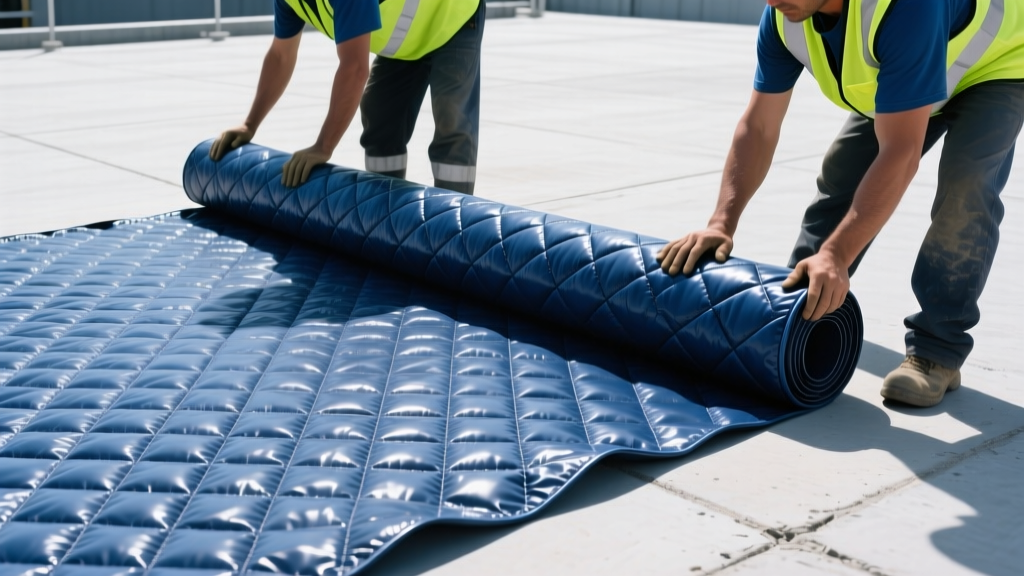
Quilted Protection Mats for Plaza Decks and Green Roofs
In protected membrane roof assemblies (PMR) and plaza decks, the primary waterproofing layer (often hot-applied rubberized asphalt or a cold-fluid applied polyurethane) is highly vulnerable to puncture during the installation of overburden, pavers, or planting soil. Here, the waterproof quilted material takes the form of a protection and drainage composite.
These materials feature a high-density polyethylene (HDPE) dimpled core bonded to a quilted, non-woven geotextile filter fabric. The 'quilted' tufting of the geotextile prevents soil fines from migrating into the drainage core while allowing liquid water to pass through laterally. The Whole Building Design Guide (WBDG) on Protected Membrane Roofs emphasizes that protection boards must possess high compressive strength to prevent the overburden from crushing the drainage channels. When selecting these quilted drainage mats, demand a minimum compressive strength of 15,000 psf (pounds per square foot) to accommodate heavy pedestrian traffic and saturated soil loads.
Critical Failure Modes and Installation Gotchas
The most common failure point in any waterproof quilted material is the seam. Because quilted materials are flexible and often rolled, they must be overlapped and sealed in the field. If you are using PVC-jacketed quilted blankets, overlapping the joints and applying a standard mastic is insufficient for below-grade applications. You must use a compatible PVC lap tape or heat-weld the seams to maintain the continuous liquid-water barrier. Relying on the quilted blanket's factory-applied adhesive flaps alone will result in capillary water intrusion at the seams under hydrostatic load.
- UV Degradation on PVC Facers: While PVC-jacketed quilted blankets are excellent for below-grade use, standard PVC facers will become brittle and crack if exposed to UV radiation for more than 30 to 60 days. If the material will be exposed on an exterior wall before cladding is installed, specify a UV-stabilized TPO jacket or an ASJ (All Service Jacket) with a polypropylene coating.
- Compression of Quilted Cores: The R-value of quilted fiberglass relies on the trapped air within the batting. If backfilled with heavy, wet clay without a rigid protection board, the hydrostatic pressure can compress the quilted core by up to 40%, severely degrading its thermal performance. Always pair below-grade quilted blankets with a rigid XPS (Extruded Polystyrene) protection board.
- Capillary Wicking at Terminations: If the bottom edge of a quilted insulation blanket rests in a concrete footing trough, it will wick groundwater upward into the wall cavity like a sponge. Always terminate quilted blankets above the finished grade or footing level, sealing the termination bar with a compatible polyurethane sealant.
2026 Procurement and Sizing Guidelines
When procuring waterproof quilted materials for large-scale commercial projects, lead times and roll dimensions significantly impact labor costs. Standard PVC-jacketed quilted blankets are typically manufactured in 48-inch wide rolls, with lengths varying from 50 to 100 linear feet. For plaza deck drainage mats, 4-foot by 50-foot rolls are the industry standard, weighing approximately 85 pounds per roll, which requires two workers or mechanical assistance for safe deployment.
As of early 2026, supply chain stabilization has brought the cost of HDPE dimpled quilted drainage composites down to an average of $1.60 to $2.20 per square foot, depending on the compressive strength rating and geotextile weight (typically 4.5 oz to 6.0 oz per square yard). When calculating material takeoffs, always add a 12% to 15% waste factor for overlaps, penetrations, and cutting around foundation piers or plaza deck drains.
Decision Flowchart: Specifying the Right Material
Use this rapid decision framework to finalize your material specification:
- Is the application below-grade or subject to liquid hydrostatic pressure?
Yes → Specify PVC or TPO-jacketed quilted insulation blankets. Do not use FSK.
No → Proceed to step 2. - Is the material acting as a protection/drainage layer over a primary roof membrane?
Yes → Specify HDPE dimple mats with quilted geotextile facers (min. 15,000 psf compressive strength).
No → Proceed to step 3. - Is the application for exterior above-grade HVAC, ductwork, or pipe insulation?
Yes → Specify FSK-faced quilted fiberglass blankets, ensuring all seams are sealed with FSK-compatible tape and the material is protected from direct weather exposure by cladding.
By matching the specific hydrostatic and compressive demands of your project to the correct facing and core configuration, you ensure the waterproof quilted material performs as a durable, long-term asset in the building envelope rather than a point of premature failure.
Written by
David NakamuraDavid Nakamura is a licensed architect (AIA) and construction technology writer focused on sustainable building methods, mass timber engineering, and high-performance building envelopes. He holds a Master of Architecture from the University of Washington and is a certified Passive House Consultant (CPHC). David spent eight years at the Seattle firm Mithun, where he led the design of three LEED Platinum projects, before founding his own practice specializing in net-zero residential design. He serves on the editorial advisory board of GreenBuilder Magazine and has authored peer-reviewed papers on cross-laminated timber (CLT) connections for the Journal of Structural Engineering. In his spare time, David teaches woodworking at Pratt Fine Arts Center and kayaks the Puget Sound.
More from David Nakamura
View all
Construction Cost
Labor Cost to Build a Deck Per Sq Ft: 2026 Installation Guide
Discover the exact labor cost to build a deck per sq ft in 2026. This installation guide breaks down contractor rates, complexity factors, and hidden fees.
Aug 4, 2026

Construction Cost
How Much Does It Cost to Build a 3 Bedroom House? Financing Guide
Learn exactly how much it costs to build a 3 bedroom house and explore 2026 financing options, construction loan types, and budget frameworks for your build.
Aug 4, 2026

Construction Cost
Cost to Build a Tennis Court: 2026 Guide
How much does it cost to build a tennis court in 2026? Breakdowns for asphalt, concrete, and synthetic surfaces plus fencing and lighting.
Jul 30, 2026