Best Waterproof Material for Outdoor Cushions: 2026 Fabric Guide
Compare the best waterproof materials for outdoor cushions in 2026. Expert analysis of acrylic, marine vinyl, and olefin fabrics, costs, and foam pairing.

The 'Waterproof' vs. 'Water-Resistant' Trap
When sourcing a waterproof material for outdoor cushions, the most common and costly mistake is conflating water resistance with total waterproofing. In the textile industry, water resistance is measured by the Hydrostatic Head test (ISO 811), which calculates the water pressure (in millimeters) a fabric can withstand before leaking. A fabric with a 300mm hydrostatic head will shed rain but may wet out under the pressure of someone sitting on a damp cushion. Conversely, a true waterproof material (like PVC-coated polyester with a 10,000mm+ rating) creates an impermeable barrier.
If you use a 100% impermeable waterproof fabric but pair it with standard open-cell polyurethane foam, ambient humidity and condensation will become trapped inside the cushion cover. Because the waterproof fabric cannot breathe, the moisture has no escape route, guaranteeing black mold and foam degradation within a single season. True outdoor cushion engineering requires matching the fabric's breathability to the correct foam core.
Top 4 Outdoor Cushion Fabrics Compared
Choosing the right material requires balancing hydrostatic head ratings, UV stability, breathability, and 2026 market pricing. Below is a deep dive into the four dominant fabric categories used by marine and patio upholstery professionals.
1. Solution-Dyed Acrylic (The Breathable Standard)
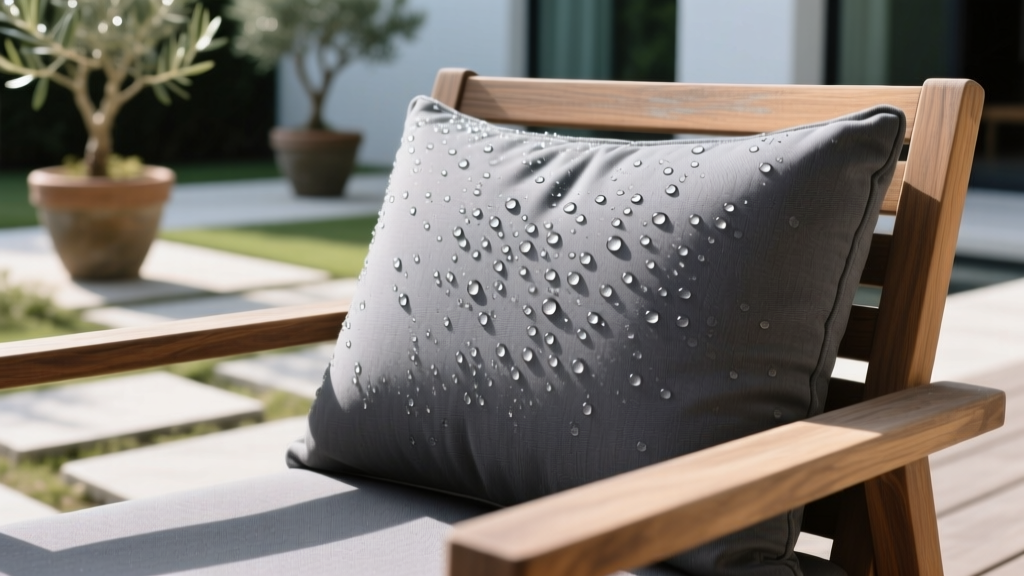
Solution-dyed acrylic, dominated by brands like Sunbrella and Outdura, is the industry benchmark for high-end patio furniture. The pigment is added to the acrylic fiber while it is in a liquid state, meaning the color goes all the way through the yarn, yielding exceptional UV resistance (often exceeding 1,500 hours of accelerated weather testing without fading). Acrylic fabrics are highly breathable and rely on a factory-applied Durable Water Repellent (DWR) fluorocarbon finish to achieve water resistance (typically 300mm–500mm hydrostatic head). Water beads up and rolls off, but under heavy, sustained downpours or standing water, it can eventually wet out.
- Pros: Supreme UV fade resistance, soft textile hand-feel, highly breathable, machine washable.
- Cons: DWR coating degrades over 12–18 months and requires re-treatment; not 100% waterproof.
- 2026 Cost: $35 – $48 per linear yard (54" width).
2. PVC-Coated Polyester & Marine Vinyl (The True Waterproof)
For environments where total waterproofing is non-negotiable—such as boat cockpits or uncovered commercial patios—PVC-coated polyesters (e.g., Stamoid) and marine-grade vinyls (e.g., Herculite or Spradling) are the materials of choice. These fabrics feature a woven polyester scrim encapsulated in polyvinyl chloride, boasting hydrostatic head ratings well over 10,000mm. They are completely impervious to water, mildew, and staining, and can be wiped clean with bleach solutions. However, they lack breathability and have a distinctly synthetic, plastic-like hand feel.
- Pros: 100% waterproof, extreme abrasion resistance, easy wipe-clean maintenance, excellent for high-traffic commercial use.
- Cons: Zero breathability (traps heat and internal moisture), stiff drape, requires heat-welding or specialized seam sealers to prevent needle-hole leaking.
- 2026 Cost: $28 – $42 per linear yard.
3. Solution-Dyed Olefin / Polypropylene (The Budget Contender)
Olefin is a synthetic fiber that is inherently resistant to moisture, mildew, and chemicals. Because it is hydrophobic by nature, it dries significantly faster than acrylic if it does get saturated. Brands like Revolution Outdoor utilize solution-dyed olefin to offer a budget-friendly alternative to acrylic. While it performs admirably in UV resistance and stain release, olefin has a lower melting point and a slightly rougher texture compared to premium acrylics.
- Pros: Highly affordable, inherently stain-resistant, fast-drying, eco-friendly (often made from upcycled polymers).
- Cons: Lower abrasion resistance than acrylic or PVC, susceptible to oil-based stains, softer hand-feel degrades faster in extreme friction environments.
- 2026 Cost: $18 – $26 per linear yard.
4. Textelene / PVC Mesh (The No-Cushion Alternative)
Textelene (a brand name often used generically for PVC-coated polyester mesh, such as Phifertex) represents a paradigm shift: eliminating the cushion insert entirely. This sling-style material is woven with gaps that allow water and air to pass straight through. It is stretched tightly over a metal or aluminum frame. Because there is no foam to trap water, mold is virtually impossible.
- Pros: Zero water retention, incredible tensile strength, UV stable, requires no winterization.
- Cons: Cannot be used for traditional plush cushioning, requires specialized spline-and-frame construction, limited pattern options.
- 2026 Cost: $22 – $30 per linear yard.
Material Comparison Matrix
| Material Type | Hydrostatic Head | Breathability | UV Warranty | Seam Requirement |
|---|---|---|---|---|
| Solution-Dyed Acrylic | 300mm - 500mm | High | 5 Years | Standard Thread (e.g., Tenara) |
| PVC-Coated Polyester | 10,000mm+ | None | 3 - 5 Years | Heat-Welded or Seam Sealer |
| Solution-Dyed Olefin | 200mm - 400mm | Medium-High | 3 Years | Standard Thread |
| Textelene Mesh | 0mm (Permeable) | Maximum | 3 - 5 Years | Spline / RF Welded |
The Foam Factor: Engineering the Core
According to technical guidelines from marine upholstery suppliers like Sailrite, the waterproof material for outdoor cushions is only half the engineering equation. The foam core dictates the lifespan of the cushion.
If using Acrylic/Olefin (Breathable): You can use standard open-cell polyurethane foam wrapped in Dacron batting, provided the cushion is stored on its edge to allow drainage.
If using PVC/Vinyl (Non-Breathable): You MUST use either closed-cell foam (which floats and absorbs zero water) or reticulated (quick-dry) foam. Reticulated foam has an open, sponge-like structure that allows water to pass straight through it instantly, preventing internal pooling even if water breaches the fabric seams.
Decision Framework: Which Material Should You Buy?
Use this field-tested decision matrix to select the exact fabric for your specific environment:
- Scenario A: Covered Lanai / Screened Porch. Choose Solution-Dyed Olefin. The roof protects against direct downpours and heavy UV, allowing you to capitalize on Olefins lower price point and soft feel without risking saturation.
- Scenario B: Uncovered Residential Patio (High Sun, Moderate Rain). Choose Solution-Dyed Acrylic (Sunbrella). The breathability prevents internal condensation, while the DWR finish sheds standard rain. Pair with reticulated foam for zero-maintenance drainage.
- Scenario C: Marine / Boat Cockpit / Commercial Hotel Pool. Choose PVC-Coated Polyester or Marine Vinyl. These environments demand bleach-cleanability and total waterproofing against chlorinated or salt water. Ensure all seams are sealed with a PVC-compatible liquid seam sealer to prevent capillary action wicking.
- Scenario D: Tropical / High-Humidity Climates (Florida, Southeast Asia). Choose Textelene Mesh with a sling-frame design. Eliminating the cushion core entirely is the only foolproof way to defeat constant ambient humidity and daily torrential downpours.
Maintenance and Re-treatment Protocols
Water-resistant fabrics require active maintenance to sustain their hydrophobic properties. The DWR finish on acrylics degrades due to UV exposure, friction, and environmental pollutants. According to Sunbrella's official care guidelines, you should re-treat acrylic and olefin fabrics every 12 to 18 months.
The Re-treatment Protocol:
- Clean: Wash the fabric with a solution of 1/4 cup mild liquid soap (like Woolite) per gallon of lukewarm water. Use a soft bristle brush to agitate dirt from the weave. Rinse thoroughly until all soap residue is gone. Soap residue attracts water and negates DWR.
- Dry: Allow the fabric to air dry completely. Applying water repellents to damp fabric traps moisture and creates cloudy white streaks.
- Treat: Apply a fluoropolymer-based water repellent, such as 303 High Tech Fabric Guard or Star brite Water Shield. Spray evenly from a distance of 6 to 8 inches, overlapping strokes. A standard 16oz aerosol can will cover approximately 40-50 square feet of fabric, costing roughly $22 in 2026.
For PVC-coated and vinyl materials, never use silicone-based repellents or heavy waxes, which can degrade the plasticizers in the vinyl, leading to cracking and premature failure. Instead, clean with a 10% bleach solution and protect with a UV-blocking vinyl conditioner like 303 Marine Clear Vinyl Protective Cleaner.
Written by
Sarah WhitfieldSarah Whitfield is a chartered quantity surveyor (MRICS) and construction cost analyst with 15 years of experience in material pricing, procurement strategy, and project budgeting. She earned her degree in Construction Management from the University of Reading (UK) and has worked on projects ranging from $2M custom homes to $180M mixed-use developments across North America and Europe. Sarah currently leads cost estimating for BuildMat Insight, maintaining a proprietary database of 4,000+ material price points updated quarterly. She is a frequent contributor to RSMeans cost data panels and has presented at the International Cost Engineering Council (ICEC) congress. Based in Denver, CO, Sarah is an avid trail runner and volunteer mentor for Women in Construction.
More from Sarah Whitfield
View all
Wood & Lumber
What Are the Different Types of Wood? A Builder's Guide
Compare structural softwoods, finish hardwoods, and engineered lumber. Analyze Janka ratings, MOE values, and 2026 pricing for construction.
Aug 4, 2026

Walls & Panels
Steel Framing vs Wood Framing: Corrosion and Moisture Defense
Compare steel framing vs wood framing for moisture resistance. Learn about galvanized coatings, condensation risks, and corrosion protection strategies.
Jul 21, 2026

Stone & Masonry
How to Cut Stone Veneer: Wet Saw vs Grinder Comparison
Compare the best tools for cutting stone veneer. We review wet saws, angle grinders, and chop saws to help you achieve clean, chip-free cuts.
Jul 21, 2026