Mastering Application Techniques for Waterproof Tablecloth Material
Learn expert application techniques for waterproof tablecloth material, including PVC heat welding, TPU seam sealing, and DWR coating reapplication.

Substrate Preparation and Material Identification
Fabricating and maintaining commercial-grade outdoor textiles requires a precise understanding of polymer chemistry and thermal dynamics. When working with waterproof tablecloth material intended for high-traffic hospitality environments, marine applications, or heavy-duty outdoor dining, the application technique must match the specific substrate. The three primary materials in this sector are Polyvinyl Chloride (PVC) laminates, Thermoplastic Polyurethane (TPU) coatings, and Polyurethane (PU) coated woven polyesters. Each requires distinct preparation, joining, and finishing protocols to ensure complete moisture ingress protection.
Before any thermal or chemical application begins, substrate preparation is mandatory. PVC and TPU fabrics often exude plasticizers—chemical additives used to maintain flexibility. If these plasticizers migrate to the surface, they create a barrier that prevents proper adhesion or thermal fusion. Technicians must wipe the seam allowance (typically a 1.5-inch border) with 99% isopropyl alcohol (IPA) or a specialized methyl ethyl ketone (MEK) solvent. According to research from the NC State Wilson College of Textiles, improper solvent flashing is the leading cause of delamination in coated architectural and hospitality fabrics. Allow the solvent to flash off completely for 3 to 5 minutes before proceeding to the welding stage.
Thermal Welding Techniques for PVC and TPU
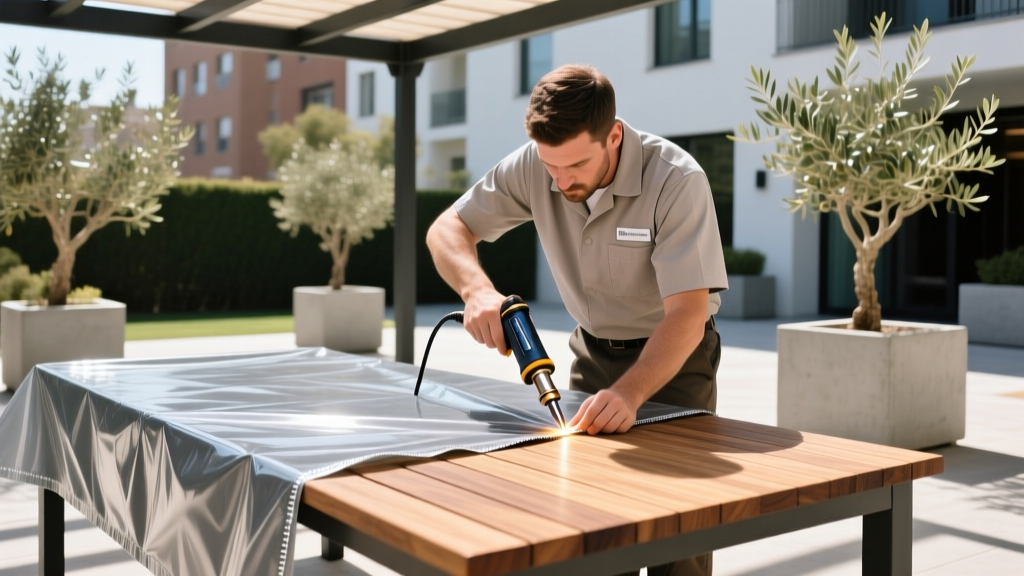
For true waterproof integrity, stitching is insufficient because needle punctures compromise the continuous membrane. Thermal welding creates a monolithic, watertight bond by melting the polymer coating of two overlapping fabric panels. For commercial operations fabricating waterproof tablecloth material, a hot air wedge welder or a handheld hot air tool (such as the Leister Triac AT) is the industry standard.
Optimal Temperature and Speed Parameters
- PVC Laminates (18oz to 22oz): Require an air temperature of 280°C to 320°C. The welding speed should be maintained at 1.5 to 2.5 meters per minute. A 2-inch silicone pressure roller must follow immediately behind the heat nozzle to apply 15 to 20 pounds of downward pressure while the polymer is in a semi-liquid state.
- TPU Coatings (10oz to 15oz): TPU has a lower melting point and is highly susceptible to scorching. Set the hot air tool between 220°C and 260°C. TPU requires slightly higher pressure during the cooling phase to prevent the seam from curling or shrinking as it crystallizes.
Always perform a destructive peel test on a scrap piece of your specific waterproof tablecloth material batch before beginning production. A properly welded seam will exhibit 'film tear'—meaning the fabric substrate will rip before the welded polymer seam separates. If the seam peels apart cleanly, increase the temperature by 10°C or decrease your travel speed.
Radio Frequency (RF) Welding for High-Volume Production
For large-scale manufacturing of uniform patio table covers, Radio Frequency (RF) or dielectric welding is preferred. RF welding uses high-frequency electromagnetic fields to agitate the dipole molecules within the PVC, generating heat from the inside out. This technique is limited to PVC and specific PU blends; it will not work on TPU or uncoated polyesters. RF welding produces perfectly flat, ultra-strong seams that are entirely impervious to water, though the initial equipment investment ranges from $15,000 to $45,000 for a standard 3kW to 5kW press.
Chemical Solvent Sealing for Complex Geometries
When thermal welding is impossible—such as when attaching rigid hardware, reinforcing corners with D-rings, or working with multi-layered hem intersections—chemical solvent cements are required. For PVC-based waterproof tablecloth material, solvent-based vinyl cements (like the industry-standard HH-66) are utilized. These cements work by chemically melting the top layer of the PVC, allowing the polymer chains of the two pieces to crosslink as the solvent evaporates.
- Apply a thin, even coat of cement to both mating surfaces using a natural bristle brush.
- Allow the cement to become tacky (usually 2 to 4 minutes, depending on ambient humidity).
- Press the surfaces together, working from the center outward to expel trapped air bubbles.
- Apply firm, even pressure using a J-roller. Full chemical cure takes 24 hours, during which the tablecloth should not be subjected to tension or folding.
Application Matrix: Joining Methods Compared
| Method | Best Substrate | Equipment Cost | Watertight Integrity | Cure/Cool Time |
|---|---|---|---|---|
| Hot Air Welding | PVC, TPU | $500 - $1,200 | Excellent | Instant (Cooling) |
| RF Dielectric Welding | PVC only | $15,000+ | Superior | Instant |
| Solvent Cement | PVC, PU | Under $50 | Very Good | 24 Hours |
| Seam Tape (Iron-on) | PU-Coated Nylon | $50 - $150 | Good | Instant |
Reapplying Durable Water Repellent (DWR) Coatings
Not all waterproof tablecloth material relies on solid polymer membranes. Woven fabrics treated with a Durable Water Repellent (DWR) finish and a light PU back-coating are popular for high-end outdoor dining due to their fabric-like drape and tactile feel. Over time, UV exposure and abrasive cleaning degrade the DWR, causing the fabric to 'wet out' and lose its beading properties.
Reapplication requires modern C0 (fluorocarbon-free) DWR chemistries, which are now mandated by various environmental regulations. The Environmental Protection Agency (EPA) provides strict guidelines on Volatile Organic Compound (VOC) limits for architectural and industrial coatings, making water-based or low-VOC solvent DWR sprays the standard for 2026 and beyond.
Step-by-Step DWR Reapplication
- Deep Cleaning: Wash the tablecloth with a technical fabric cleaner to remove oils, sunscreen, and food grease that block the fabric's pores.
- Application: Lay the material flat. Apply the C0 DWR spray from a distance of 6 to 8 inches using a cross-hatch pattern to ensure uniform coverage without pooling.
- Heat Activation: This is the most critical step. C0 DWR polymers require heat to crosslink and orient themselves outward on the fiber surface. Use a commercial conveyor ironer set to 140°C, or a handheld heat gun on a low setting, moving continuously to reactivate the coating without melting the synthetic fibers.
When applying solvent-based seam sealers or heavy-duty PU topcoats indoors, ensure your facility meets local VOC emission standards. The Advanced Textiles Association (ATA) frequently publishes updated compliance matrices for coated fabric manufacturers. Always utilize localized exhaust ventilation (LEV) systems when working with MEK or high-VOC cements.
Diagnosing and Repairing Hydrolysis and Delamination
The most common catastrophic failure mode for PU-coated waterproof tablecloth material is hydrolysis. This chemical reaction occurs when polyurethane molecules react with ambient moisture over time, breaking down the polymer chains. The physical symptom is a sticky, tacky surface that eventually flakes off, leaving the base fabric completely unprotected.
Once hydrolysis begins, it cannot be reversed or sealed over. The application technique for repair involves complete stripping and recoating:
- Apply an alkaline-based stripper to dissolve the degraded PU layer.
- Scrub with a stiff nylon brush and power wash the substrate.
- Once dry, apply a two-part solvent-based polyurethane coating using a high-volume, low-pressure (HVLP) sprayer. Two-part PU systems utilize an isocyanate hardener that creates a highly cross-linked network, offering vastly superior resistance to future hydrolysis compared to single-part water-based coatings.
Edge Hemming and Bias Tape Application
The edges of waterproof tablecloth material are highly susceptible to wicking and fraying. To seal the perimeter, fabricators use a technique called 'encased hemming.' Instead of folding the fabric over and stitching it (which creates needle holes), a strip of PVC or TPU binding tape is thermally welded over the raw edge. Using a specialized edge-folding hot air nozzle, the binding tape is heated to 290°C and folded simultaneously over the tablecloth edge, sealing the raw fibers inside a continuous waterproof polymer envelope. This technique not only guarantees 100% waterproof integrity at the seams but also adds structural weight and rigidity to the tablecloth perimeter, allowing it to drape correctly over outdoor patio tables in high-wind conditions.
Written by
James ThorntonJames Thornton is a construction industry veteran with 25 years of hands-on experience in wood framing, lumber grading, and residential building codes. He started as a framing carpenter in rural Oregon, earned his ICC Residential Building Inspector certification, and eventually became a senior plan reviewer for the City of Portland Bureau of Development Services. James holds a B.S. in Wood Science & Technology from Oregon State University and is a certified lumber grader through the West Coast Lumber Inspection Bureau (WCLIB). He has inspected over 3,000 residential construction sites and authored the city's internal guide on advanced framing techniques (2x6 at 24" O.C.). James lives in Bend, OR, where he builds custom timber-frame cabins and competes in lumberjack sports.
More from James Thornton
View all
Insulation
Best Home Insulation Materials: Complete 2026 Guide
Compare top home insulation materials for 2026. Find R-values, installed costs per square foot, and best uses for fiberglass, spray foam, and mineral wool.
Aug 4, 2026

Sustainable Building
Certify Your Green Building Material for LEED and WELL
Step-by-step guide to certifying a green building material for LEED v5 and WELL v2. Master EPDs, HPDs, and VOC limits for 2026 project specifications.
Aug 4, 2026

Stone & Masonry
Veneer Stacked Stone Panels: Interior Design & Style Showcase
Discover how veneer stacked stone panels transform interiors. Explore modern design profiles, material pairings, and technical installation specs.
Aug 4, 2026