Waterproof Vinyl Material vs. Epoxy & Tile: Wet Area Comparison
Compare waterproof vinyl material, 100% solids epoxy, and porcelain tile for wet areas. Analyze costs, ASTM moisture limits, and SPC vs WPC cores.
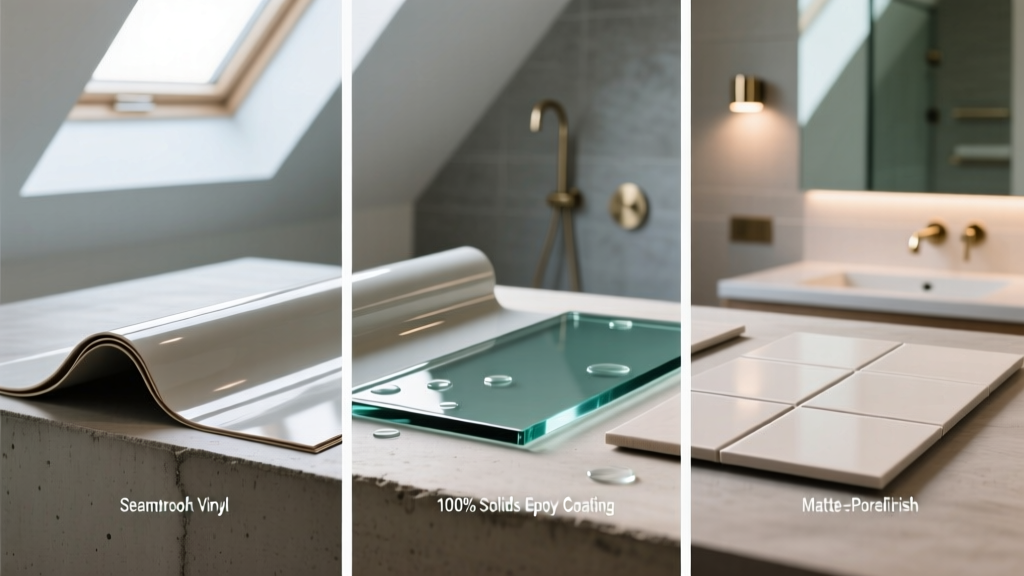
The Core Contenders in Moisture-Prone Environments
The term 'waterproof' is frequently misapplied in the building materials industry. When specifying flooring for commercial kitchens, residential wet rooms, or basement laboratories, architects and contractors must distinguish between surface water resistance and hydrostatic vapor tolerance. A material may be entirely impervious to standing water, yet fail catastrophically if moisture vapor migrates through the concrete substrate beneath it.
This guide provides a technical comparison of waterproof vinyl material (specifically rigid core SPC and WPC variants), 100% solids epoxy resin, and glazed porcelain tile. By analyzing dimensional stability, moisture vapor transmission limits, and slip resistance coefficients, you can accurately match the material to the specific hydraulic and structural demands of your project.
Material Matrix: Technical Specifications & Cost Baselines
The following matrix contrasts the three primary wet-area flooring systems based on 2026 commercial pricing and standardized testing limits. Costs reflect material and basic installation supplies, excluding extensive subfloor remediation.
| Material System | Core / Composition | Surface Water Rating | Hydrostatic Limit (ASTM F1869) | Dynamic Coefficient of Friction (DCOF) | Material Cost (per sq.ft.) |
|---|---|---|---|---|---|
| SPC Vinyl (Stone Plastic) | Limestone/PVC composite | 100% Impervious | 3-5 lbs/1000sf (Glue-down) | 0.42 - 0.50 | $3.50 - $6.50 |
| WPC Vinyl (Wood Plastic) | Foamed wood-plastic core | 100% Impervious | 3 lbs/1000sf (Glue-down) | 0.40 - 0.48 | $4.00 - $7.50 |
| 100% Solids Epoxy | Bisphenol-A / Epichlorohydrin | 100% Impervious | 3 lbs/1000sf (Without primer) | 0.55 - 0.70 (with aggregate) | $4.00 - $8.00 |
| Porcelain Tile | Fired clay / feldspar | 100% Impervious (Glazed) | Breathable (Cementitious thinset) | 0.42 - 0.65 (Texture dependent) | $5.00 - $15.00 |
Deep Dive: Waterproof Vinyl Material Mechanics
Modern waterproof vinyl material has evolved far beyond the flexible sheet goods of the previous decade. The market is now dominated by rigid core luxury vinyl plank (LVP) and tile (LVT), which are engineered to resist indentation and moisture absorption simultaneously. However, the core composition dictates how the material behaves under thermal stress and prolonged moisture exposure.
SPC vs. WPC: Choosing the Right Core
- Stone Plastic Composite (SPC): Formulated with a high-density calcium carbonate (limestone) and polyvinyl chloride matrix. SPC boasts a density of approximately 1.2 g/cm³, making it highly resistant to thermal expansion. In sunrooms or glass-enclosed wet areas where surface temperatures can exceed 95°F (35°C), SPC maintains a thermal expansion coefficient of roughly 0.000012 in/in/°F, preventing joint separation.
- Wood Plastic Composite (WPC): Utilizes a foamed wood-plastic core with a lower density (~0.6 g/cm³). While WPC offers superior acoustic dampening (IIC ratings often exceeding 55) and underfoot comfort, its foamed structure makes it more susceptible to thermal expansion. WPC is best reserved for temperature-controlled interior bathrooms rather than solarium wet rooms.
The Hydrostatic Pressure Trap
Where Epoxy and Porcelain Outperform Vinyl
While waterproof vinyl material excels in residential and light-commercial applications, severe hydraulic environments demand alternative systems.
Chemical and Impact Resistance
In commercial kitchens or laboratory settings, flooring must withstand harsh caustic cleaners, animal fats, and heavy point loads. 100% solids epoxy resin, particularly when broadcast with aluminum oxide or quartz sand, provides a seamless, chemical-resistant membrane that vinyl simply cannot match. Vinyl seams—even those utilizing tight-click locking mechanisms—can allow aggressive liquids to penetrate the subfloor if not sealed with a topical urethane grout.
Compound Slopes and Drainage
Wet rooms requiring a centralized floor drain demand compound slopes (pitching in multiple directions toward a single point). Rigid core waterproof vinyl material cannot be bent or shaped to accommodate compound slopes without cutting into numerous small, unmanageable pieces that compromise the waterproof integrity. Porcelain tile, set over a sloped mortar bed (deck mud), remains the undisputed standard for custom shower pans and commercial wet-room drainage systems.
Decision Framework: Selecting the Optimal System
Use the following operational parameters to dictate your material specification:
- Scenario A: Residential Bathroom over Wood Subfloor.
Specification: SPC Waterproof Vinyl Material (Floating).
Rationale: Wood subfloors deflect and move. Rigid SPC with an attached underlayment bridges minor subfloor irregularities and accommodates seasonal dimensional shifts in the wood framing without cracking, unlike porcelain tile which requires a rigidified subfloor (e.g., cement backer board or uncoupling membrane). - Scenario B: Commercial Food Processing or Industrial Kitchen.
Specification: 100% Solids Epoxy with Quartz Broadcast.
Rationale: Eliminates seams where bacteria can harbor. The quartz broadcast provides a DCOF above 0.60, meeting OSHA slip-resistance requirements for continuously wet, greasy environments. - Scenario C: Barrier-Free Shower with Linear Drain.
Specification: Porcelain Tile over a pre-sloped foam pan system (e.g., Schluter-Kerdi or Wedi).
Rationale: Allows for precise slope manipulation and seamless integration with surface-applied waterproofing membranes. Vinyl cannot be welded seamlessly to vertical shower curbs without specialized heat-welding equipment typically reserved for commercial sheet vinyl.
Critical Pre-Installation Moisture Testing Standards
Failure to test concrete substrates for moisture vapor emission is the leading cause of wet-area flooring failure. The Resilient Floor Covering Institute (RFCI) mandates strict adherence to testing protocols before any impermeable surface is applied to concrete.
ASTM F2170 vs. ASTM F1869
The historical calcium chloride test (ASTM F1869) only measures moisture emission at the surface of the concrete slab. However, as a slab dries, moisture migrates from the bottom up. The industry standard is now the in-situ relative humidity probe test (ASTM F2170), which measures moisture deep within the slab (typically at 40% of the slab's total depth).
Most waterproof vinyl material manufacturers require an RH reading of 75% or less. If readings exceed this threshold, a moisture mitigation system is required. According to Building Science Corporation's guidelines on moisture control, sealing the concrete with a two-part epoxy moisture barrier (such as Mapei Primer MF or Bostik M-Set) effectively caps the vapor emission, allowing the installation of vinyl or epoxy topcoats to proceed safely.
Alkalinity and pH Testing
Moisture vapor carries alkaline salts to the surface of the concrete. If the pH level exceeds 9, it will saponify (break down) the acrylic or pressure-sensitive adhesives used in glue-down vinyl applications. Always perform a pH test alongside your moisture tests. If high alkalinity is present, an acid wash or specialized alkalinity-resistant primer must be applied before the flooring system is installed, a critical step frequently overlooked by general contractors.
Long-Term Maintenance and Lifecycle Considerations
When evaluating the total cost of ownership, consider the maintenance profiles dictated by the EPA's Moisture Control Guidelines. Waterproof vinyl material requires daily damp mopping with neutral-pH cleaners; harsh alkaline strippers will dull the urethane wear layer over time. Epoxy floors require periodic re-coating of their sacrificial topcoat (usually every 3 to 5 years in high-traffic zones) to maintain their gloss and chemical resistance. Porcelain tile demands the least material maintenance but requires periodic grout sealing to prevent microbial growth in the joints.
By aligning the specific hydraulic, structural, and chemical demands of your wet area with the precise technical limitations of SPC vinyl, epoxy, and tile, you eliminate the risk of catastrophic moisture failure and ensure a durable, code-compliant installation.
Written by
Marcus ChenMarcus Chen is a licensed structural engineer (PE) and building materials analyst with over 12 years of experience across residential, commercial, and industrial construction. He holds a Master of Science in Civil Engineering from UC Berkeley and spent six years at Thornton Tomasetti before transitioning to independent consulting and technical writing. Marcus specializes in material selection for seismic-prone regions, concrete reinforcement strategies, and lifecycle cost analysis. His work has been cited by the American Concrete Institute (ACI) and the Structural Engineers Association of California (SEAOC). When he is not on a job site or at his desk, you will find him hiking the Sierra Nevada or restoring a 1920s craftsman bungalow in Oakland, CA.
More from Marcus Chen
View all
Construction Cost
How Much Did the Eiffel Tower Cost to Build?
How much did the Eiffel Tower cost to build in 1889? We adjust for inflation and compare its budget to modern skyscraper construction.
Aug 4, 2026

Fire Resistance
What Is a Fire Resistant Material? Testing & Certification Guide
Discover what is a fire resistant material through ASTM and UL testing. Learn how fire ratings, certifications, and assemblies work in construction.
Aug 4, 2026

Construction Cost
How Much Did the Burj Khalifa Cost to Build?
How much did the Burj Khalifa cost to build? We break down the $1.5B project and extract 5 money-saving strategies for your next build.
Jul 30, 2026