What Is a Waterproof Material? Diagnosing Building Envelope Leaks
Discover what is a waterproof material versus water-resistant. Learn to diagnose building envelope leaks, hydrostatic failures, and membrane degradation.

The Core Misdiagnosis: Waterproof vs. Water-Resistant
When a below-grade foundation weeps or a plaza deck stains the ceiling below, contractors and building owners often blame poor workmanship. However, the root cause is frequently a fundamental misunderstanding of the question: what is a waterproof material? In construction terminology, "waterproof" and "water-resistant" are not interchangeable. According to the U.S. Department of Energy, moisture control requires matching the material's absolute impermeability to the specific hydrostatic load of the environment.
A water-resistant material (like building wrap or standard painted drywall) slows liquid water penetration under low-pressure conditions, such as wind-driven rain. A true waterproof material (like a fully adhered HDPE membrane or hot-applied rubberized asphalt) forms a continuous, impermeable barrier capable of withstanding continuous hydrostatic pressure without degradation. When a "water-resistant" product is mistakenly specified for a below-grade application with a high water table, failure is not a matter of if, but when.
Diagnostic Matrix: Identifying the Leak Source
Before tearing out finishes, use this diagnostic matrix to trace the moisture back to the specific material failure. Understanding what is a waterproof material in practice means recognizing how different barriers fail under specific environmental stressors.
| Leak Symptom | Environmental Trigger | Likely Material Misapplication | Correct Waterproofing Class |
|---|---|---|---|
| Efflorescence on basement walls | Hydrostatic pressure from saturated soil | Dampproofing (asphalt cutback) used instead of waterproofing | Blind-side HDPE or fluid-applied polyurethane |
| Localized ceiling stains below plaza deck | Thermal expansion/contraction of substrate | Rigid sheet membrane with unsealed laps | Hot-applied rubberized asphalt with reinforcing fabric |
| Active dripping at cold joints | Seasonal water table rise | Standard waterstops lacking hydrophilic properties | Bentonite or hydrophilic rubber waterstops |
| Blistering on roof or deck coatings | Trapped substrate moisture + UV exposure | Non-breathable surface coating over damp concrete | Vapor-permeable silane/siloxane sealers |
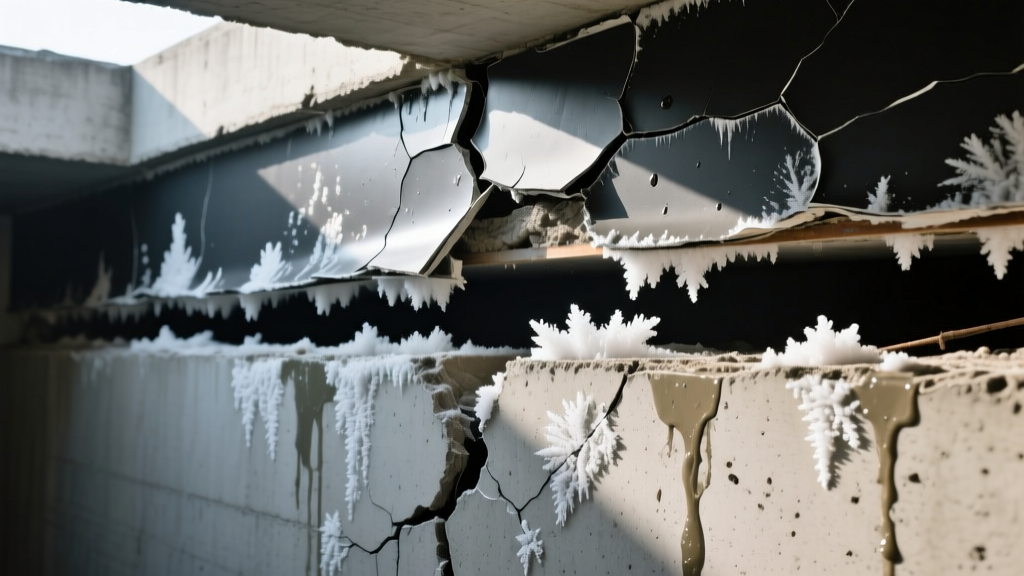
Three Common Material Failures and How to Fix Them
1. Hydrostatic Overwhelm in Below-Grade Walls
Hydrostatic pressure is the primary enemy of below-grade structures. Every one foot of water head exerts 0.433 pounds per square inch (psi) of pressure. A basement wall with a 10-foot water table above the footing faces 4.33 psi of continuous outward force. Many modified bitumen "peel-and-stick" membranes are only rated for minor damp-proofing and will delaminate or allow water migration through the side laps under this pressure.
The Fix: For active hydrostatic leaks, interior injection is required. Use a hydrophobic polyurethane injection resin (such as Spetec PUR H400 or equivalent). Unlike hydrophilic resins that require moisture to cure and can shrink in dry cycles, hydrophobic resins react with water to form a rigid, closed-cell foam that permanently fills the void. For exterior remediation, excavate to the footing and apply a fluid-applied polyurethane membrane (minimum 60 mils dry film thickness) paired with an HDPE dimpled drainage mat to relieve the hydrostatic head.
2. UV and Thermal Degradation on Plaza Decks
Plaza decks and podiums experience extreme thermal cycling. Concrete substrates can expand and contract significantly between summer days and winter nights. If a rigid or semi-rigid sheet membrane is used without adequate elastomeric properties, the thermal movement will tear the membrane at the seams or around penetrations.
The Fix: Transition to a hot-applied rubberized asphalt membrane (e.g., Tremco or CCW systems) reinforced with a spun-bonded polyester fabric. These systems cure to a monolithic, fully adhered layer with elongation properties exceeding 1000%, allowing them to bridge dynamic cracks up to 1/8 inch without tearing. Current 2026 pricing for hot-applied systems averages $8.50 to $12.00 per square foot installed, reflecting the specialized equipment and labor required.
3. Chemical Incompatibility at Seams and Penetrations
A common error occurs when contractors mix membrane chemistries. For example, applying a solvent-based adhesive to an EPDM sheet, or using a polyurethane sealant over a bituminous surface. The solvents can re-emulsify the bitumen or degrade the EPDM, creating microscopic pathways for water ingress. As noted in FEMA Technical Bulletin 2 regarding flood-resistant materials, the continuity of the waterproofing layer is only as strong as its chemical and mechanical transitions.
The Fix: Always use manufacturer-approved transition mastics. When tying a below-grade foundation membrane to an above-grade air/water barrier, use a specifically formulated termination mastic and a stainless-steel termination bar mechanically fastened at 8-inch on-center intervals, sealed with a compatible polyether sealant.
WARNING: The Bentonite Hydration Trap
Sodium bentonite clay panels are highly effective waterproofing materials because they swell to 15 times their dry volume when wet, creating an impermeable gel. However, they require moisture to activate. In arid climates with dry, sandy soils that experience sudden, intense flash flooding, the bentonite may not have sufficient time or ambient moisture to hydrate and swell before the hydrostatic pressure forces water through the unsealed joints. Never specify raw bentonite panels in fast-draining, low-moisture soils without a pre-hydration protocol or a hybrid membrane system.
Material Selection Framework by Hydrostatic Head
To definitively answer what is a waterproof material for your specific project, you must match the material's physical properties to the calculated hydrostatic head and substrate condition. The EPA's guidelines on moisture control emphasize that preventing bulk water intrusion is the first and most critical line of defense in building durability.
- Zero Hydrostatic Head (Damp Soil / Well-Drained): Modified bitumen self-adhered sheets (Peel-and-stick). Cost: $2.50 - $4.00/sq ft. Best for residential basements with active perimeter French drains.
- Low to Moderate Head (Seasonal Water Table): Fluid-applied asphalt-modified polyurethanes. Cost: $4.50 - $6.50/sq ft. Excellent for seamless coverage over complex footings and pipe penetrations.
- High Hydrostatic Head (Permanent Water Table / Coastal): Mechanically fastened or fully adhered HDPE cross-laminated membranes with reactive core technology. Cost: $7.00 - $10.00/sq ft. These membranes chemically bond to the poured concrete, eliminating lateral water migration between the membrane and the structure.
- Blind-Side Applications (Property Line Constraints): Pre-applied HDPE with pressure-sensitive adhesive and granular surface. The concrete is poured directly against the membrane, creating a mechanical and chemical lock.
Verification and Quality Assurance
Specifying the correct material is only half the battle. Verifying the installation ensures the theoretical waterproofing becomes practical reality. For fluid-applied membranes, mandate wet-mil thickness testing using a mil gauge during application, followed by dry-mil testing via non-destructive ultrasonic thickness gauges. For sheet membranes, require 100% seam probing with a blunt scribe to ensure no fish-mouths or unadhered edges exist. Finally, conduct a 48-hour flood test on all horizontal plaza deck and podium applications before placing any overburden, protection courses, or paving.
Written by
Sarah WhitfieldSarah Whitfield is a chartered quantity surveyor (MRICS) and construction cost analyst with 15 years of experience in material pricing, procurement strategy, and project budgeting. She earned her degree in Construction Management from the University of Reading (UK) and has worked on projects ranging from $2M custom homes to $180M mixed-use developments across North America and Europe. Sarah currently leads cost estimating for BuildMat Insight, maintaining a proprietary database of 4,000+ material price points updated quarterly. She is a frequent contributor to RSMeans cost data panels and has presented at the International Cost Engineering Council (ICEC) congress. Based in Denver, CO, Sarah is an avid trail runner and volunteer mentor for Women in Construction.
More from Sarah Whitfield
View all
Wood & Lumber
What Are the Different Types of Wood? A Builder's Guide
Compare structural softwoods, finish hardwoods, and engineered lumber. Analyze Janka ratings, MOE values, and 2026 pricing for construction.
Aug 4, 2026

Walls & Panels
Steel Framing vs Wood Framing: Corrosion and Moisture Defense
Compare steel framing vs wood framing for moisture resistance. Learn about galvanized coatings, condensation risks, and corrosion protection strategies.
Jul 21, 2026

Stone & Masonry
How to Cut Stone Veneer: Wet Saw vs Grinder Comparison
Compare the best tools for cutting stone veneer. We review wet saws, angle grinders, and chop saws to help you achieve clean, chip-free cuts.
Jul 21, 2026