502 Building Materials Supply Inc: Technical Specs & Material Grades
Review technical specifications, ASTM grading standards, and structural data for core inventory at 502 Building Materials Supply Inc.

Overview of Regional Material Specifications
When procuring structural components for commercial and multi-family residential projects, verifying the technical specifications of your supply chain is non-negotiable. Regional distributors like 502 Building Materials Supply Inc serve as critical nodes in the Ohio River Valley construction network, moving high volumes of structural lumber, concrete masonry units (CMU), and masonry mortar. However, the mere presence of a material on a lumber yard pallet does not guarantee it meets the specific load-bearing or environmental requirements of your engineered plans. This guide details the exact ASTM grading standards, structural design values, and material tolerances you must verify when sourcing core inventory from 502 Building Materials Supply Inc to ensure compliance with the 2026 International Building Code (IBC) adoption cycles.
Structural Lumber: Grading, Moisture, and Treatment
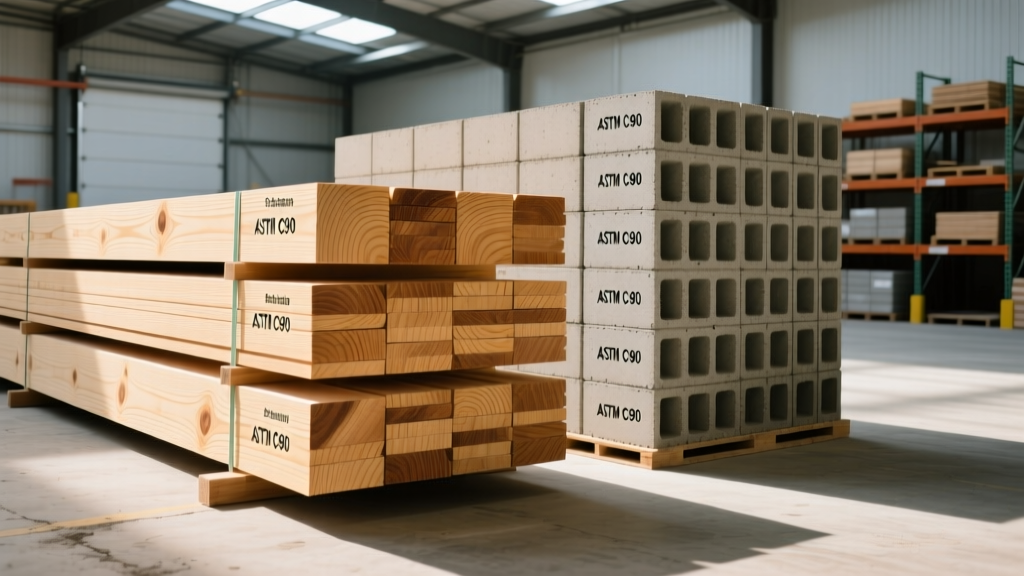
The backbone of light-frame and timber construction relies heavily on the specific gravity (G) and visual grading of the dimensional lumber supplied. At 502 Building Materials Supply Inc, the primary structural softwoods stocked are Southern Yellow Pine (SYP) and Spruce-Pine-Fir (SPF). Understanding the reference design values for these species is critical for structural engineers and framers alike.
According to the American Wood Council's National Design Specification (NDS), reference design values must be adjusted using wet service, temperature, and incising factors. When reviewing grade stamps on SYP and SPF inventory, look for the following baseline mechanical properties before applying adjustment factors:
| Species & Grade | Bending (Fb) psi | Tension (Ft) psi | Modulus of Elasticity (E) psi | Specific Gravity (G) |
|---|---|---|---|---|
| SYP No. 2 (2x4 to 2x8) | 1,100 | 675 | 1,600,000 | 0.55 |
| SYP Select Structural | 2,250 | 1,350 | 1,800,000 | 0.55 |
| SPF No. 2 (2x4 to 2x8) | 875 | 450 | 1,400,000 | 0.42 |
Moisture Content and Treatment Classifications
Dimensional lumber sourced from 502 Building Materials Supply Inc will typically carry a moisture content (MC) stamp. For interior framing, specify S-DRY (Surfaced Dry, maximum 19% MC) or MC15 (maximum 15% MC) to minimize post-installation shrinkage, which can cause drywall cracking and fastener pop. For exterior or ground-contact applications, pressure-treated SYP is required. Verify the AWPA U1 treatment category on the end tags:
- UC3B (Above Ground, coated): 0.25 pcf retention. Suitable for decking and exterior framing with adequate drainage.
- UC4A (Ground Contact): 0.40 pcf retention. Mandatory for sill plates, posts embedded in concrete, and ledger boards.
- UC4B (Heavy Duty Ground Contact): 0.60 pcf retention. Required for critical structural components in high-decay environments or permanent wood foundations.
Concrete Masonry Units (CMU): ASTM C90 Compliance
For commercial load-bearing walls, firewalls, and elevator shafts, the CMU inventory must strictly adhere to ASTM C90 standards. The National Concrete Masonry Association (NCMA) outlines that ASTM C90 governs the physical properties of load-bearing concrete masonry units, ensuring they can withstand both compressive loads and environmental degradation.
Dimensional Tolerances and Compressive Strength
A standard nominal 8x8x16 CMU block sourced from 502 Building Materials Supply Inc will have actual dimensions of 7.625 inches by 7.625 inches by 15.625 inches to accommodate a standard 3/8-inch mortar joint. When reviewing the supplier's mill certificates, verify the following technical thresholds:
- Compressive Strength (f'm): Standard load-bearing CMU must meet a minimum net-area compressive strength of 2,000 psi. For multi-story structures or high-seismic zones, specify 3,000 psi or 4,000 psi units. Note that the specified masonry prism strength (f'm) is often lower than the unit strength due to mortar interaction.
- Absorption Limits: Normal weight units (density > 125 lb/ft³) must not exceed an absorption rate of 18 lb/ft³. Lightweight units (density < 105 lb/ft³) must not exceed 22 lb/ft³. High absorption rates lead to excessive moisture migration and efflorescence.
- Face Shell and Web Thickness: For standard 8-inch units, the minimum face shell thickness must be 1.25 inches, and the minimum web thickness must be 1.00 inch to ensure adequate grout cavity space and rebar embedment.
"Always request the batch-specific compressive strength test results from 502 Building Materials Supply Inc prior to grouting. Relying solely on the generic ASTM C90 stamp without verifying the specific batch's f'm can lead to structural deficiencies in high-load shear walls."
Mortar and Grout Technical Standards
The structural integrity of a masonry assembly is only as strong as the mortar binding it. Mortar supplied or mixed using bulk masonry cement from 502 Building Materials Supply Inc must comply with ASTM C270. The selection between Type N and Type S mortar dictates the wall's flexural tensile strength and resistance to lateral loads.
| Mortar Type | Min. Compressive Strength (28 days) | Proportions by Volume (Cement : Lime : Sand) | Primary Application |
|---|---|---|---|
| Type S | 1,800 psi | 1/2 : 1 to 1-1/4 : 2.25 to 3 | Load-bearing walls, below-grade foundations, high lateral loads |
| Type N | 750 psi | 1 : 1 to 1-1/4 : 2.25 to 3 | Above-grade exterior veneer, interior non-load-bearing partitions |
Grout Specifications for Reinforced Masonry
For cells containing vertical and horizontal rebar, the grout must meet ASTM C476 standards. When ordering bulk grout mix or raw Portland cement and sand from 502 Building Materials Supply Inc, ensure the grout achieves a minimum compressive strength of 2,000 psi to match the CMU. The grout must exhibit a high slump (8 to 11 inches) to flow completely around the reinforcing steel without segregation, ensuring full consolidation within the block cavities.
Structural Hardware and Fastener Specifications
Modern light-frame construction relies heavily on engineered metal connectors. When sourcing joist hangers, holdowns, and anchor bolts from 502 Building Materials Supply Inc, verify the coating and load tables against the Simpson Strong-Tie Technical Information database or equivalent manufacturer specs. Key hardware specifications to verify include:
- Joist Hangers (e.g., LUS26): Must be 18-gauge steel. Verify the allowable download and uplift values match the truss engineer's reaction forces.
- Holdowns (e.g., HDU series): Essential for continuous load path shear wall design. Ensure the specified holdown includes the correct seat washer and that the anchor bolt embedment depth into the concrete foundation meets the minimum 7-inch or 12-inch requirement based on the concrete's f'c (typically 2,500 psi or 3,000 psi).
- Coatings: Standard G90 zinc coating is sufficient for interior, dry environments. For exterior applications or connections to treated lumber, specify ZMAX (G185) or hot-dip galvanized (HDG) finishes to prevent hydrogen embrittlement and galvanic corrosion.
Quality Assurance and Mill Certification Protocols
Sourcing from a reputable regional supplier like 502 Building Materials Supply Inc provides the advantage of localized quality control and rapid replacement of non-conforming materials. However, the burden of verification remains with the general contractor and the site superintendent. Upon delivery, implement the following QA protocol:
- Visual Inspection: Check lumber for excessive wane, bow, or crook that exceeds the limits set by the NLGA (National Lumber Grades Authority) or SPIB (Southern Pine Inspection Bureau).
- CMU Chipping: Inspect block pallets for corner chipping or web cracking caused by transit vibration. Damaged units compromise the grout cavity seal and reduce shear capacity.
- Documentation: Collect and file all mill certificates, treatment tags, and batch test reports. These documents are mandatory for the final building inspector sign-off and future liability protection.
By strictly adhering to these technical specifications and leveraging the detailed material data provided by 502 Building Materials Supply Inc, construction teams can mitigate structural failures, pass inspections on the first attempt, and ensure the long-term durability of the built environment.
Written by
David NakamuraDavid Nakamura is a licensed architect (AIA) and construction technology writer focused on sustainable building methods, mass timber engineering, and high-performance building envelopes. He holds a Master of Architecture from the University of Washington and is a certified Passive House Consultant (CPHC). David spent eight years at the Seattle firm Mithun, where he led the design of three LEED Platinum projects, before founding his own practice specializing in net-zero residential design. He serves on the editorial advisory board of GreenBuilder Magazine and has authored peer-reviewed papers on cross-laminated timber (CLT) connections for the Journal of Structural Engineering. In his spare time, David teaches woodworking at Pratt Fine Arts Center and kayaks the Puget Sound.
More from David Nakamura
View all
Construction Cost
Labor Cost to Build a Deck Per Sq Ft: 2026 Installation Guide
Discover the exact labor cost to build a deck per sq ft in 2026. This installation guide breaks down contractor rates, complexity factors, and hidden fees.
Aug 4, 2026

Construction Cost
How Much Does It Cost to Build a 3 Bedroom House? Financing Guide
Learn exactly how much it costs to build a 3 bedroom house and explore 2026 financing options, construction loan types, and budget frameworks for your build.
Aug 4, 2026

Construction Cost
Cost to Build a Tennis Court: 2026 Guide
How much does it cost to build a tennis court in 2026? Breakdowns for asphalt, concrete, and synthetic surfaces plus fencing and lighting.
Jul 30, 2026