The Complete Guide to AMC Building Materials in Modern Construction
Discover how Aluminum Matrix Composite (AMC) building materials are transforming structural integrity and facade design with specific 2026 cost data.

Defining AMC: Aluminum Matrix Composites vs. Cladding
In the architectural and structural engineering sectors, the acronym AMC is frequently misidentified. While many contractors confuse it with ACM (Aluminum Composite Material, commonly used for exterior cladding panels like Alucobond), true AMC building materials refer to Aluminum Matrix Composites. These are advanced, high-performance structural metals engineered by embedding ceramic reinforcements—typically Silicon Carbide (SiC) or Aluminum Oxide (Al2O3)—into a standard aluminum alloy matrix.
Unlike standard extruded aluminum used in window frames, AMCs are engineered for extreme load-bearing scenarios, high-cycle fatigue resistance, and thermal stability. According to research supported by the National Institute of Standards and Technology (NIST), the integration of ceramic particulates into aluminum matrices increases specific stiffness and wear resistance by up to 40%, making AMCs a critical material for next-generation high-rise structural nodes, seismic dampers, and long-span facade mullions.
Material Snapshot: 20% SiC Reinforced AMC (6061 Base)
- Matrix Alloy: 6061-T6 or 7075-T6 Aluminum
- Reinforcement: 15% - 25% Silicon Carbide (SiC) particulates
- Density: 2.85 g/cm³ (compared to 2.70 g/cm³ for unreinforced Al)
- Yield Strength: 480 - 550 MPa
- Coefficient of Thermal Expansion (CTE): 16.5 µm/m-°C (significantly lower than standard aluminum's 23.6 µm/m-°C)
Primary Architectural Applications for AMCs
The adoption of AMC building materials in commercial construction is driven by specific structural bottlenecks where traditional steel is too heavy and standard aluminum lacks the necessary yield strength or fatigue limit.
1. Seismic Energy Dissipation Dampers
In regions with high seismic activity, structural engineers utilize AMC alloys for friction dampers and yielding shear panels. The ceramic reinforcement drastically improves the high-cycle fatigue life of the metal. While standard 6061-T6 aluminum may suffer micro-fracturing after 10,000 stress cycles, a 20% SiC-reinforced AMC can endure upwards of 50,000 cycles at the same stress amplitude, ensuring the damper survives multiple seismic events without replacement.
2. Long-Span Facade Mullions and Space Frame Nodes
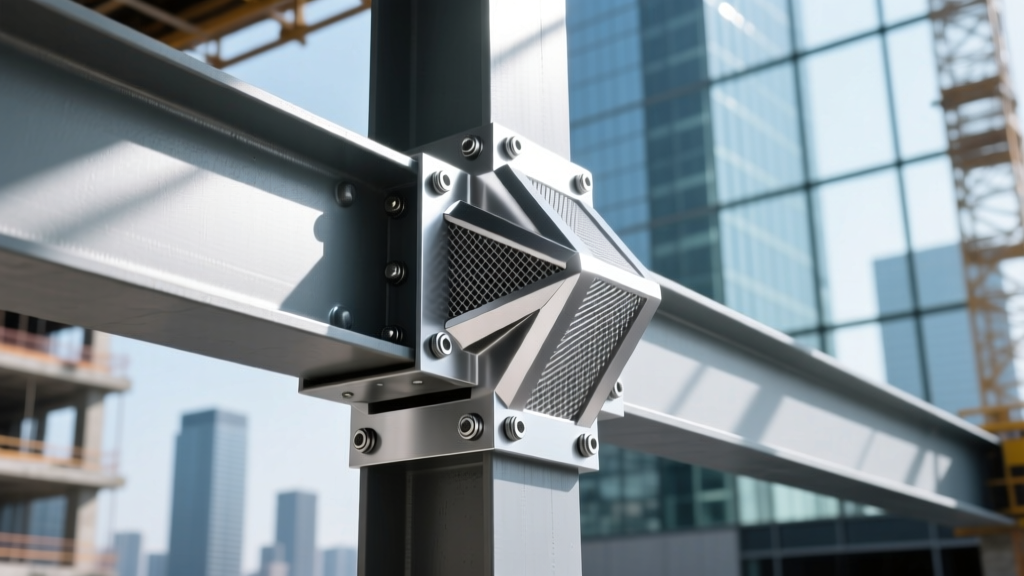
For curtain walls exceeding 40 meters in height, wind load deflection becomes a critical failure point. AMC mullions offer the stiffness of structural steel at one-third of the weight. Furthermore, in complex geometric space frames (such as stadium roofs or airport terminals), cast AMC structural nodes provide the necessary localized strength to handle multi-directional load vectors without the massive dead-weight penalty of cast steel nodes.
3. High-Speed Elevator Guide Rails
Supertall buildings require high-speed elevators that generate immense friction and heat on guide rails. AMC rails, leveraging their superior wear resistance and thermal stability, prevent the rail deformation and thermal expansion issues inherent in standard extruded aluminum or steel rails.
Performance Matrix: AMC vs. Traditional Structural Metals
When specifying materials for high-stress architectural elements, engineers must weigh the mechanical properties against the dead load. The following comparison matrix illustrates why AMC building materials are replacing traditional alloys in specialized applications.
| Material Property | AMC (20% SiC / 6061 Base) | Standard 6061-T6 Aluminum | Structural Steel (ASTM A992) |
|---|---|---|---|
| Density (g/cm³) | 2.85 | 2.70 | 7.85 |
| Yield Strength (MPa) | 480 - 550 | 276 | 345 |
| Young's Modulus (GPa) | 100 - 115 | 69 | 200 |
| Thermal Expansion (µm/m-°C) | 16.5 | 23.6 | 12.0 |
| Abrasive Wear Resistance | Exceptional | Poor | Moderate |
The Fabrication Challenge: Machining AMC Building Materials
The most significant barrier to the widespread adoption of AMCs in construction is fabrication. The very ceramic particles (SiC or Al2O3) that give the material its strength are highly abrasive. This creates severe challenges during CNC machining, drilling, and routing.
Expert Fabrication Warning: Never attempt to machine AMC building materials with standard High-Speed Steel (HSS) or uncoated Tungsten Carbide tooling. The silicon carbide particulates will destroy the cutting edge of a standard carbide end mill in less than three minutes of continuous cutting, leading to catastrophic tool failure and ruined workpieces.
Required Tooling and Parameters
To successfully fabricate AMC structural nodes or mullion connectors, machine shops must utilize Polycrystalline Diamond (PCD) or Chemical Vapor Deposition (CVD) diamond-coated tooling. PCD inserts maintain their edge geometry up to 50 times longer than standard carbide when cutting 20% SiC AMCs.
- Spindle Speed: Maintain high surface speeds (150-250 m/min) to ensure clean shearing of the aluminum matrix.
- Feed Rate: Use moderate to high feed rates to prevent the tool from rubbing against the abrasive ceramic particles, which accelerates flank wear.
- Coolant: High-pressure, flood coolant is mandatory to flush the abrasive swarf (chips) away from the cutting zone and prevent secondary abrasion on the finished surface.
2026 Procurement and Cost Framework
Sourcing AMC building materials requires navigating a specialized supply chain. Unlike standard aluminum extrusions available from local metal service centers, AMCs are typically produced via powder metallurgy or liquid stir-casting processes by specialized advanced materials foundries.
Raw Material vs. Machined Component Costs
As of early 2026, the pricing structure for AMC construction components reflects both the raw material premium and the high cost of diamond-tool machining.
- Raw Billet/Ingot Cost: $45 to $85 per kilogram, depending on the SiC volume fraction and base alloy (7075 matrices command a premium over 6061).
- Custom CNC Machining: $150 to $300+ per hour. Due to the requirement for PCD tooling and slower material removal rates, machine time is roughly 3x more expensive than standard aluminum.
- Finished Structural Node Cost: Expect to pay between $200 and $400 per kilogram for fully machined, toleranced, and anodized AMC structural components.
While the upfront cost is substantially higher than structural steel, the lifecycle value emerges in reduced foundation loads, lower crane rental times during erection, and eliminated maintenance for high-wear architectural elements.
Specification and Industry Standards
When writing project specifications for AMC building materials, architects and structural engineers cannot rely solely on standard aluminum codes. The Aluminum Association provides baseline standards for the matrix alloys (such as ASTM B209 for sheet and plate), but the composite nature of the material requires additional testing protocols.
Specifiers should mandate third-party verification for:
- Particulate Distribution: Ensuring the SiC or Al2O3 is evenly dispersed without agglomeration, which creates weak points in the metal matrix.
- Porosity Testing: Liquid metallurgy (stir casting) AMCs can trap gas porosity. Ultrasonic or X-ray non-destructive testing (NDT) must be specified for all load-bearing structural nodes.
- Tensile and Fatigue Certification: Mill certificates must include specific fatigue limit data relevant to the project's seismic or wind-load requirements, verified per ASTM International E466 standards for axial fatigue testing.
Frequently Asked Questions
Can AMC building materials be welded on-site?
No. Traditional fusion welding (TIG/MIG) melts the aluminum matrix but leaves the ceramic reinforcement intact, leading to severe agglomeration, porosity, and a massive drop in joint strength. AMC components must be joined using mechanical fasteners (high-strength steel or titanium bolts) or specialized solid-state welding techniques like Friction Stir Welding (FSW) performed in a controlled factory environment prior to site delivery.
Are AMCs suitable for exterior cladding?
While technically possible, using AMCs for broad exterior cladding is economically unviable due to the high cost per square meter. AMCs are best reserved for high-stress, low-volume structural components, connectors, and specialized architectural hardware where their unique mechanical properties solve specific engineering bottlenecks.
How do AMCs perform in coastal, high-salinity environments?
The corrosion resistance of an AMC is largely dictated by its base aluminum matrix. A 6061-based AMC will exhibit similar galvanic and pitting corrosion characteristics to standard 6061 aluminum. For coastal high-rise applications, AMC components must be hard-anodized (MIL-A-8625 Type III) or coated with a marine-grade PVDF fluoropolymer to prevent saltwater degradation of the aluminum matrix surrounding the ceramic particles.
Written by
Elena RodriguezElena Rodriguez is a civil engineer and technical writer specializing in concrete technology, masonry systems, and ASTM/ACI compliance. She earned her B.S. in Civil Engineering from Texas A&M University and spent a decade at a materials testing laboratory, performing over 2,000 concrete compressive strength tests and masonry prism evaluations. Elena is an ACI-certified Field Testing Technician (Grade I) and a member of ASTM Committee C12 on Natural Building Stone. She currently consults on forensic engineering cases involving concrete failures and moisture intrusion. Based in San Antonio, TX, Elena is a proud member of the Society of Women Engineers (SWE) and coaches her daughter's FIRST Robotics team.
More from Elena Rodriguez
View all
Walls & Panels
Cost Analysis: Light Gauge Steel Framing Advantages and Disadvantages
Evaluate light gauge steel framing advantages and disadvantages through a strict cost analysis lens, comparing material, labor, and lifecycle expenses.
Aug 4, 2026

Walls & Panels
Gypsum Board Types: Exact Specifications, Thickness & Dimensions
Compare standard, Type X, and moisture-resistant gypsum board types. Get exact specifications, thicknesses, dimensions, and ASTM standards for your project.
Aug 4, 2026

Fire Resistance
Best Fire-Resistant Outdoor Decking Materials: 2026 Buyer Guide
Discover the best fire-resistant outdoor decking materials for 2026. Compare Class A PVC, aluminum, and hardwood options for WUI compliance and safety.
Aug 4, 2026