Fabric as a Building Material: 2026 Architectural Textile Comparison
Compare PTFE, PVC, ETFE, and HDPE architectural fabrics. Discover 2026 costs, lifespans, failure modes, and specs for tensile building envelopes.

The Engineering Reality of Architectural Textiles
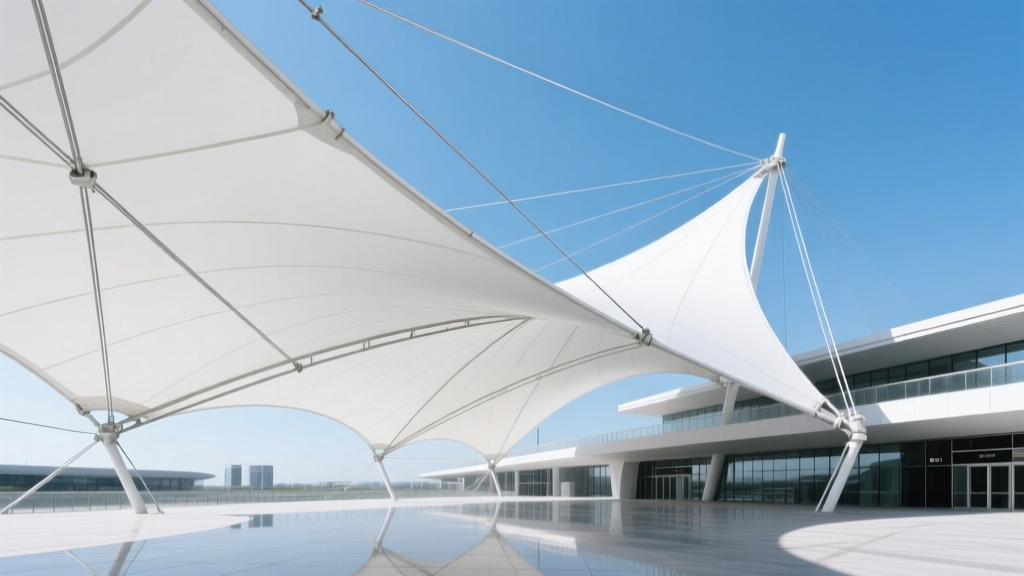
Using fabric as a building material has transitioned from temporary event pavilions to permanent, code-compliant building envelopes. Modern architectural textiles offer high strength-to-weight ratios, dynamic thermal performance, and complex geometric capabilities that rigid materials cannot match. However, specifying tensile membranes requires a precise understanding of polymer chemistry, structural mechanics, and long-term degradation modes. This comparison evaluates the four dominant membrane systems in 2026: PTFE-coated fiberglass, PVC-coated polyester, ETFE foil, and HDPE shade cloth.
Material Matrix: Core Specifications and Performance
The selection of a tensile membrane hinges on the intersection of project lifespan, light transmission requirements, and budget. The table below outlines the baseline engineering properties for the primary architectural fabrics available today.
| Material | Base Yarn / Polymer | Typical Lifespan | Light Transmission | Fire Rating (US) | Weight (oz/yd²) |
|---|---|---|---|---|---|
| PTFE | Fiberglass / Polytetrafluoroethylene | 30+ Years | 15% - 40% | ASTM E84 Class A | 34 - 46 |
| PVC | Polyester / Polyvinyl Chloride | 12 - 20 Years | 10% - 35% | NFPA 701 Pass | 24 - 36 |
| ETFE | Extruded Ethylene Tetrafluoroethylene | 35+ Years | 50% - 95% | ASTM E84 Class A | N/A (Film) |
| HDPE | High-Density Polyethylene Monofilament | 10 - 15 Years | 5% - 20% (Shade) | Varies by Treat. | 10 - 18 |
Deep Dive: Failure Modes and Installation Nuances
PTFE-Coated Fiberglass: The Premium Standard
PTFE (Polytetrafluoroethylene) coated fiberglass, such as Saint-Gobain's Sheerfill line, is the benchmark for permanent civic and commercial structures. The fiberglass core provides immense tensile strength and dimensional stability, meaning it does not stretch or creep significantly under sustained loads. Furthermore, PTFE is entirely inert and self-cleaning; UV exposure actually whitens the material over the first few months of installation.
Fiberglass yarns are essentially spun glass. If the membrane is folded or creased during transit or installation, the glass core snaps. This creates permanent weak lines, compromises the structural integrity, and leads to coating delamination. PTFE must always be shipped rolled on large-diameter tubes (minimum 4 to 6 inches) and handled with extreme care on-site. Thermal fusion seaming requires specialized sintering equipment, making field repairs nearly impossible.
PVC-Coated Polyester: The Budget Workhorse
PVC membranes, like Mehler's Valmex or Serge Ferrari's Precontraint, utilize a woven polyester base coated with polyvinyl chloride and topped with a PVDF (polyvinylidene fluoride) or acrylic lacquer. They are highly flexible, easy to fabricate, and can be high-frequency or hot-wedge welded in the field.
The primary degradation mechanism for PVC is plasticizer migration. Over time, the chemical softeners that keep the PVC flexible leach out due to UV exposure and thermal cycling. As plasticizers deplete, the membrane shrinks, stiffens, and eventually becomes brittle, leading to micro-cracking at the seams. Specifying a high-quality PVDF topcoat (such as Ferrari's Fluotop) is non-negotiable for projects requiring a 15-year lifespan, as it acts as a chemical barrier that slows plasticizer loss. For fire safety compliance, PVC textiles must be rigorously tested to NFPA 701 standards to ensure flame propagation is adequately suppressed.
ETFE Foil: The Glass Alternative
While technically an extruded fluoropolymer film rather than a woven fabric, ETFE (Ethylene Tetrafluoroethylene) is integral to the tensile structures industry. Pioneered by companies like Vector Foiltec, ETFE is primarily used in multi-layer pneumatic cushions held within aluminum extrusions.
Multi-layer ETFE cushions require a continuous air supply to maintain their structural rigidity and thermal insulation values. The internal pressure typically ranges from 200 to 800 Pascals. If the blower system fails or an air hose develops a leak, the cushion deflates. In a flat or low-slope application, this deflection leads to water ponding, which adds massive dead loads that the deflated foil cannot support, risking catastrophic structural collapse.
HDPE Shade Cloth: Exterior Solar Control
High-Density Polyethylene (HDPE) knitted fabrics are strictly used for exterior shading, not waterproof building envelopes. They block UV rays while allowing convective airflow. The most common failure point in HDPE shade sails is not the fabric body, but the edge reinforcement. If the perimeter webbing and D-ring patches are not sewn using UV-stabilized PTFE thread with a proper catenary curve cut, the corners will tear out under wind uplift.
2026 Cost Analysis: Material vs. Installed Pricing
When budgeting for fabric as a building material, the membrane itself often represents only 20% to 30% of the total project cost. The secondary steel substructure, cable rigging, and specialized labor dominate the budget. Below are the current estimated installed costs per square foot for the complete tensile system (membrane + primary substructure + rigging).
- HDPE Shade Sails: $12 - $22 per sq. ft. (Minimal steel, simple anchor points)
- PVC Tensile Roofs: $35 - $65 per sq. ft. (Moderate steel, standard welding)
- PTFE Civic Roofs: $75 - $130+ per sq. ft. (Heavy steel, complex 3D patterning, specialized seaming)
- ETFE Pneumatic Cushions: $60 - $110 per sq. ft. (Includes aluminum extrusions, blower units, and control sensors)
According to the U.S. Department of Energy, highly reflective tensile membranes also contribute significantly to cool roof metrics, reducing HVAC cooling loads by up to 15% in hot climates, which helps offset the higher initial capital expenditure of PTFE or ETFE systems over a 20-year lifecycle.
Decision Framework: Specifying the Right Membrane
Use this diagnostic framework to narrow down your material selection based on project parameters:
- Is the structure fully enclosed and climate-controlled?
If yes, discard HDPE. Choose PTFE for 30+ year permanence, or ETFE if maximum daylighting (e.g., botanical gardens, atriums) is required. - Is the project a temporary or semi-permanent installation (under 15 years)?
If yes, PVC-coated polyester is the most economical choice. Ensure a PVDF topcoat is specified for UV resistance. - Does the local building code mandate non-combustible roofing materials?
If yes, PVC will likely fail the code review. You must specify PTFE or ETFE, both of which easily achieve ASTM E84 Class A fire ratings and will not sustain combustion. - Is the geometry highly complex with double-curved hyperbolic paraboloids?
Woven fabrics (PTFE/PVC) handle biaxial tension beautifully. ETFE foil cannot be stretched into complex 3D shapes without thermal forming; it is best suited for single-curve barrels or flat pneumatic cushions.
Frequently Asked Questions
How do you prevent water ponding on tensile fabric roofs?
Water ponding is prevented through strict geometric patterning. Tensile fabrics must be cut and seamed into anticlastic (saddle) shapes, where one axis curves upward while the perpendicular axis curves downward. This creates continuous surface tension that sheds water. A minimum slope of 15 degrees is generally required at all points to prevent localized deflection and ponding under snow or rain loads.
Can architectural fabrics withstand hurricane-force winds?
Yes, but the fabric rarely fails; the connections do. Tensile structures in high-wind zones require rigorous dynamic wind tunnel testing. The membrane is designed to billow and dissipate energy, but the steel mast bases, cable swage fittings, and concrete anchor blocks must be engineered to withstand the extreme uplift and shear forces transferred by the pre-stressed cables.
What is the maintenance requirement for PTFE vs. PVC?
PTFE is virtually maintenance-free. Its non-stick surface allows rain to wash away dirt and biological growth. PVC, however, requires periodic cleaning (every 2-3 years) with mild, non-alkaline detergents to prevent the buildup of pollutants that can degrade the plasticizers and void the manufacturer's warranty.
Written by
Elena RodriguezElena Rodriguez is a civil engineer and technical writer specializing in concrete technology, masonry systems, and ASTM/ACI compliance. She earned her B.S. in Civil Engineering from Texas A&M University and spent a decade at a materials testing laboratory, performing over 2,000 concrete compressive strength tests and masonry prism evaluations. Elena is an ACI-certified Field Testing Technician (Grade I) and a member of ASTM Committee C12 on Natural Building Stone. She currently consults on forensic engineering cases involving concrete failures and moisture intrusion. Based in San Antonio, TX, Elena is a proud member of the Society of Women Engineers (SWE) and coaches her daughter's FIRST Robotics team.
More from Elena Rodriguez
View all
Walls & Panels
Cost Analysis: Light Gauge Steel Framing Advantages and Disadvantages
Evaluate light gauge steel framing advantages and disadvantages through a strict cost analysis lens, comparing material, labor, and lifecycle expenses.
Aug 4, 2026

Walls & Panels
Gypsum Board Types: Exact Specifications, Thickness & Dimensions
Compare standard, Type X, and moisture-resistant gypsum board types. Get exact specifications, thicknesses, dimensions, and ASTM standards for your project.
Aug 4, 2026

Fire Resistance
Best Fire-Resistant Outdoor Decking Materials: 2026 Buyer Guide
Discover the best fire-resistant outdoor decking materials for 2026. Compare Class A PVC, aluminum, and hardwood options for WUI compliance and safety.
Aug 4, 2026