What Building Materials Have Asbestos? Technical Spec Guide
Identify what building materials have asbestos using technical specs, mineralogy thresholds, and ASTM testing protocols for ACMs.
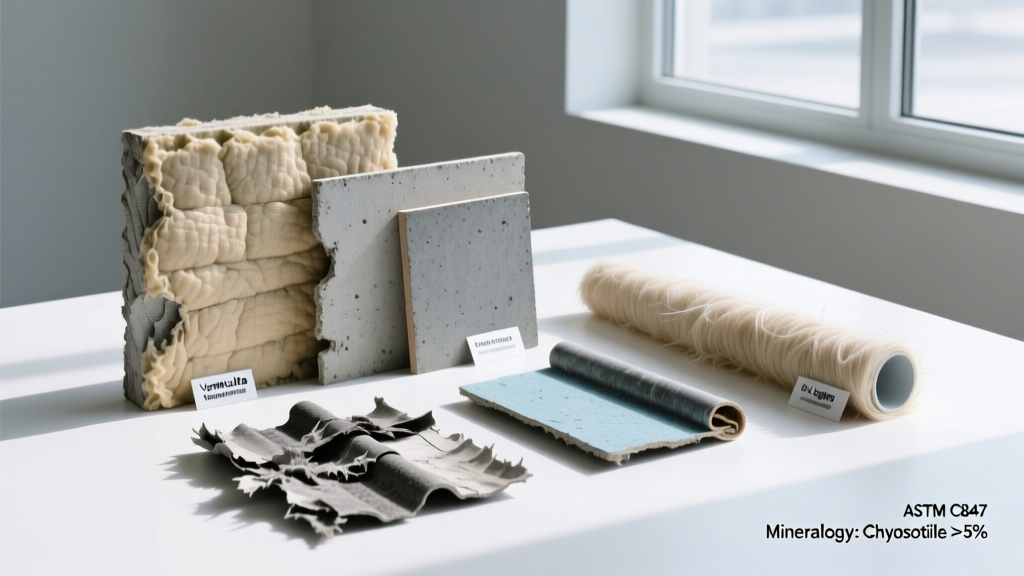
The Mineralogy and Regulatory Thresholds of ACMs
To accurately determine what building materials have asbestos, one must first understand the mineralogical properties that made these silicate minerals ubiquitous in 20th-century construction. Asbestos is not a single material but a commercial designation for six naturally occurring fibrous silicate minerals. In building materials, three variants dominate the technical specifications:
- Chrysotile (White Asbestos): A serpentine mineral with a curly, flexible fiber structure. It accounts for roughly 90% of all asbestos used in global building products, primarily in cementitious matrices, roofing felts, and vinyl floor tiles.
- Amosite (Brown Asbestos): An amphibole mineral with straight, needle-like fibers. Highly resistant to heat and chemical degradation, it was the primary specification for thermal system insulation (TSI) and cement boards.
- Crocidolite (Blue Asbestos): An amphibole mineral offering extreme resistance to strong acids. It was heavily specified in high-pressure cement pipes and specialized spray-applied fireproofing.
From a regulatory standpoint, the Environmental Protection Agency (EPA) defines an Asbestos-Containing Material (ACM) as any material containing more than 1% asbestos by weight. Materials containing 1% or less are classified as Asbestos-Containing Building Materials (ACBM) but are subject to different, often less stringent, abatement protocols under the National Emission Standards for Hazardous Air Pollutants (NESHAP).

High-Risk Material Categories and Manufacturing Specs
Identifying ACMs requires looking beyond visual appearance and understanding the historical manufacturing specifications and binding matrices used in these products.
Thermal System Insulation (TSI)
TSI represents the highest-risk category due to its high asbestos concentration and friable nature. These materials were engineered to withstand extreme thermal loads.
- Magnesia Block Insulation (85%): Manufactured primarily between 1900 and 1950, this pre-formed pipe insulation contains exactly 85% magnesium carbonate and 15% amosite asbestos. The asbestos acts as a structural reinforcement matrix to prevent the magnesia from cracking under thermal expansion.
- Calcium Silicate Block: Used for high-temperature steam pipes (up to 1200°F), calcium silicate blocks manufactured prior to 1972 typically contain 15% to 25% amosite. The fibers provide the necessary tensile strength to maintain structural integrity at extreme heat.
- Air-Cell Corrugated Paper: Often mistaken for standard cardboard, this pipe wrap consists of corrugated paper laminated with asbestos-containing adhesives, typically yielding 1% to 5% chrysotile content.
Surfacing and Spray-Applied Fireproofing
Spray-applied materials were engineered for rapid deployment and high fire-resistance ratings. Products like Cafco and Blair spray-on fireproofing, applied to structural steel beams and decking, contained between 40% and 70% amosite or crocidolite. The binding matrix was typically a Portland cement or gypsum base, with the asbestos fibers providing the cohesive 'fuzz' that allowed the material to adhere to overhead steel surfaces without slumping during the curing process. Acoustical plasters applied to ceilings, such as those containing the 'popcorn' or 'cottage cheese' texture, frequently incorporated 1% to 10% chrysotile for acoustic dampening and crack resistance.
Cementitious and Friction Products
In non-friable applications, asbestos was used as a micro-reinforcement fiber, similar to how fiberglass or steel rebar is used in modern concrete.
- Transite Pipes and Boards: A proprietary Johns Manville product, transite is a dense cement-asbestos composite. Transite water and sewer pipes were manufactured in Class 100 to Class 500 pressure ratings, containing 12% to 50% chrysotile and amosite. The fibers prevented brittle failure and allowed the pipes to withstand high internal hydraulic pressures and soil loading.
- Vinyl Asbestos Tile (VAT): The 9-inch by 9-inch floor tile is a primary indicator of ACM. These tiles contain 1% to 7% chrysotile. The asbestos fibers were mixed into the vinyl resin to provide dimensional stability, preventing the tiles from shrinking, curling, or cracking under heavy foot traffic and rolling loads. Conversely, 12x12 tiles rarely contain asbestos.
- Asphalt Roofing Felts: Organic asphalt shingles and roll roofing manufactured before 1980 often utilized an organic felt mat (rag or paper) saturated with asphalt and reinforced with 1% to 5% chrysotile to increase tear resistance during installation and thermal cycling.
Technical Identification Matrix: Visual Cues vs. Laboratory Analytics
While visual inspection can identify suspect materials, definitive classification requires understanding the analytical thresholds of different testing methodologies. The following matrix outlines the technical parameters for identifying what building materials have asbestos.
| Material Category | Historical Asbestos % | Primary Binder Matrix | Standard Friability State | Recommended Analytical Method |
|---|---|---|---|---|
| Spray-Applied Fireproofing | 40% - 70% | Portland Cement / Gypsum | Highly Friable | PLM (EPA 600/R-93/116) |
| 9x9 Vinyl Floor Tile | 1% - 7% | Vinyl Resin / Asphalt | Non-Friable (Intact) | TEM (if PLM is inconclusive) |
| Transite Cement Board | 12% - 50% | Portland Cement | Non-Friable | PLM with point counting |
| Pipe Insulation (Magnesia) | 15% (Amosite) | Magnesium Carbonate | Highly Friable | PLM / Gravimetric Reduction |
| Drywall Joint Compound | 1% - 5% | Calcium Carbonate / Talc | Friable (when sanded) | PLM / TEM for trace levels |
Friability Classifications and Exposure Mechanics
When assessing what building materials have asbestos, the technical hazard is not merely the presence of the mineral, but its friability—the material's physical tendency to crumble, pulverize, or release fibers under minimal mechanical stress.
Under OSHA regulations, the Permissible Exposure Limit (PEL) for airborne asbestos is 0.1 fibers per cubic centimeter (f/cc) as an 8-hour Time-Weighted Average (TWA). Non-friable materials (like intact VAT or transite) do not generate airborne concentrations exceeding this PEL unless subjected to aggressive mechanical forces, such as high-speed abrasive sanding, aggressive sawing with non-HEPA filtered tools, or severe structural degradation.
Friable ACMs (e.g., TSI, spray fireproofing, acoustical plaster) can be crushed to a powder by hand pressure (typically defined as less than 25 psi of force). These materials pose an immediate technical hazard because their binding matrices are highly porous or degraded, allowing fibers to passively shed into the ambient air.
Non-Friable ACMs are divided into two sub-categories:
- Category I: Materials where the asbestos is tightly bound in a resilient matrix (e.g., asphalt roofing, VAT, transite). These rarely release fibers unless subjected to severe abrasion.
- Category II: Materials that are currently non-friable but have the potential to become friable during standard demolition or renovation activities (e.g., asbestos-containing drywall joint compound, ceiling tiles, or cementitious siding that requires cutting).
Sampling Protocols and Analytical Standards
Determining the exact concentration of asbestos in a suspect material requires strict adherence to analytical standards. Building inspectors and industrial hygienists rely on specific microscopy techniques depending on the material's physical properties.
Polarized Light Microscopy (PLM)
PLM is the standard methodology outlined in EPA 600/R-93/116. It utilizes dispersion staining to identify asbestos fibers based on their unique refractive indices (RI). For example, chrysotile exhibits an RI of approximately 1.550, while amosite registers at 1.690. PLM is highly effective for materials containing >1% asbestos but struggles to accurately quantify trace amounts in highly heterogeneous matrices like floor tiles or heavily pigmented mastics.
Transmission Electron Microscopy (TEM)
When PLM yields inconclusive results, or when analyzing materials suspected of containing trace asbestos (such as 9x9 VAT or certain joint compounds), TEM is required. TEM uses electron diffraction and energy-dispersive X-ray spectroscopy (EDS) to identify the exact crystalline structure and elemental composition of the fibers. This allows for the definitive identification of amphibole asbestos even at concentrations as low as 0.01%, ensuring compliance with stringent CPSC guidelines for consumer safety.
Bulk Sampling Mechanics
Proper bulk sampling requires extracting a full-thickness cross-section of the material to account for stratification. For example, a multi-ply roofing system may have asbestos only in the bottom ply of felt, while the top ply is fiberglass. Samples must be sealed in clean, new zip-lock bags (never paper envelopes, which allow fiber escape), double-bagged, and labeled with specific metadata including the exact location, date, and material homogeneity. A minimum of three samples per homogeneous area is the standard statistical requirement for walls and ceilings under AHERA protocols.
Written by
Priya KapoorPriya Kapoor is a real estate market analyst and construction economics researcher with expertise in housing affordability, development feasibility, and infrastructure investment. She holds a Master of Regional Planning from Cornell University and previously worked as a senior analyst at CBRE's Investment Properties group, where she modeled returns for $4B in mixed-use development pipelines. Priya now runs an independent research practice advising developers, municipalities, and REITs on construction cost forecasting and market timing. She publishes the quarterly "BuildMat Market Pulse" report tracking material price indices across 12 commodity categories. Based in Austin, TX, Priya serves on the board of Habitat for Humanity Austin and is a marathon runner.
More from Priya Kapoor
View all
Construction Cost
Cost to Build a 1600 Sq Ft Home in 2026: Full Breakdown
Accurate 2026 cost to build a 1600 sq ft home—material, labor, and regional pricing breakdowns included. Plan your budget with real-time estimates.
Aug 11, 2026

Wood & Lumber
Name the Types of Wood for Pressure Treatment and Preservation
Learn how to name the types of wood best suited for pressure treatment. Compare species treatability, chemical retention levels, and 2026 preservation costs.
Aug 4, 2026

Stone & Masonry
Stone Veneer Suppliers Lindenhurst: 2026 Cost Analysis
Analyze 2026 stone veneer costs in Lindenhurst, NY. Compare local supplier pricing, delivery fees, and Suffolk County installation labor rates.
Aug 4, 2026