A&A Building Materials vs Big Box: 2026 Sourcing Comparison
Compare A&A Building Materials against big box retailers for 2026 contractor sourcing. Analyze pricing, LBM inventory depth, and job-site delivery logistics.
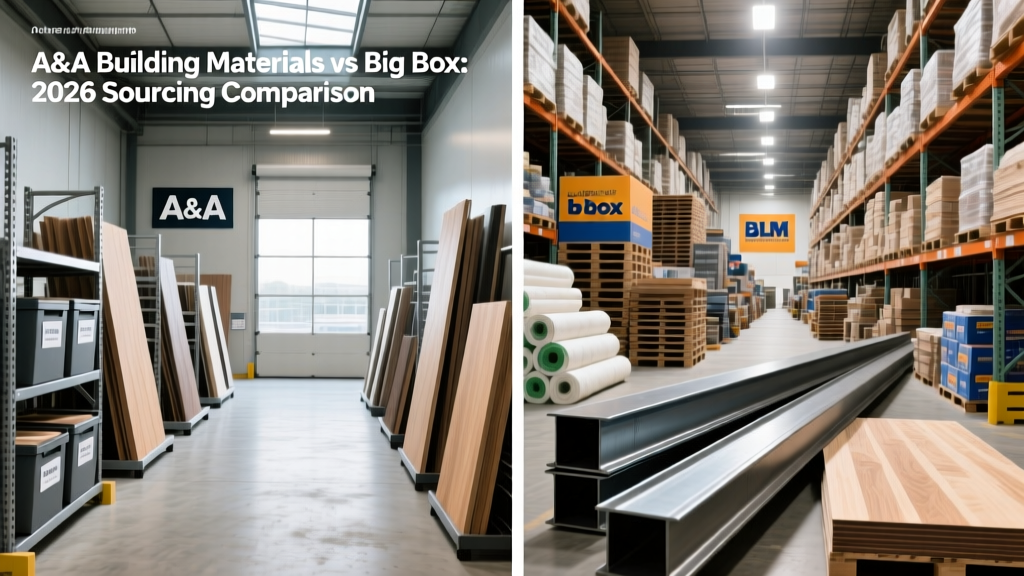
The 2026 Material Sourcing Landscape
Sourcing building materials in 2026 requires navigating algorithmic retail pricing, fragmented regional supply chains, and stringent building code updates. For general contractors and custom home builders, the decision between utilizing a specialized regional distributor like A&A Building Materials versus relying on national big box home improvement centers fundamentally alters project margins and timelines. While big box stores offer immediate retail convenience, specialized Lumber and Building Material (LBM) dealers provide structural advantages in engineered wood procurement, bulk masonry logistics, and margin-protecting pricing models.
This comparison review dissects the operational, financial, and logistical differences between A&A Building Materials and national big box pro desks, providing a concrete framework for contractors to optimize their 2026 supply chain strategies.
Inventory Depth: Commodity vs. Engineered Specialties
The most glaring divergence between specialized LBM yards and big box retailers is inventory composition. Big box stores optimize their floor space for high-turnover retail commodities and DIY-friendly dimensions. In contrast, A&A Building Materials operates as a contractor-first hub, stocking deep reserves of structural and architectural materials that big box stores simply do not carry on-site.
| Material Category | Big Box Pro Desk | A&A Building Materials (Specialized LBM) |
|---|---|---|
| Dimensional Lumber (SPF #2) | High stock, limited to 16ft lengths | Unit-quantities, up to 24ft, KD-HT certified |
| Engineered Beams (LVL/PSL) | Special order only (2-3 week lead) | In-stock Boise Cascade & Weyerhaeuser, custom cut |
| Architectural Siding | Limited vinyl/HardiePlank colors | Full LP SmartSide, James Hardie Artisan, Cedar lines |
| Roofing Systems | Standard 3-tab and basic architectural | GAF Timberline HDZ, Owens Corning Duration, metal panels |
| Fasteners & Connectors | Retail boxes, limited Simpson Strong-Tie | Bulk kegs, full Simpson catalog, specialty structural screws |
When a project requires continuous rim board, specialized I-joists, or specific fire-rated gypsum assemblies, big box stores act merely as order-takers for third-party mills. A&A Building Materials maintains direct mill relationships, allowing contractors to source complex structural packages without managing five different vendor delivery schedules.
Pricing Mechanics and Margin Protection
Understanding how suppliers calculate costs is critical for protecting contractor margins. According to data tracked by the Bureau of Labor Statistics Producer Price Index, construction material inputs remain subject to geopolitical and environmental volatility. Big box retailers utilize dynamic, algorithmic point-of-sale pricing that fluctuates daily based on localized retail demand and national commodity indexes.
Real-World Cost Breakdown: Framing Package
Consider a standard 2,500 square foot residential framing package (including plates, studs, headers, and engineered floor joists) in the current market:
- Big Box Retail Pro Desk: $38,500 - $42,000 (Subject to daily POS fluctuations, no dedicated estimator review).
- A&A Building Materials (Tier 2 Account): $33,200 - $35,800 (Includes dedicated takeoff estimation, waste-factor optimization, and 45-day price lock).
The specialized dealer's ability to perform accurate digital takeoffs from CAD files reduces material waste by 8-12%, a savings that compounds significantly over a multi-home development.
Job-Site Logistics: The Hidden Cost of Delivery
Material handling is one of the most underestimated labor costs in residential and light commercial construction. The National Association of Home Builders (NAHB) frequently highlights that inefficient material staging leads to severe labor bottlenecks. The delivery mechanisms employed by these two sourcing models are fundamentally incompatible with each other.
Big Box Delivery Limitations
National chains typically deploy 26-foot box trucks equipped with standard pallet jacks. These vehicles are designed for driveway drops on flat, paved surfaces. If a job site features soft terrain, steep grading, or requires materials to be staged in a narrow side-yard or rear easement, the big box driver will drop the pallet at the street line. This forces the framing crew to spend 4 to 6 hours manually breaking down and carrying bundles of 2x10s and subflooring to the actual build zone.
The A&A Materials Logistics Fleet
Specialized LBM dealers invest heavily in job-site specific logistics. A&A Building Materials utilizes 53-foot flatbed trailers equipped with Moffett truck-mounted forklifts. This operational difference provides massive on-site advantages:
- Second-Story Staging: Moffett forklifts can elevate bundles of LP SmartSide siding or architectural shingles directly onto the second-floor deck, eliminating dangerous manual hoisting.
- Soft-Terrain Navigation: All-terrain forklifts can traverse muddy, ungraded lots to drop masonry pallets exactly where the masons need them.
- Crane Coordination: For steel beams or massive LVL headers, specialized dealers coordinate directly with local crane services, ensuring the delivery truck and crane arrive in a synchronized window.
Credit, Terms, and Project Financing
Cash flow dictates the survival of contracting businesses. Big box stores push their proprietary commercial credit cards, which often feature deferred interest but operate on strict, inflexible 30-day billing cycles with high penalty APRs. They do not offer traditional trade credit.
Conversely, A&A Building Materials operates on traditional B2B trade terms. Established contractors can secure Net-30 or Net-60 accounts, and for large-scale commercial or multi-family projects, specialized dealers will often structure 'draw-based' billing. This means the contractor is invoiced in phases as materials are delivered to the site, aligning the material debt directly with the builder's bank draw schedule. This financial flexibility is entirely absent from the big box retail model.
The Decision Matrix: Matching Supplier to Project Scope
Neither model is universally superior; the optimal choice depends entirely on the project parameters. Use the following decision framework to route your 2026 purchasing orders:
When to use Big Box Pro Desks:
- Emergency Shortages: You are missing three sheets of 3/4-inch AdvanTech subflooring and need them within two hours to keep the crew working.
- Small-Scale Remodels: Interior gut-jobs or bathroom remodels requiring small quantities of commodity drywall, paint, and trim.
- Weekend/After-Hours Needs: Leveraging extended retail hours when specialized lumber yards are closed.
When to use A&A Building Materials (Specialized LBM):
- New Construction & Additions: Full structural framing packages, engineered floor systems, and exterior weatherization envelopes.
- Complex Rooflines: Sourcing specific architectural shingles, specialized ice-and-water shields, and custom-fabricated flashing.
- Tight Urban Lots: Projects requiring precise, scheduled drops with truck-mounted forklifts due to zero lot-line setbacks.
- Custom Exteriors: Procuring premium siding, composite decking (Trex/TimberTech), and custom window/door packages that require manufacturer-certified handling.
Final Sourcing Strategy
Treating material sourcing as a purely transactional, price-per-stud exercise is a critical error in modern construction management. While big box retailers serve a vital role in emergency procurement and small-scale commodity needs, A&A Building Materials and similar specialized LBM dealers provide the structural, logistical, and financial scaffolding required to execute complex, high-margin projects. By leveraging specialized takeoff services, project-locked pricing, and Moffett-equipped delivery fleets, contractors can effectively neutralize supply chain volatility and protect their bottom line throughout the build cycle.
Written by
Elena RodriguezElena Rodriguez is a civil engineer and technical writer specializing in concrete technology, masonry systems, and ASTM/ACI compliance. She earned her B.S. in Civil Engineering from Texas A&M University and spent a decade at a materials testing laboratory, performing over 2,000 concrete compressive strength tests and masonry prism evaluations. Elena is an ACI-certified Field Testing Technician (Grade I) and a member of ASTM Committee C12 on Natural Building Stone. She currently consults on forensic engineering cases involving concrete failures and moisture intrusion. Based in San Antonio, TX, Elena is a proud member of the Society of Women Engineers (SWE) and coaches her daughter's FIRST Robotics team.
More from Elena Rodriguez
View all
Walls & Panels
Cost Analysis: Light Gauge Steel Framing Advantages and Disadvantages
Evaluate light gauge steel framing advantages and disadvantages through a strict cost analysis lens, comparing material, labor, and lifecycle expenses.
Aug 4, 2026

Walls & Panels
Gypsum Board Types: Exact Specifications, Thickness & Dimensions
Compare standard, Type X, and moisture-resistant gypsum board types. Get exact specifications, thicknesses, dimensions, and ASTM standards for your project.
Aug 4, 2026

Fire Resistance
Best Fire-Resistant Outdoor Decking Materials: 2026 Buyer Guide
Discover the best fire-resistant outdoor decking materials for 2026. Compare Class A PVC, aluminum, and hardwood options for WUI compliance and safety.
Aug 4, 2026