Building Material Supplier Software: 2026 Implementation Guide
Master your lumber, masonry, or roofing supply chain. This guide details building material supplier software selection, ERP integration, and ROI tracking.
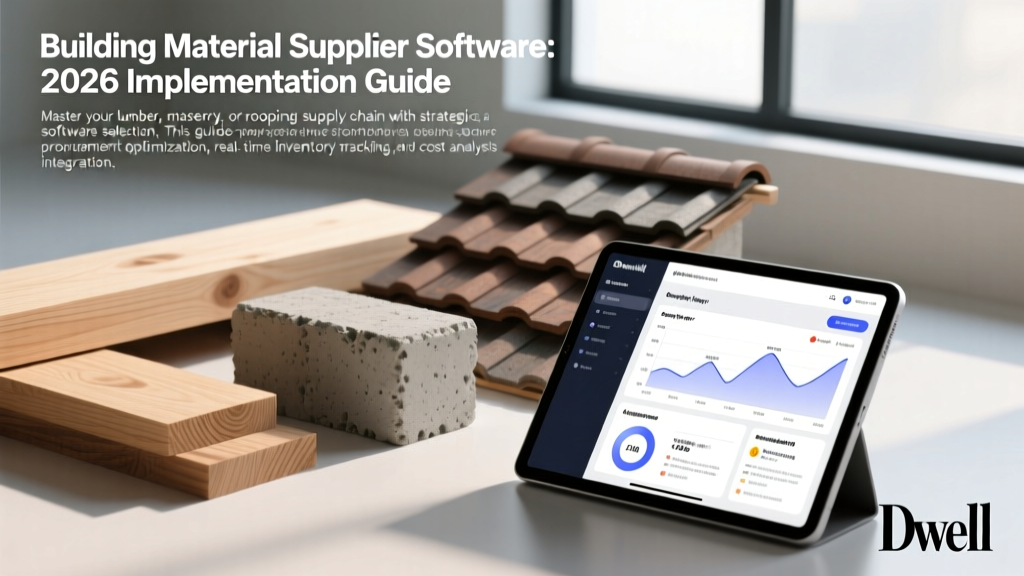
The Shift to Specialized ERPs in Material Supply
Distributing construction materials in 2026 requires far more than basic inventory tracking. Between volatile commodity pricing, complex unit-of-measure (UOM) conversions, and multi-branch logistics, general-purpose retail software fails to meet the demands of modern lumberyards, masonry suppliers, and roofing distributors. According to recent industry analysis by ConstructConnect, technology adoption in the construction supply chain has accelerated, with specialized building material supplier software becoming a baseline requirement for maintaining margin integrity.
Implementing a dedicated Enterprise Resource Planning (ERP) or distribution management system is a high-stakes operational overhaul. This application guide breaks down the exact phases, technical requirements, and financial realities of deploying building material supplier software, ensuring your yard, fleet, and front office operate on a single source of truth.
Decision Matrix: Tier 1 vs. Tier 2 vs. Niche Platforms
Not all distribution software is built for the physical realities of a lumberyard or a pipe yard. Before initiating data migration, you must select a platform engineered for heavy, bulky, and multi-dimensional inventory. Below is a comparison of the primary software tiers utilized by building material suppliers today.
| Platform Tier | Examples | Best For | Estimated Base Cost | Key Differentiator |
|---|---|---|---|---|
| Tier 1 (Enterprise) | Infor M3, Epicor Prophet 21 | Multi-state distributors, $100M+ revenue | $150,000 - $500,000+ | Deep financial consolidation, advanced mill-direct procurement |
| Tier 2 (Mid-Market) | DealerPRO, BisTrack | Regional lumberyards, 3-10 branches | $50,000 - $120,000 | Native truss/component manufacturing modules, robust delivery routing |
| Tier 3 (Niche/SMB) | Buildxact, ECI Spruce | Single-location dealers, specialty shops | $10,000 - $35,000 | Quick deployment, integrated contractor CRM, basic estimating |
For mid-sized building suppliers, platforms like Epicor Prophet 21 remain the industry standard due to their specialized handling of building supply workflows, including fractional quantity tracking and multi-step pricing matrices.
Phase 1: Data Migration and SKU Rationalization
The most common point of failure in software implementation occurs before the system goes live. Building materials possess unique data attributes that crash generic databases. Your migration strategy must address three critical data hurdles:
1. Unit of Measure (UOM) Conversions
Unlike retail goods, building materials are bought, stored, and sold in conflicting units. You purchase PVC pipe in 20-foot sticks, store it in bundles of 50, and sell it by the linear foot. You buy drywall in sheets, but estimate and sell it in 'squares' (100 sq. ft.). Your new software must support multi-dimensional UOM tracking with automated break-bulk calculations to prevent severe margin leakage at the point of sale.
2. Dimensional Lumber and Matrix Pricing
A single SKU for a '2x4' is insufficient. Pricing must fluctuate based on length (8', 10', 12', 16'), grade (Stud, #2, Select Structural), and treatment (KD, PT, Fire-Treated). Ensure your software supports matrix pricing grids rather than flat SKU lists.
If you supply masonry or natural stone, you must configure catch-weight functionality. Natural stone is ordered by the square foot but shipped and invoiced by the exact pound or ton. Failing to enable catch-weight modules will result in massive freight discrepancies and customer disputes.

Phase 2: EDI and API Integrations for Procurement
Manual purchase order entry is obsolete. To maintain optimal stock levels of high-velocity items like OSB, insulation, and fasteners, your building material supplier software must integrate directly with major manufacturers (e.g., USG, James Hardie, Owens Corning) via Electronic Data Interchange (EDI) or modern RESTful APIs.
Mapping EDI Documents for Building Materials
When configuring your procurement module, prioritize the automation of the following EDI transaction sets:
- EDI 850 (Purchase Order): Automates replenishment based on min/max levels or predictive seasonal algorithms.
- EDI 855 (PO Acknowledgment): Instantly flags mill-direct backorders or substitutions, allowing your sales team to proactively notify contractors before the delivery truck arrives short.
- EDI 856 (Advance Ship Notice): Allows your receiving yard to pre-stage forklifts and designate bin locations before the railcar or flatbed truck arrives.
- EDI 810 (Invoice): Enables 3-way matching (PO, ASN, Invoice) to automate accounts payable and capture early-payment discounts from vendors.
Supply chain volatility remains a primary concern for the industry, with the National Association of Home Builders (NAHB) continually highlighting the need for resilient, tech-enabled procurement strategies to buffer against material delays.
Phase 3: Yard Management and Routing Optimization
Software is only as effective as the hardware executing it in the yard. A modern building material supplier implementation extends beyond the front counter into the mud, dust, and diesel of the lumberyard.
Mobile Hardware Deployment
Equip yard personnel with ruggedized mobile computers (such as Zebra TC52x or Honeywell CK65) mounted on forklifts. These devices must run the software's native warehouse management (WMS) module, enabling barcode scanning for bundle tags and RFID reading for high-value, custom-milled items like pre-hung doors or composite decking pallets.
Configure your software to generate digital pick tickets that route yard staff via the most efficient forklift path. Implement a dedicated 'Will-Call' staging lane where scanned materials are locked to a specific customer order, preventing the accidental loading of reserved inventory onto a delivery truck.
Delivery Routing and Proof of Delivery (POD)
Delivering 40,000 lbs of roofing shingles requires specialized routing that accounts for vehicle weight limits, CDL requirements, and crane-truck (boom) availability. Integrate your ERP with a routing engine that captures digital signatures and photo-based Proof of Delivery (POD) directly to the customer's mobile device, instantly triggering the accounts receivable billing cycle.
Cost Breakdown and ROI Timelines
Budgeting for building material supplier software requires looking beyond the initial licensing fees. Below is a realistic financial framework for a mid-market supplier (3 branches, 50+ employees) implementing a Tier 2 system in 2026.
| Cost Category | Year 1 (Implementation) | Year 2+ (Recurring) | Notes |
|---|---|---|---|
| Software Licensing (SaaS) | $45,000 | $45,000 / year | Typically priced per named user or branch location |
| Implementation & Data Migration | $65,000 | $0 | Includes UOM mapping, historical data import, and EDI setup |
| Yard Hardware & Scanners | $22,000 | $2,500 / year (maintenance) | Rugged tablets, forklift mounts, mobile receipt printers |
| Custom API Integrations | $15,000 | $5,000 / year | Connecting to local contractor portals or accounting suites |
| Total Estimated Spend | $147,000 | $52,500 / year | ROI typically realized within 14-18 months via margin recovery |
Common Implementation Failure Modes
To ensure your deployment succeeds, actively mitigate these three frequent pitfalls:
- Ignoring the Counter Culture: Veteran counter sales staff often resist new software due to complex interface navigation. Mandate vendor-led, on-site training specifically focused on keyboard shortcuts and quick-order entry screens to maintain counter speed.
- Underestimating Freight Logic: Building materials involve complex inbound freight (mill-direct, rail, LTL). If your software cannot accurately distribute inbound freight costs down to the individual SKU level, your gross margin reports will be artificially inflated, leading to disastrous pricing decisions.
- Skipping the Physical Inventory Audit: Migrating 'dirty' data into a new ERP simply digitizes your chaos. Conduct a rigorous, wall-to-wall physical inventory count, reconcile all UOM discrepancies, and purge obsolete SKUs before the final data cutover weekend.
Deploying specialized building material supplier software transforms a chaotic yard into a precision logistics hub. By prioritizing complex UOM handling, automating mill-direct procurement via EDI, and extending digital visibility to the forklift driver, suppliers can protect margins and deliver the reliability that modern contractors demand.
Written by
James ThorntonJames Thornton is a construction industry veteran with 25 years of hands-on experience in wood framing, lumber grading, and residential building codes. He started as a framing carpenter in rural Oregon, earned his ICC Residential Building Inspector certification, and eventually became a senior plan reviewer for the City of Portland Bureau of Development Services. James holds a B.S. in Wood Science & Technology from Oregon State University and is a certified lumber grader through the West Coast Lumber Inspection Bureau (WCLIB). He has inspected over 3,000 residential construction sites and authored the city's internal guide on advanced framing techniques (2x6 at 24" O.C.). James lives in Bend, OR, where he builds custom timber-frame cabins and competes in lumberjack sports.
More from James Thornton
View all
Insulation
Best Home Insulation Materials: Complete 2026 Guide
Compare top home insulation materials for 2026. Find R-values, installed costs per square foot, and best uses for fiberglass, spray foam, and mineral wool.
Aug 4, 2026

Sustainable Building
Certify Your Green Building Material for LEED and WELL
Step-by-step guide to certifying a green building material for LEED v5 and WELL v2. Master EPDs, HPDs, and VOC limits for 2026 project specifications.
Aug 4, 2026

Stone & Masonry
Veneer Stacked Stone Panels: Interior Design & Style Showcase
Discover how veneer stacked stone panels transform interiors. Explore modern design profiles, material pairings, and technical installation specs.
Aug 4, 2026