The Ultimate Guide to Casa Building Materials Bronx Supply Yards
Discover where to source casa building materials in the Bronx. Compare local supply yards, 2026 pricing, masonry specs, and NYC DOB compliance logistics.

The Unique Landscape of Bronx Residential Construction
Sourcing materials for residential projects in New York City's northernmost borough requires a highly localized strategy. The Bronx housing stock is heavily dominated by pre-war masonry multi-family buildings (2-4 family homes), mid-century brick walk-ups, and a growing sector of new affordable housing developments. When contractors and developers search for casa building materials, Bronx supply chains present unique logistical hurdles and strict code compliance requirements that differ vastly from suburban markets.
Unlike new-build subdivisions where materials are dropped on wide dirt pads, Bronx residential renovations involve narrow streets, strict NYC Department of Transportation (DOT) commercial parking limits, and the need to match historic facade palettes. This guide breaks down the exact material specifications, local supply yard logistics, and 2026 cost benchmarks required to execute residential projects in the borough efficiently.
Core Material Categories for Bronx "Casa" Projects
Residential renovations in the Bronx typically fall into three categories: facade restoration, flat-roof replacement, and interior multi-family gut rehabs. Each requires specific material grades to survive the local climate and pass NYC Department of Buildings (DOB) inspections.
Masonry and Facade Restoration
The Bronx experiences severe freeze-thaw cycles, making masonry selection critical. For repointing and facade repair on pre-war homes, standard Type N mortar is insufficient. Contractors must source Type S mortar, which offers higher compressive and flexural bond strength (minimum 1,800 psi) to resist winter spalling. When sourcing replacement face brick, local yards along the Bruckner Boulevard corridor typically stock mid-range reds and iron-spot blends that match the historic palettes of neighborhoods like Belmont and Morrisania.
- CMU Blocks: For new partition walls or foundation repairs, ASTM C90 standard weight concrete masonry units (8x8x16) remain the baseline.
- Lintels and Shelf Angles: Must be hot-dip galvanized per NYC Building Code to prevent rust-jacking, a common failure mode in Bronx pre-war facades.
Low-Slope Roofing and Waterproofing
Over 85% of Bronx multi-family homes feature flat or low-slope roofs. Traditional tar and gravel systems have been entirely phased out in favor of high-performance membranes.
- SBS Modified Bitumen: The preferred choice for residential flat roofs. A two-ply torch-applied or cold-adhesive system (base sheet + granular cap sheet) provides superior puncture resistance.
- Polyiso Insulation: To meet the 2024/2026 NYC Energy Conservation Code, roof assemblies must achieve a minimum R-value of R-30 to R-38. This typically requires layering 4.5 to 5.5 inches of polyisocyanurate insulation board beneath the membrane.
Interior Framing and Fire-Rated Assemblies
Multi-family homes (3+ units) require strict fire separation between dwelling units and egress corridors. Standard 1/2-inch drywall will fail inspection. You must source 5/8-inch Type X gypsum board, which contains glass fibers to maintain structural integrity during a fire, providing a 1-hour fire rating per ASTM E119 when installed on wood or steel studs.
Navigating Local Supply Yards and Logistics
The geographic distribution of building supply yards in the Bronx is concentrated heavily in industrial zones. Understanding where to buy and how to receive deliveries is half the battle.
| Supply Hub Location | Primary Inventory | Logistical Profile |
|---|---|---|
| Hunts Point / Bruckner Blvd | Heavy masonry, roofing, lumber, structural steel. | Excellent highway access (I-278, I-895). Ideal for flatbed deliveries. High commercial traffic. |
| Zerega Avenue Corridor | Interior finishes, drywall, HVAC, plumbing fixtures. | Proximity to Throgs Neck Bridge. Better for box-truck deliveries to eastern Bronx sites. |
| Westchester Ave (East Bronx) | Lightweight materials, tools, fasteners, paint. | Mixed commercial/residential zoning. Tighter parking for loading; best for sprinter van pickups. |
Overcoming the "Last Mile" Delivery Challenge
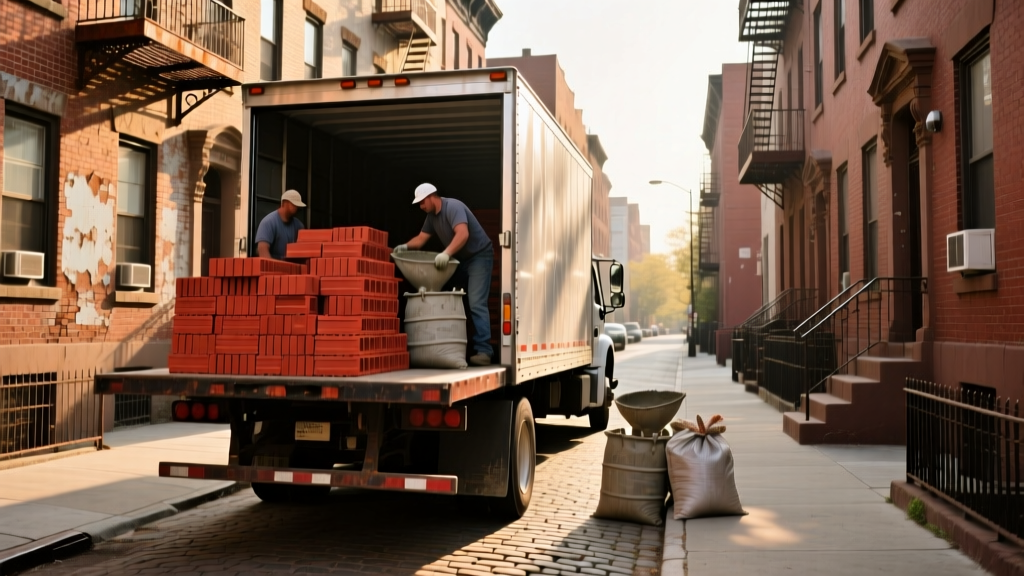
Delivering heavy materials like roofing insulation or pallets of mortar to a residential street in the South Bronx or Kingsbridge requires precise coordination. Flatbed trucks often cannot navigate streets with double-parked cars or low-hanging tree branches.
"For tight Bronx residential blocks, we mandate that suppliers use boom trucks with articulating cranes rather than standard flatbeds with Moffett forklifts. A Moffett requires a 12-foot clearance lane to unload, which you simply don't have on a typical 25-foot wide Bronx street lined with parked cars."
— Marcus V., Bronx-based General Contractor specializing in multi-family rehabs.
2026 Cost Benchmarking: Bronx Material Pricing
Material costs in the Bronx carry a localized premium due to last-mile delivery surcharges, NYC commercial insurance requirements for suppliers, and bridge tolls. Below are the average wholesale costs for core residential materials as of early 2026.
| Material Category | Specification | 2026 Unit Cost (Bronx) |
|---|---|---|
| Fire-Rated Drywall | 5/8" Type X Gypsum Board (4x8) | $19.50 - $23.00 / sheet |
| Roofing Membrane | SBS Modified Bitumen Cap Sheet | $2.85 - $3.40 / sq. ft. |
| Roof Insulation | Polyiso Board (R-25, 4.1") | $1.60 - $1.95 / sq. ft. |
| Masonry Mortar | Type S Pre-blended (80lb bag) | $11.00 - $13.50 / bag |
| Face Brick | Standard Red Modular (Pallet qty) | $0.72 - $0.95 / brick |
Sustainable and Code-Compliant Sourcing
New York City's aggressive climate mandates dictate material selection. Under Local Law 97, multi-family buildings over 25,000 square feet face strict carbon emission caps. While this primarily targets operational energy, the materials you source for envelope upgrades directly impact compliance.
When sourcing insulation and windows for Bronx residential retrofits, prioritize materials that help buildings meet the 2026 and 2030 emission thresholds. Furthermore, the NYC Energy Conservation Code mandates continuous insulation (ci) on exterior walls for new construction and major gut rehabs. Sourcing rigid mineral wool boards (like Rockwool ComfortBoard 80) is increasingly common in the Bronx to provide both the required R-value and non-combustible fire protection, a critical dual-benefit for dense urban housing.
For facade work, contractors must also adhere to the Facade Inspection & Safety Program (FISP). Any masonry materials sourced for FISP-mandated repairs must be accompanied by mill certificates and ASTM testing documentation to prove they meet the structural requirements of the original assembly.
Expert Framework: Selecting Your Bronx Supply Partner
Choosing where to buy your casa building materials in the Bronx comes down to a trade-off between volume pricing and logistical agility. Use this framework to decide which supply model fits your current project phase.
National Big-Box Retailers (e.g., Home Depot Pro, Lowe's)
- Pros: Transparent pricing, easy online ordering, extended hours, good for small-volume interior finishes (paint, trim, basic hardware).
- Cons: Limited stock of specialized NYC-code materials (e.g., specific fire-stopping assemblies, heavy masonry). Delivery fleets are often not equipped for complex Bronx street drops.
- Best For: Phase 2 interior fit-outs, punch-list items, and owner-operator DIY repairs.
Local Bronx Specialty Yards (e.g., Hunts Point Lumber, local masonry suppliers)
- Pros: Deep inventory of heavy, code-specific materials. Dispatchers understand local DOT restrictions, bridge weight limits, and can route boom trucks appropriately. Credit terms available for established local contractors.
- Cons: Pricing is opaque and requires negotiation. Minimum delivery fees are higher. Yards close early (usually 3:30 PM - 4:00 PM).
- Best For: Phase 1 structural work, facade restoration, roofing, and bulk masonry orders.
Final Procurement Strategy
Successfully executing a residential build or renovation in the Bronx requires treating material procurement as a logistical operation, not just a shopping trip. Always verify that your supplier can provide the specific ASTM certifications required by your DOB-approved architectural drawings. Consolidate heavy deliveries to a single drop using an articulating boom truck to minimize street-blocking fines, and maintain a 10-15% overage on all masonry and roofing materials to account for the high breakage rates inherent in urban crane lifts and narrow stairwell carries. By aligning your material specs with local climate realities and NYC building codes, you ensure your project passes inspection on the first attempt.
Written by
Sarah WhitfieldSarah Whitfield is a chartered quantity surveyor (MRICS) and construction cost analyst with 15 years of experience in material pricing, procurement strategy, and project budgeting. She earned her degree in Construction Management from the University of Reading (UK) and has worked on projects ranging from $2M custom homes to $180M mixed-use developments across North America and Europe. Sarah currently leads cost estimating for BuildMat Insight, maintaining a proprietary database of 4,000+ material price points updated quarterly. She is a frequent contributor to RSMeans cost data panels and has presented at the International Cost Engineering Council (ICEC) congress. Based in Denver, CO, Sarah is an avid trail runner and volunteer mentor for Women in Construction.
More from Sarah Whitfield
View all
Wood & Lumber
What Are the Different Types of Wood? A Builder's Guide
Compare structural softwoods, finish hardwoods, and engineered lumber. Analyze Janka ratings, MOE values, and 2026 pricing for construction.
Aug 4, 2026

Walls & Panels
Steel Framing vs Wood Framing: Corrosion and Moisture Defense
Compare steel framing vs wood framing for moisture resistance. Learn about galvanized coatings, condensation risks, and corrosion protection strategies.
Jul 21, 2026

Stone & Masonry
How to Cut Stone Veneer: Wet Saw vs Grinder Comparison
Compare the best tools for cutting stone veneer. We review wet saws, angle grinders, and chop saws to help you achieve clean, chip-free cuts.
Jul 21, 2026