Tax Deductions When You Donate Building Materials: A Cost Analysis
Discover the true financial impact when you donate building materials. Learn how to calculate tax deductions, appraisal costs, and hidden savings.

The Financial Reality of Construction Waste
Construction and demolition (C&D) debris accounts for over 600 million tons of waste annually in the United States. For general contractors, developers, and property owners, hauling this waste to a landfill is traditionally viewed as an unavoidable sunk cost. However, choosing to donate building materials transforms a pure liability into a calculated financial asset. By leveraging federal tax deductions and avoiding municipal tipping fees, material reuse becomes a strategic line item in your project budget. This cost analysis breaks down the exact mathematics of deconstruction, material valuation, and IRS compliance to determine when donating makes financial sense.
Deconstruction vs. Demolition: A Cost-Benefit Breakdown
The prerequisite to donating building materials is deconstruction—the careful dismantling of a structure to preserve the integrity of reusable components. Standard demolition is fast and destructive, while deconstruction is methodical and labor-intensive. To justify the upfront labor premium, you must calculate the delta against avoided disposal costs and projected tax write-offs.
| Metric | Standard Demolition | Selective Deconstruction |
|---|---|---|
| Average Labor Cost (per sq. ft.) | $2.00 - $4.00 | $5.00 - $9.00 |
| Timeline (2,000 sq. ft. interior) | 2 - 4 Days | 8 - 14 Days |
| Material Recovery Rate | < 10% | 40% - 70% |
| Landfill Tipping Fees Incurred | High (Bulk Weight) | Low (Heavy items diverted) |
| Tax Deduction Eligibility | None | High (Fair Market Value) |
If you are gutting a 2,000-square-foot commercial space, deconstruction may add $6,000 to $10,000 in upfront labor compared to standard demolition. However, if that space yields $15,000 in appraised reusable materials (such as commercial VRF HVAC units, architectural glass, and solid-core wood doors), and your effective tax rate is 30%, the $4,500 tax savings combined with $3,000 in avoided tipping fees easily eclipses the labor premium.
Navigating IRS Tax Deductions for Donated Materials
The Internal Revenue Service allows taxpayers to deduct the Fair Market Value (FMV) of donated building materials, but the documentation requirements scale strictly with the claimed deduction amount. Understanding these tiers is critical to avoiding audit triggers and unnecessary administrative costs.
The Deduction Tiers and Documentation Requirements
- Under $250: Requires a basic receipt from the receiving charity (e.g., a Habitat for Humanity ReStore) detailing the date and location of the drop-off.
- $250 to $500: Requires a contemporaneous written acknowledgment from the charity stating whether any goods or services were provided in exchange for the donation.
- $500 to $5,000: Requires IRS Form 8283 (Section A), detailing the donor's cost basis, acquisition date, and FMV calculation method.
- Over $5,000: Requires Form 8283 (Section B) and a Qualified Appraisal conducted by a certified professional no earlier than 60 days before the donation date.
For authoritative guidance on noncash charitable contributions, contractors and owners should consult the IRS Form 8283 instructions directly to ensure compliance with current tax codes.
A certified qualified appraisal for commercial building materials typically costs between $800 and $1,500. If your bundle of donated materials (e.g., salvaged copper wiring and commercial lighting fixtures) is appraised at $5,200, the appraisal fee will consume nearly 30% of your gross tax benefit. Strategic Move: Bundle donations to land safely under the $5,000 threshold to avoid the appraisal requirement, or ensure the donation is substantial enough (e.g., $15,000+) to easily absorb the appraisal cost.
Material Valuation Matrix: High-Yield vs. Low-Yield Donations
Charities like Habitat for Humanity ReStores accept a wide variety of goods, but not all materials generate a meaningful tax deduction. Fair Market Value is dictated by what a willing buyer would pay for the item in its current, used condition. High-end architectural elements and specialized commercial systems retain value, while commodity building supplies depreciate to near-zero the moment they are installed.
| Material Category | High-Yield (High FMV Retention) | Low-Yield (Low/No FMV Retention) |
|---|---|---|
| Flooring | Reclaimed longleaf pine, antique terracotta tile | Used laminate, standard carpet, worn vinyl |
| Fixtures | Kohler commercial flush valves, brass hardware | Standard builder-grade plastic vanity tops |
| Exterior | Trex Transcend composite decking, standing seam metal | Used asphalt shingles, rotted wood siding |
| Mechanical | Commercial VRF systems, heavy-duty transformers | Outdated window AC units, old thermostats |
When conducting a pre-demolition audit, focus your deconstruction labor hours exclusively on the High-Yield column. Extracting used drywall or fiberglass batt insulation costs more in labor than the resulting tax deduction will ever yield.
Avoided Tipping Fees and Logistics Costs
The financial equation of donating building materials must also factor in the avoided costs of landfill disposal. As of 2026, municipal C&D diversion mandates in states like California, Massachusetts, and Washington have driven landfill tipping fees to an average of $55 in the rural Midwest to over $125 per ton in the Northeast and West Coast. A standard 2,000-square-foot commercial teardown can easily generate 50 to 100 tons of debris.
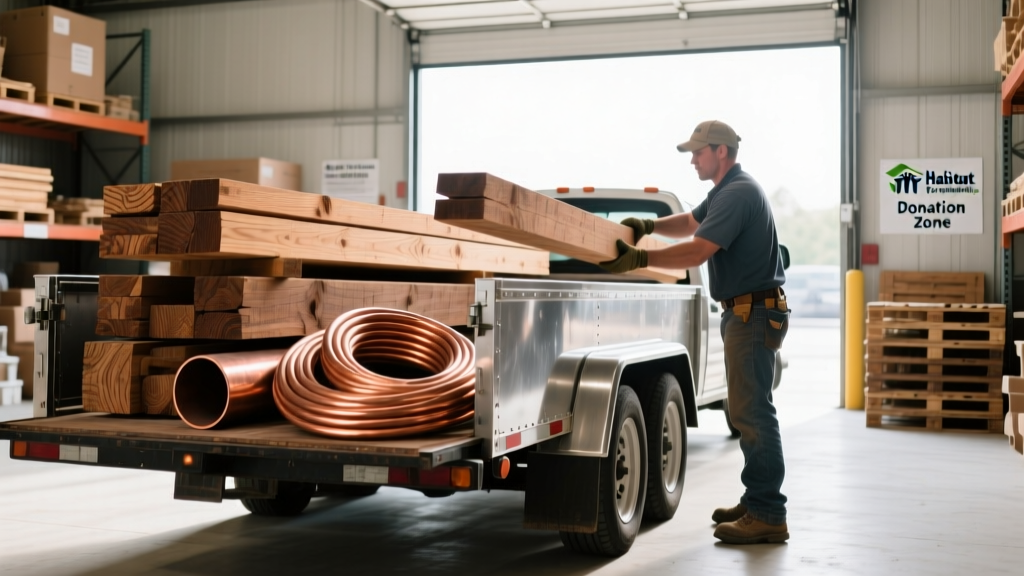
Heavy, dense materials like masonry, dimensional lumber, and structural steel dictate your tonnage. By diverting 30 tons of heavy, reusable materials to a donation center instead of a landfill, you save between $1,650 and $3,750 in pure disposal fees. However, you must subtract the logistics cost of the donation. While some ReStores offer free pickup for large commercial donations, others require you to rent a 26-foot box truck ($150-$300 per day) and pay for two laborers to load and transport the goods. Always secure a written pickup agreement or calculate your transport logistics before finalizing the deconstruction schedule.
The Contractor's Decision Framework
Use this step-by-step framework on your next renovation or teardown project to determine the most profitable end-of-life pathway for your building materials:
- Conduct a Pre-Deconstruction Audit: Walk the site with a qualified estimator. Tag all High-Yield materials (lumber, metals, high-end fixtures) and estimate their used Fair Market Value using local marketplace listings.
- Calculate the Labor Delta: Get quotes for both standard demolition and selective deconstruction. Subtract the demo cost from the deconstruction cost to find your upfront premium.
- Factor in Avoided Tipping Fees: Estimate the tonnage of the tagged materials. Multiply by your local C&D tipping fee (call your local waste authority for the exact 2026 rate).
- Apply the Tax Multiplier: Multiply your estimated FMV by your effective marginal tax rate. If the FMV is over $5,000, subtract $1,000 for the required qualified appraisal.
- Execute the Decision: If (Avoided Tipping Fees + Net Tax Benefit) > (Labor Delta + Transport Costs), proceed with deconstruction and donate the materials. Otherwise, demo and scrap the metals for direct cash recycling.
By treating the decision to donate building materials as a rigorous cost-analysis exercise rather than a mere charitable afterthought, contractors and developers can unlock hidden margins, comply with stringent municipal waste diversion laws, and significantly improve the bottom line of their construction projects.
Written by
James ThorntonJames Thornton is a construction industry veteran with 25 years of hands-on experience in wood framing, lumber grading, and residential building codes. He started as a framing carpenter in rural Oregon, earned his ICC Residential Building Inspector certification, and eventually became a senior plan reviewer for the City of Portland Bureau of Development Services. James holds a B.S. in Wood Science & Technology from Oregon State University and is a certified lumber grader through the West Coast Lumber Inspection Bureau (WCLIB). He has inspected over 3,000 residential construction sites and authored the city's internal guide on advanced framing techniques (2x6 at 24" O.C.). James lives in Bend, OR, where he builds custom timber-frame cabins and competes in lumberjack sports.
More from James Thornton
View all
Insulation
Best Home Insulation Materials: Complete 2026 Guide
Compare top home insulation materials for 2026. Find R-values, installed costs per square foot, and best uses for fiberglass, spray foam, and mineral wool.
Aug 4, 2026

Sustainable Building
Certify Your Green Building Material for LEED and WELL
Step-by-step guide to certifying a green building material for LEED v5 and WELL v2. Master EPDs, HPDs, and VOC limits for 2026 project specifications.
Aug 4, 2026

Stone & Masonry
Veneer Stacked Stone Panels: Interior Design & Style Showcase
Discover how veneer stacked stone panels transform interiors. Explore modern design profiles, material pairings, and technical installation specs.
Aug 4, 2026