Evaluate CertainTeed Building Materials: Trim Products Cost Guide
Analyze 2026 costs for CertainTeed trim products. Compare cellular PVC, fiber cement, and vinyl options for material, labor, and lifecycle ROI.

The 2026 CertainTeed Trim Portfolio: Material vs. Lifecycle Costs
When builders and architects evaluate the building materials company CertainTeed on trim products, the analysis must extend far beyond the initial per-linear-foot price tag. In 2026, the true cost of exterior trim is dictated by a triad of variables: raw material pricing, specialized labor requirements, and long-term maintenance liabilities. CertainTeed segments its trim offerings into three distinct material categories—Cellular PVC (Restoration Millwork), Fiber Cement (WeatherBoards), and Vinyl (CedarBoards). Each material demands a completely different installation methodology, fastener specification, and finishing protocol.
To accurately forecast your project budget, you must map the specific product line to your regional labor rates and environmental exposure. The following matrix breaks down the baseline 2026 costs for standard 5/4 x 6 trim profiles across the CertainTeed portfolio.
| Product Line | Material Type | Material Cost (per LF) | Est. Labor Cost (per LF) | 20-Year Maintenance |
|---|---|---|---|---|
| Restoration Millwork | Cellular PVC | $4.50 - $6.20 | $3.80 - $5.50 | $0.00 (if factory finished) |
| WeatherBoards Trim | Fiber Cement | $3.10 - $4.40 | $5.20 - $7.80 | $2.50 (repaint cycle) |
| CedarBoards Trim | Vinyl | $1.80 - $2.60 | $2.50 - $3.90 | $0.00 (wash only) |
Restoration Millwork (Cellular PVC): Premium Upfront, Zero Maintenance
CertainTeed’s Restoration Millwork cellular PVC is the premium choice for high-moisture environments, coastal builds, and complex architectural details. Because it is impervious to rot and insect damage, it eliminates the lifecycle replacement costs associated with wood or engineered wood trims. However, the upfront material cost is the highest in the portfolio.
The Hidden Cost of Thermal Expansion
The most common financial bleed on cellular PVC projects occurs when installers treat it like traditional wood. PVC expands and contracts at a rate of approximately 1/8 inch per 18-foot board for every 50°F temperature swing. If installed tightly without expansion gaps, the boards will buckle, requiring costly tear-outs and replacements.
When using Restoration Millwork, budget an additional $0.85 to $1.10 per linear foot for the Cortex concealed fastening system. While this increases material costs, it completely eliminates the labor hours required to fill, sand, and prime traditional nail holes. On a standard 2,500 sq. ft. home requiring 400 LF of trim, Cortex saves approximately 12 hours of finishing labor, yielding a net positive ROI.
Paint Adhesion and LRV Limitations
If you are painting the PVC on-site rather than ordering CertainTeed’s pre-finished ColorView options, you must strictly adhere to Light Reflectance Value (LRV) guidelines. Painting cellular PVC with dark colors (LRV below 55) causes the material to absorb excessive heat, leading to irreversible warping and voiding the manufacturer warranty. Always specify 100% acrylic latex paints formulated specifically for PVC substrates.
WeatherBoards (Fiber Cement): The Hidden Labor Multipliers
CertainTeed WeatherBoards fiber cement trim offers exceptional impact resistance, a Class A fire rating, and a rigid, wood-like aesthetic that appeals to historic restoration projects and high-end custom builds. The material cost is moderate, but the installation labor carries significant hidden multipliers that estimators frequently overlook.
Weight and Handling Logistics
A standard 16-foot length of 1x6 fiber cement trim weighs approximately 38 pounds. Unlike PVC or vinyl, which can be easily manipulated by a single carpenter, fiber cement requires two-person handling or specialized material lifts for second-story applications. This effectively doubles the base handling time compared to lighter alternatives, pushing the labor cost per linear foot up by 20% to 30% on multi-story elevations.
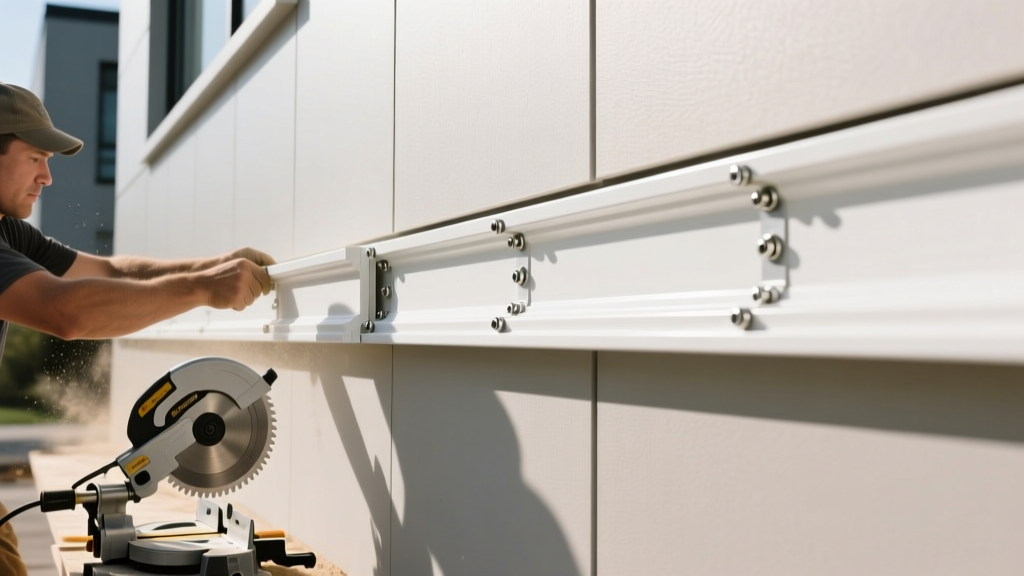
Cutting fiber cement generates respirable crystalline silica. Under current OSHA respiratory protection and silica standards, contractors must use HEPA-filtered vacuum attachments on all miter saws and provide P100 respirators to workers. Failure to comply can result in fines exceeding $16,500 per violation in 2026. When bidding a WeatherBoards project, add $0.40 to $0.60 per linear foot to cover the depreciation of HEPA dust extraction equipment and mandatory PPE.
Fastener Corrosion and Flashing
Fiber cement is highly alkaline and will rapidly corrode standard galvanized nails, leading to rust streaks that ruin the exterior finish. You must budget for hot-dipped galvanized or 304-grade stainless steel trim nails. Furthermore, because fiber cement is porous, all end cuts must be sealed with a high-quality acrylic caulk or flashing tape to prevent wicking, adding roughly 15 minutes of labor per joint.
CedarBoards (Vinyl Trim): Budget Constraints and Thermal Limits
For production builders and strict budget envelopes, CertainTeed CedarBoards vinyl trim provides the lowest barrier to entry. Priced between $1.80 and $2.60 per linear foot, it requires no painting, resists moisture, and installs quickly using standard pneumatic nailers and vinyl-specific J-channels.
The Limitations of Vinyl Rigidity
While the material is cheap, CedarBoards lacks the structural rigidity of PVC or fiber cement. It cannot be used for structural load-bearing applications or as a backing for heavy shutters and light fixtures without independent blocking. Additionally, vinyl trim is limited in profile depth; the thickest standard profile is typically 5/8 inch, which may not align flush with thicker siding profiles like traditional cedar shakes or thick fiber cement lap, requiring custom flashing solutions to bridge the gap.
Project Decision Framework: Which CertainTeed Trim Fits Your Budget?
To finalize your material selection, apply this decision matrix based on your project's primary constraints:
- Choose Restoration Millwork (PVC) if: The project is located in a coastal zone (salt spray), ground-contact applications are unavoidable, or the client demands a zero-maintenance lifecycle with complex routed details.
- Choose WeatherBoards (Fiber Cement) if: The project requires a Class A fire rating (e.g., Wildland-Urban Interface zones), the architectural style demands a rigid, authentic wood-grain texture, and the budget can absorb higher skilled-labor rates.
- Choose CedarBoards (Vinyl) if: The project is a high-volume production build, the budget is strictly capped below $3.00/LF for total trim costs, and the trim will be paired with matching vinyl siding systems for unified expansion rates.
Final Estimating Advice
When evaluating the building materials company CertainTeed on trim products for your 2026 ledger, always request a 10% waste factor for PVC and Vinyl due to thermal expansion cuts, and a 12% waste factor for Fiber Cement due to brittle breakage during transport and angled miter cuts. Factoring in the precise accessory costs—from stainless steel fasteners to specialized sealants—will prevent margin erosion and ensure a durable, code-compliant exterior envelope.
Written by
Marcus ChenMarcus Chen is a licensed structural engineer (PE) and building materials analyst with over 12 years of experience across residential, commercial, and industrial construction. He holds a Master of Science in Civil Engineering from UC Berkeley and spent six years at Thornton Tomasetti before transitioning to independent consulting and technical writing. Marcus specializes in material selection for seismic-prone regions, concrete reinforcement strategies, and lifecycle cost analysis. His work has been cited by the American Concrete Institute (ACI) and the Structural Engineers Association of California (SEAOC). When he is not on a job site or at his desk, you will find him hiking the Sierra Nevada or restoring a 1920s craftsman bungalow in Oakland, CA.
More from Marcus Chen
View all
Construction Cost
How Much Did the Eiffel Tower Cost to Build?
How much did the Eiffel Tower cost to build in 1889? We adjust for inflation and compare its budget to modern skyscraper construction.
Aug 4, 2026

Fire Resistance
What Is a Fire Resistant Material? Testing & Certification Guide
Discover what is a fire resistant material through ASTM and UL testing. Learn how fire ratings, certifications, and assemblies work in construction.
Aug 4, 2026

Construction Cost
How Much Did the Burj Khalifa Cost to Build?
How much did the Burj Khalifa cost to build? We break down the $1.5B project and extract 5 money-saving strategies for your next build.
Jul 30, 2026