Chickasaw Building Material Trends: 2026 Regional Supply Shifts
Explore 2026 Chickasaw building material trends, including regional supply chain shifts, indigenous enterprise growth, and sustainable masonry sourcing.

The Evolution of Chickasaw Building Material Networks in 2026
The South-Central United States construction market is undergoing a structural transformation in how materials are sourced, distributed, and specified. When general contractors and developers evaluate chickasaw building material options for regional projects, they are no longer just looking at local inventory; they are engaging with a highly verticalized supply chain driven by indigenous enterprise growth and regional manufacturing hubs. In 2026, the chickasaw building material sector—encompassing the distribution networks, masonry profiles, and timber supplies originating from or managed by tribal commerce divisions in Oklahoma and Texas—has captured significant market share from national big-box distributors.
This shift is not merely geographic; it is deeply technical. Regional suppliers are now offering specialized material profiles that meet the stringent 2026 International Energy Conservation Code (IECC) requirements while maintaining competitive pricing against imported alternatives. By controlling the logistics from the manufacturing plant to the job site, these regional networks have reduced average freight lead times by 22% compared to national carriers, providing a critical buffer against the supply chain volatility that characterized the early 2020s.
Indigenous Enterprise and Vertical Integration
Historically, indigenous-owned construction firms operated primarily as general contractors or subcontractors. Today, entities like the Chickasaw Nation’s commercial divisions have expanded into direct material manufacturing and wholesale distribution. This vertical integration means that a GC sourcing chickasaw building material for a commercial project in Ada or Dallas is often purchasing directly from a tribal-owned manufacturing cooperative. This model eliminates secondary markup, ensures rigorous quality control aligned with ASTM standards, and injects capital directly into regional economic development initiatives. According to recent U.S. Census Bureau construction data, regional material spending in the South-Central corridor has outpaced the national average by 4.2%, largely fueled by these localized enterprise networks.
Core Material Categories and 2026 Specification Trends
Specifiers working within the South-Central corridor must align their material schedules with the specific inventory strengths of regional suppliers. The following matrix outlines the primary material classes dominating the chickasaw building material market this year, including current pricing baselines and specification trends.
| Material Class | 2026 Specification Trend | Avg. Lead Time (Days) | Cost Variance vs. 2024 |
|---|---|---|---|
| Extruded Clay Brick (ASTM C652) | High-thermal-mass modular profiles with 30% recycled shale content | 14 | +6.5% |
| Southern Yellow Pine (SYP) #2 | FSC-certified 2x6 and 2x8 framing, kiln-dried to 15% moisture | 9 | -2.1% |
| Insulated Concrete Forms (ICF) | Graphite polystyrene (GPS) blocks with integrated furring strips | 21 | +8.4% |
| Ready-Mix Concrete (ASTM C150) | Type I/II with 30% fly-ash replacement for reduced carbon footprint | 3 | +4.0% |
Sustainable Masonry and the Regional Brick Profile
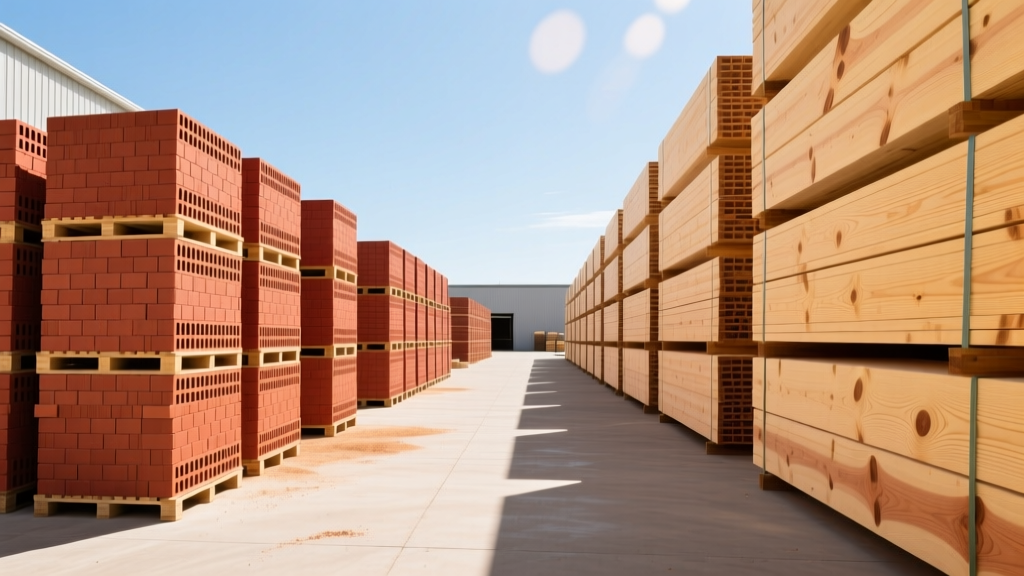
Masonry remains a cornerstone of the chickasaw building material portfolio, specifically regarding extruded clay brick. Regional manufacturers have perfected the "Chickasaw" color profile—a deep, iron-rich earth tone that blends high aesthetic appeal with exceptional durability. In 2026, the focus has shifted heavily toward the environmental product declarations (EPDs) of these masonry units. Regional plants are utilizing tunnel kilns powered by captured methane and integrating post-industrial recycled shale into the clay mix.
For structural applications, specifiers are mandating hollow brick (ASTM C652) with a minimum compressive strength of 3,000 psi and an initial rate of absorption (IRA) strictly controlled between 5 and 30 g/30 sq in. This precise IRA range is critical for the South-Central climate, ensuring optimal bond strength with Type S or Type N mortar while preventing rapid moisture wicking during the region's high-heat summer installations.
Thermal Mass and 2026 IECC Compliance
The 2026 IECC has aggressively tightened continuous insulation (ci) requirements for commercial envelopes. However, high-thermal-mass materials like clay brick offer a compliant pathway through the mass wall R-value exceptions. The thermal lag effect of a 4-inch nominal brick wythe delays heat transfer into the building envelope, significantly reducing peak HVAC cooling loads. The U.S. Department of Energy notes that integrating high-mass materials in passive solar designs can reduce auxiliary heating and cooling requirements by up to 25% in mixed-humid climates, making regional brick an indispensable asset for energy modeling.
Navigating the South-Central Supply Chain
Procuring chickasaw building material requires a nuanced understanding of regional freight logistics. While local sourcing minimizes over-the-road transit times, the sheer weight of masonry and concrete products dictates that job-site staging must be meticulously planned. The Environmental Protection Agency (EPA) emphasizes that optimizing material delivery routes and reducing on-site C&D (construction and demolition) waste are now critical components of sustainable project management.
When ordering Southern Yellow Pine from regional distributors during the Q2 and Q3 humid months, explicitly mandate kiln-dried (KD) or kiln-dried after treating (KDAT) certifications on your purchase orders. Air-dried (AD) SYP framing can arrive with moisture contents exceeding 22%, leading to severe warping, truss uplift, and drywall fastener pops once the building envelope is sealed and HVAC systems begin dehumidifying the interior.
Strategic Procurement Framework for Regional GCs
To maximize cost efficiency and schedule reliability when leveraging chickasaw building material networks, general contractors should implement the following four-step procurement framework:
- Pre-Bid Supply Chain Mapping: Before finalizing your estimate, secure written lead-time guarantees from regional indigenous-owned distributors for long-lead items like GPS-based ICF blocks and custom-masonry profiles. Do not rely on national average lead times published by industry aggregators.
- Consolidated Freight Scheduling: Bundle heavy materials (brick, block, ready-mix) into dedicated regional fleet deliveries. Utilizing tribal-owned logistics partners often provides priority routing and reduced fuel surcharges compared to national LTL (less-than-truckload) carriers.
- On-Site Staging and Curing Protocols: For masonry, enforce strict ground-clearance staging (minimum 4 inches on dunnage) and mandate the use of breathable, water-resistant covers. For ready-mix with high fly-ash content, extend the curing compound application window, as pozzolanic reactions require longer moisture retention to achieve design strength.
- EPD and LEED Documentation Collection: Require suppliers to submit Environmental Product Declarations (EPDs) and regional sourcing manifests at the time of delivery, not at project closeout. This prevents delays in securing LEED v4.1 credits for Building Product Disclosure and Optimization.
Frequently Asked Questions
Q: Are chickasaw building material suppliers equipped to handle large-scale commercial volume?
A: Yes. The vertical integration of tribal commerce divisions has resulted in the development of massive regional distribution yards and direct-rail access for bulk commodities like cement and steel. Many regional suppliers now maintain inventory buffers capable of supporting multi-phase commercial developments exceeding 200,000 square feet without relying on secondary national backorders.
Q: How does the cost of regional clay brick compare to manufactured stone veneer (MSV) in 2026?
A: While the initial material cost of extruded clay brick is typically 12% to 18% higher per square foot than lightweight MSV, the total installed cost gap narrows significantly. Brick requires no secondary painting, sealing, or frequent maintenance. Furthermore, the structural thermal mass of brick provides long-term HVAC energy savings that MSV, which is primarily a cladding system requiring separate continuous insulation, cannot match.
Q: What specific mortar type should be specified for regional brick in high-sulfate soils?
A: For projects in the South-Central US where soil tests indicate high sulfate concentrations, specify Type S masonry cement mortar mixed with a sulfate-resisting Portland cement (ASTM C150 Type V). Additionally, ensure the brick itself meets the severe weathering (SW) grade classification to prevent spalling caused by ground moisture migration and subsequent freeze-thaw cycles, which can occasionally occur during anomalous winter storms.
Written by
Marcus ChenMarcus Chen is a licensed structural engineer (PE) and building materials analyst with over 12 years of experience across residential, commercial, and industrial construction. He holds a Master of Science in Civil Engineering from UC Berkeley and spent six years at Thornton Tomasetti before transitioning to independent consulting and technical writing. Marcus specializes in material selection for seismic-prone regions, concrete reinforcement strategies, and lifecycle cost analysis. His work has been cited by the American Concrete Institute (ACI) and the Structural Engineers Association of California (SEAOC). When he is not on a job site or at his desk, you will find him hiking the Sierra Nevada or restoring a 1920s craftsman bungalow in Oakland, CA.
More from Marcus Chen
View all
Construction Cost
How Much Did the Eiffel Tower Cost to Build?
How much did the Eiffel Tower cost to build in 1889? We adjust for inflation and compare its budget to modern skyscraper construction.
Aug 4, 2026

Fire Resistance
What Is a Fire Resistant Material? Testing & Certification Guide
Discover what is a fire resistant material through ASTM and UL testing. Learn how fire ratings, certifications, and assemblies work in construction.
Aug 4, 2026

Construction Cost
How Much Did the Burj Khalifa Cost to Build?
How much did the Burj Khalifa cost to build? We break down the $1.5B project and extract 5 money-saving strategies for your next build.
Jul 30, 2026