2026 Trends Shaping Non Combustible Building Materials
Explore 2026 trends in non combustible building materials, from advanced aerogel insulation to updated IBC fire codes and mineral wool innovations.

The Regulatory Shift: 2026 IBC Code Updates Driving Demand
The specification of non combustible building materials has transitioned from a niche code-compliance exercise to a primary driver of architectural design and insurance underwriting. Driven by the escalating frequency of wildland-urban interface (WUI) fires and stricter urban density mandates, the 2024 and upcoming 2027 International Building Code (IBC) cycles have heavily penalized combustible cladding and insulation in Type I through Type IV constructions. According to the International Code Council (ICC), modern code enforcement now requires continuous exterior insulation systems to pass rigorous NFPA 285 testing, effectively eliminating expanded polystyrene (EPS) and polyisocyanurate from high-rise and mid-rise exterior envelopes unless heavily shielded by non-combustible barriers.
This regulatory pressure has forced a supply chain pivot. Manufacturers are scaling up production of basalt-based stone wool, autoclaved aerated concrete (AAC), and advanced fiber cement composites to meet the 2026 demand surge, particularly in western U.S. states adopting California's stringent Chapter 7A WUI standards.
Material Innovations: Beyond Traditional Concrete and Steel
While concrete and structural steel remain the baseline for non-combustible framing, the industry is rapidly innovating in the envelope, insulation, and interior partition sectors to reduce embodied carbon without sacrificing fire ratings.
High-Performance Stone Wool and Aerogel Composites
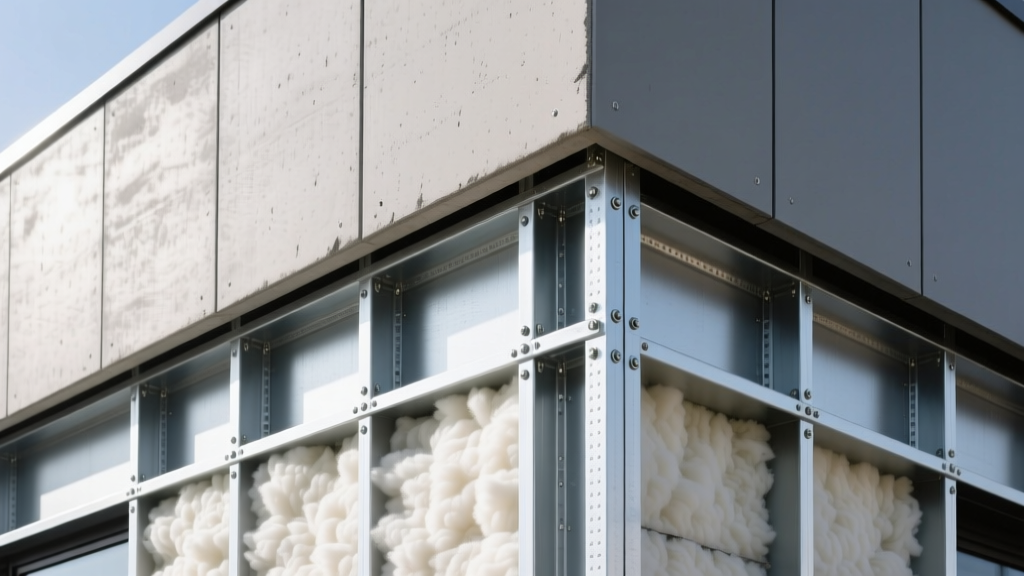
Stone wool (mineral wool) remains the dominant non-combustible insulation, but 2026 product lines have shifted toward higher-density, hydrophobic rigid boards designed for continuous exterior insulation (ci). Products like ROCKWOOL's CurtainRock series are engineered to withstand temperatures exceeding 2,150°F (1,177°C)—well above the point where structural steel begins to lose its load-bearing capacity (approx. 1,100°F). Furthermore, the integration of silica aerogel blankets into mineral wool matrices is emerging in high-end commercial builds. These composites achieve R-values of R-10 per inch while maintaining an ASTM E136 non-combustible classification, allowing architects to meet strict energy codes without increasing wall cavity depth.
Autoclaved Aerated Concrete (AAC) Evolution
AAC has historically been limited by its brittleness and moisture sensitivity. However, next-generation AAC panels, such as those produced by Hebel, now feature advanced polymer-modified mineral finishes that eliminate the need for combustible exterior sealants. An 8-inch thick AAC panel inherently provides a 4-hour fire rating per ASTM E119, functioning simultaneously as the structural wall, thermal insulation, and fire barrier. This consolidation of trades is heavily trending in 2026 for multi-family residential projects seeking to reduce labor costs and accelerate enclosure timelines.
CRITICAL DISTINCTION: Fire-Rated vs. Non-Combustible
A common and costly error in material specification is conflating 'fire-resistive' with 'non-combustible'. Fire-retardant-treated (FRT) wood and intumescent-coated gypsum are combustible materials that have been chemically or physically altered to delay ignition and flame spread (tested via ASTM E84). True non-combustible materials must pass ASTM E136, proving they will not ignite, burn, support combustion, or release flammable vapors when subjected to extreme heat. Always verify the ASTM E136 certification for exterior cladding in WUI zones, as FRT wood is increasingly being banned in these high-risk corridors.
Cost & Supply Chain Matrix: 2026 Pricing Reality
The premium for non-combustible materials has narrowed as production scales and combustible alternatives face rising insurance premiums and code-mandated testing costs. Below is the 2026 market baseline for primary non-combustible envelope and partition materials.
| Material Type | Key Standard | 2026 Avg Cost (Material) | Primary Application |
|---|---|---|---|
| Rigid Stone Wool Board (8 lb/ft³) | ASTM E136 / C612 | $2.80 - $3.50 / sq ft | Exterior Continuous Insulation (ci) |
| Fiber Cement Cladding (5/16" thick) | ASTM C1186 | $3.50 - $5.00 / sq ft | WUI Compliant Rainscreen Siding |
| AAC Structural Panels (8" thick) | ASTM E119 (4-hr) | $9.00 - $12.50 / sq ft | Mid-rise Multi-family Exterior Walls |
| Type X Gypsum Board (5/8" thick) | ASTM C1396 | $0.65 - $0.90 / sq ft | Interior Shaft & Partition Liners |
| Magnesium Oxide (MgO) Board | ASTM E136 | $1.80 - $2.40 / sq ft | Moisture-Prone Fire Rated Sheathing |
Passive Fire Protection (PFP): The Intumescent Shift
While structural steel is inherently non-combustible, it is highly vulnerable to heat-induced structural failure. The 2026 trend in commercial construction is moving away from traditional cementitious spray-on fireproofing (SFRM) toward advanced thin-film intumescent coatings. Products like Sherwin-Williams FIRETEX and Nullifire are formulated to swell up to 50 times their original thickness when exposed to temperatures above 400°F, creating a dense, carbonaceous char that insulates the steel.
This shift is driven by aesthetic demands in exposed-ceiling commercial designs and the need for precise, verifiable thickness applications. Modern intumescent epoxies can provide up to 2-hour fire resistance ratings with a dry film thickness (DFT) of less than 0.2 inches, significantly reducing the dead load on the structure compared to traditional concrete encasement or heavy mineral wool wrapping.
Decision Framework: Selecting Materials by Building Type
Specifying the correct non combustible building materials requires aligning product capabilities with the specific IBC Construction Type. Use this framework to guide material procurement:
- Type I (Fire-Resistive High-Rise): Mandates non-combustible structural elements with 2 to 4-hour fire resistance ratings. Action: Specify structural steel protected by epoxy intumescent coatings or dense concrete encasement. Use rigid stone wool for cavity insulation and avoid any EPS/XPS in the roof assembly.
- Type II (Non-Combustible Commercial): Requires non-combustible materials but with lower fire-resistance rating requirements (0 to 1 hour). Action: Opt for cold-formed steel (CFS) framing with Type X gypsum sheathing and fiber-cement exterior cladding to balance cost and code compliance.
- Type III (Ordinary / Mixed): Allows combustible interior elements but mandates non-combustible exterior walls. Action: The critical failure point here is the wall-to-roof intersection. Specify AAC panels or concrete masonry units (CMU) for the exterior envelope to prevent vertical fire spread, ensuring the parapet extends above the combustible roof deck.
Future Outlook: Bio-Based Non-Combustibles?
Research monitored by the National Institute of Standards and Technology (NIST) is currently exploring the limits of heavily mineralized bio-composites. While true non-combustibility requires inorganic mineral bases (like basalt, silica, or calcium silicate), new treatments involving deep-penetration phosphate and borate mineralization are pushing the boundaries of what constitutes a 'limited-combustible' material. However, until these bio-composites can reliably pass ASTM E136 without degrading under UV or moisture exposure, traditional mineral-based materials will dominate the 2026 and 2027 construction landscape.
Ultimately, the selection of non combustible building materials is no longer just about passing a local fire marshal's inspection; it dictates long-term insurance premiums, lifecycle maintenance costs, and structural survivability in an era of escalating climate-driven fire risks.
Written by
Marcus ChenMarcus Chen is a licensed structural engineer (PE) and building materials analyst with over 12 years of experience across residential, commercial, and industrial construction. He holds a Master of Science in Civil Engineering from UC Berkeley and spent six years at Thornton Tomasetti before transitioning to independent consulting and technical writing. Marcus specializes in material selection for seismic-prone regions, concrete reinforcement strategies, and lifecycle cost analysis. His work has been cited by the American Concrete Institute (ACI) and the Structural Engineers Association of California (SEAOC). When he is not on a job site or at his desk, you will find him hiking the Sierra Nevada or restoring a 1920s craftsman bungalow in Oakland, CA.
More from Marcus Chen
View all
Construction Cost
How Much Did the Eiffel Tower Cost to Build?
How much did the Eiffel Tower cost to build in 1889? We adjust for inflation and compare its budget to modern skyscraper construction.
Aug 4, 2026

Fire Resistance
What Is a Fire Resistant Material? Testing & Certification Guide
Discover what is a fire resistant material through ASTM and UL testing. Learn how fire ratings, certifications, and assemblies work in construction.
Aug 4, 2026

Construction Cost
How Much Did the Burj Khalifa Cost to Build?
How much did the Burj Khalifa cost to build? We break down the $1.5B project and extract 5 money-saving strategies for your next build.
Jul 30, 2026