Essential Closet Building Materials for Custom Walk-In Designs
Discover the best closet building materials for custom walk-ins. Compare MDF, plywood, melamine, and hardware costs for your 2026 storage project.

Framing the Envelope: Lumber and Structural Blocking
The longevity of any custom closet begins behind the drywall. While standard interior framing utilizes 2x4 SPF (Spruce-Pine-Fir) studs spaced 16 inches on center, closet-specific structural requirements demand targeted blocking to support dynamic loads. A fully loaded double-hang clothing rod can exert up to 40 pounds of downward force per linear foot. Relying solely on drywall anchors or standard stud placement is a primary cause of catastrophic system failure.
Critical Blocking Specifications
- Upper Shelving Cleats: Install 2x6 solid wood blocking horizontally between studs at 80 inches and 84 inches above the finished floor. This provides a continuous nailing surface for heavy-duty ledger boards supporting upper storage bins and luggage racks.
- Hang Rod Reinforcement: Place 2x4 blocking at 42 inches (for double-hang lower rods) and 84 inches (for single-hang long garments). Secure blocking with 3-inch structural screws rather than nails to prevent pull-out under vibrational loads (e.g., sliding hangers).
- Island Foundations: If your walk-in design includes a center island, frame a dedicated 2x4 floor platform anchored directly to the subfloor joists to prevent shifting and to conceal electrical runs for integrated lighting or drawer outlets.
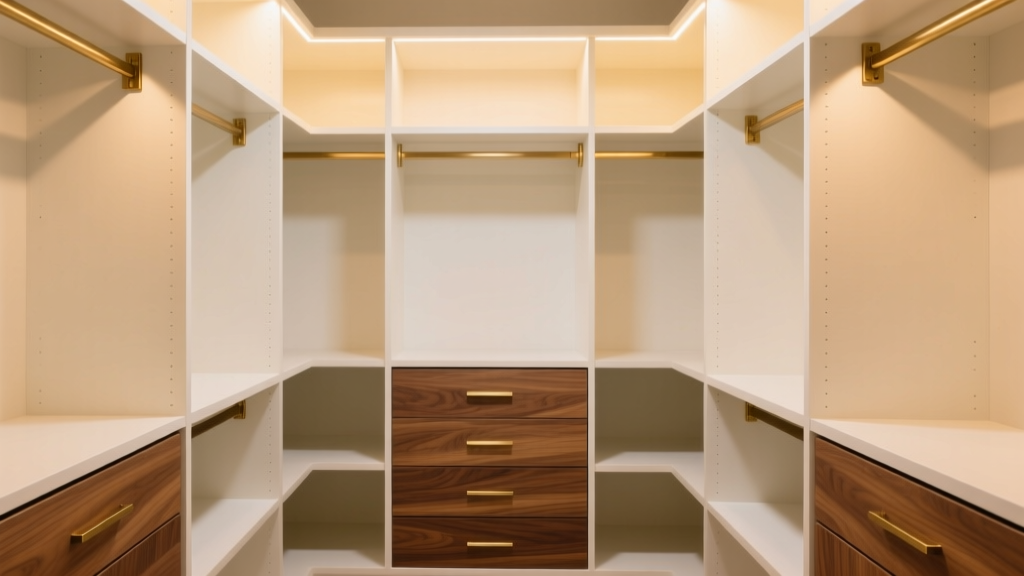
Core Substrates: Selecting the Right Panel Product
The cabinet boxes and shelving form the visual and functional bulk of the closet. Choosing the correct engineered wood product dictates the system's load capacity, moisture resistance, and finish quality. According to standards set by the Architectural Woodwork Institute, cabinetry substrates must be matched to their specific structural application to meet premium grade requirements.
| Material | Composition | Best Application | Limitations |
|---|---|---|---|
| Thermally Fused Melamine (TFL) | Particleboard core with resin-saturated decorative paper fused under heat/pressure. | Vertical cabinet partitions, drawer boxes, adjustable shelving. | Prone to chipping during cutting; heavy; susceptible to swelling if edges are exposed to water. |
| Medium Density Fiberboard (MDF) | Wood fibers bonded with synthetic resin under high heat and pressure. | Paint-grade shaker door fronts, decorative trim, baseboards. | Extremely poor sag resistance; cannot hold screws under tension; absorbs moisture rapidly. |
| Cabinet-Grade Plywood | Thin wood veneers (plies) glued with alternating grain directions (e.g., PureBond Birch). | Long horizontal shelving spans, structural cabinet boxes, heavy-duty island bases. | Higher material cost; requires edgebanding or solid wood face frames to hide plies. |
The Edgebanding Imperative
When using melamine or plywood, exposed edges must be sealed. For high-end closets, specify PUR (Polyurethane Reactive) hot melt adhesive edgebanding rather than standard EVA (Ethylene Vinyl Acetate). PUR creates a moisture-proof chemical bond that prevents the edgebanding from peeling off in humid environments, a critical factor detailed in APA - The Engineered Wood Association guidelines on panel moisture management.
The Sag Factor: Span Limits and Load Bearing
Shelf deflection (sagging) is the most common aesthetic and structural failure in closet design. The maximum unsupported span of a shelf depends entirely on the substrate thickness and the anticipated load. Heavy winter coats and stacked denim exert significantly more point-load pressure than folded t-shirts.
Maximum Span Guidelines for 3/4-Inch Materials
- Melamine (Particleboard Core): Maximum span of 24 to 28 inches for heavy clothing storage. Beyond 28 inches, the particleboard core will permanently bow under loads exceeding 20 lbs per linear foot.
- MDF: Maximum span of 18 to 20 inches. MDF should generally be avoided for horizontal shelving unless reinforced with a solid wood backer strip.
- Hardwood Plywood (e.g., 7-Ply Birch): Maximum span of 36 to 40 inches. The cross-banded veneer layers provide superior tensile strength, allowing for wider, cleaner visual spans without center supports.
If your walk-in closet shares an unventilated wall with a master bathroom, avoid MDF entirely. The ambient humidity fluctuations will cause MDF to swell and degrade the paint finish within 12 to 18 months. Use moisture-resistant (MR) MDF or exterior-grade plywood for door fronts in these specific zones, and ensure the closet has a dedicated return air vent to equalize humidity.
Hardware: Tracks, Hinges, and Suspension Systems
Hardware represents less than 10% of the material cost but dictates 90% of the user experience. Cheap hinges and tracks will fail long before the wood substrates degrade.
Hinges and Drawer Slides
For overlay doors, specify the Blum CLIP top 38N series with integrated BLUMOTION soft-close. These hinges are rated for 200,000 cycles and feature a 3-way cam adjustment that allows for micro-alignment after the house settles. For drawers, undermount soft-close slides (like the Blum TANDEM series) are mandatory for premium builds; they support up to 100 lbs and keep the drawer box interior fully accessible, unlike side-mount ball-bearing slides that consume 1/2 inch of interior width on each side.
Hanging Rods and Brackets
Ditch the standard 1-1/4 inch wooden dowels. Upgrade to 1-5/16 inch oval aluminum or brushed steel rods. The oval profile prevents hangers from sliding and bunching together. For high shelves (above 80 inches), integrate pull-down wardrobe lifts, such as the Rev-A-Shelf heavy-duty pneumatic series, which safely lower garments to eye level with a 15-pound assist mechanism.
2026 Material Cost Matrix
Budgeting for a custom closet requires understanding the baseline material costs. The following matrix reflects average wholesale and retail pricing for premium-grade closet building materials as of early 2026. Prices are based on standard 4x8 foot sheets for panels and per-unit pricing for hardware.
| Material Category | Specific Product / Grade | Estimated 2026 Cost | Cost Impact on Total Build |
|---|---|---|---|
| Melamine Panel (4x8) | 3/4" White TFL, 2-sided | $55 - $75 / sheet | Baseline (1x) |
| Plywood Panel (4x8) | 3/4" PureBond Birch, Cabinet Grade | $105 - $135 / sheet | 1.8x Baseline |
| Edgebanding | Pre-glued PVC vs. PUR applied | $0.40 vs $1.20 / linear ft | Minor (+3% total) |
| Hinges | Blum CLIP top BLUMOTION | $6.50 - $8.00 / pair | Minor (+5% total) |
| Drawer Slides | Undermount Soft-Close (15"-21") | $28 - $45 / pair | Moderate (+12% total) |
| Oval Hang Rod | Anodized Aluminum, 1-5/16" | $12 - $18 / linear ft | Minor (+4% total) |
Troubleshooting Common Material Failures
Even with premium closet building materials, improper fabrication and installation techniques will compromise the system. Recognize these failure modes before they occur:
1. Edgebanding Delamination
Symptom: PVC edge tape peeling away from melamine shelves near the floor or in humid areas.
Cause: Use of standard EVA hot melt glue, which reactivates and loses adhesion when exposed to high heat or moisture.
Fix: Specify PUR edgebanding from your cabinet fabricator. PUR cures via a chemical reaction with ambient moisture, creating a permanent, waterproof bond that cannot be reactivated by heat.
2. Drawer Box Racking
Symptom: Drawers bind, stick, or fail to close evenly after a few months of use.
Cause: Drawer boxes constructed with stapled melamine or butt-jointed MDF lack diagonal rigidity. When loaded heavily, the box twists (racks), throwing the undermount slides out of alignment.
Fix: Use 5/8-inch solid hardwood (like poplar or maple) with blind dovetail or dowel joinery for drawer boxes. If using melamine for cost savings, ensure the bottom panel is fully captured in a routed groove and glued, which provides essential shear strength to prevent racking.
3. Shelf Cleat Pull-Out
Symptom: Adjustable shelf pins or fixed cleats tearing out of the vertical side panels.
Cause: Drilling shelf pin holes too close to the edge of particleboard melamine, or using standard 5mm metal pins in unsupported particleboard.
Fix: Maintain a minimum 3/4-inch margin from the front and back edges when drilling 5mm holes. For heavy-load shelves, upgrade to 7mm metal shelf supports with a wide spoon-style base that distributes the point load across a larger surface area of the substrate.
Written by
James ThorntonJames Thornton is a construction industry veteran with 25 years of hands-on experience in wood framing, lumber grading, and residential building codes. He started as a framing carpenter in rural Oregon, earned his ICC Residential Building Inspector certification, and eventually became a senior plan reviewer for the City of Portland Bureau of Development Services. James holds a B.S. in Wood Science & Technology from Oregon State University and is a certified lumber grader through the West Coast Lumber Inspection Bureau (WCLIB). He has inspected over 3,000 residential construction sites and authored the city's internal guide on advanced framing techniques (2x6 at 24" O.C.). James lives in Bend, OR, where he builds custom timber-frame cabins and competes in lumberjack sports.
More from James Thornton
View all
Insulation
Best Home Insulation Materials: Complete 2026 Guide
Compare top home insulation materials for 2026. Find R-values, installed costs per square foot, and best uses for fiberglass, spray foam, and mineral wool.
Aug 4, 2026

Sustainable Building
Certify Your Green Building Material for LEED and WELL
Step-by-step guide to certifying a green building material for LEED v5 and WELL v2. Master EPDs, HPDs, and VOC limits for 2026 project specifications.
Aug 4, 2026

Stone & Masonry
Veneer Stacked Stone Panels: Interior Design & Style Showcase
Discover how veneer stacked stone panels transform interiors. Explore modern design profiles, material pairings, and technical installation specs.
Aug 4, 2026