Top Alternative House Building Materials Trending in 2026
Explore the top alternative house building materials trending in 2026, including hempcrete, CLT, and mycelium, with costs, R-values, and code compliance.

The 2026 Shift: Embodied Carbon and Material Innovation
The residential construction sector in 2026 is defined by stringent embodied carbon regulations and a severe shortage of skilled framing labor. Builders and architects are actively pivoting away from traditional concrete and dimensional lumber toward alternative house building materials that offer carbon sequestration, rapid assembly, and superior thermal performance. According to the U.S. Environmental Protection Agency (EPA), the built environment is responsible for nearly 40% of global greenhouse gas emissions, with a significant portion tied to the manufacturing of conventional building materials. This has accelerated the adoption of bio-based and mass-timber systems that not only meet modern energy codes but actively store carbon.
Hempcrete and Pre-Cast Hemp Blocks
Hempcrete—a biocomposite of hemp hurd, a lime-based binder, and water—has transitioned from a niche experimental material to a codified wall system. While traditional cast-in-place hempcrete requires extensive formwork and up to six months to cure and dry sufficiently for interior finishes, the 2026 market is dominated by pre-cast hempcrete blocks and HempWool batt insulation.
Technical Specifications and R-Values
- Cast-in-Place Hempcrete: Typically mixed at a 1:4 or 1:5 binder-to-hemp ratio by volume. A standard 12-inch thick wall yields an R-value between R-30 and R-42 (approximately R-2.5 to R-3.5 per inch). It provides exceptional thermal mass and moisture buffering but lacks the compressive strength for load-bearing applications in multi-story builds.
- Pre-Cast Blocks: Companies like Hempitecture now offer standardized, kiln-dried pre-cast blocks that eliminate the on-site curing bottleneck. These blocks are laid using a specialized lime mortar, reducing wall assembly time by 60% compared to cast-in-place methods.
- HempWool Batts: For conventional timber-framed homes seeking alternative insulation, HempWool provides R-3.7 per inch. It is vapor-permeable, highly resistant to mold, and naturally deters pests without chemical treatments.
Cross-Laminated Timber (CLT) for Residential Scale
Once reserved for large commercial projects, Cross-Laminated Timber (CLT) has scaled down to the luxury and custom residential market. CLT panels consist of alternating layers of kiln-dried lumber glued at 90-degree angles, creating massive, structurally rigid panels that serve as walls, floors, and roofs simultaneously.
According to WoodWorks, modern CLT manufacturing has standardized panel grades and fire ratings, making it highly predictable for structural engineers. In 2026, a standard 5-ply CLT panel (6.875 inches thick) achieves a 2-hour fire resistance rating due to the predictable charring rate of mass timber (1.5 inches per hour), which protects the structural core.
CLT vs. Traditional Stick Framing Matrix
| Metric | 5-Ply CLT Panels | 2x6 Wood Stick Framing |
|---|---|---|
| Material Cost (2026) | $14.00 - $18.00 / sq ft | $6.50 - $9.00 / sq ft |
| Labor & Assembly Time | 3-5 days (crane assisted) | 2-3 weeks (manual framing) |
| Thermal Bridging | Low (massive continuous wood) | High (studs create thermal bridges) |
| Exterior Insulation Req. | Required (R-15 to R-25 continuous) | Cavity + continuous recommended |
Mycelium Composites: Insulation and Acoustics
Mycelium—the root structure of fungi—is being grown into agricultural waste substrates to create fully compostable, fire-resistant building materials. In 2026, mycelium is primarily utilized for interior acoustic panels and non-structural insulation boards rather than load-bearing walls.
Products like Ecovative’s MycoBoard offer an R-value of approximately R-3.8 per inch. More importantly, mycelium acoustic panels achieve Noise Reduction Coefficients (NRC) of 0.85 or higher, making them highly sought after for open-concept residential builds and home theaters. The material is naturally fire-retardant, meeting ASTM E84 Class A fire ratings without the use of formaldehyde or halogenated chemical treatments.
Stabilized Rammed Earth (SRE)
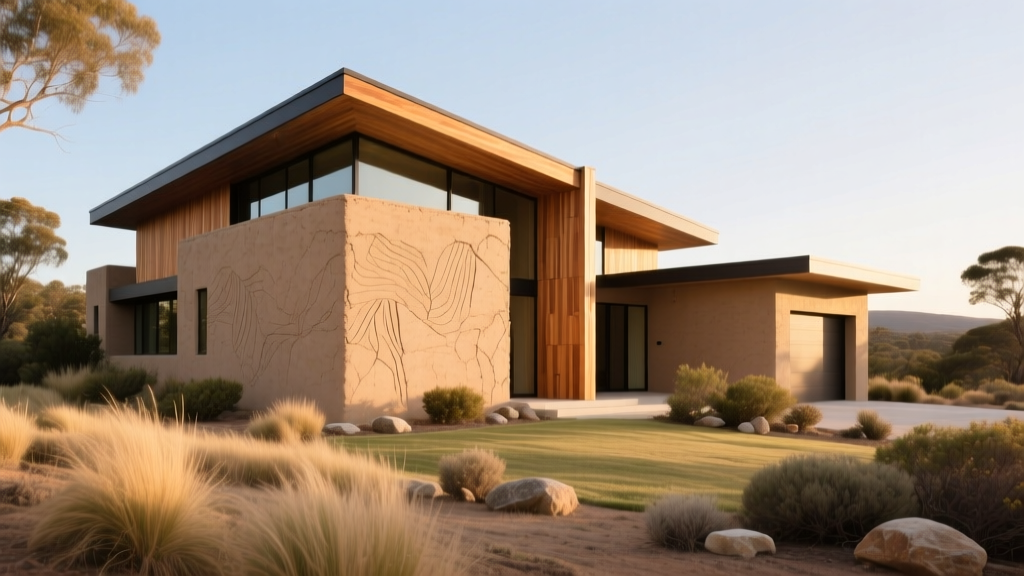
Modern rammed earth has evolved past its historical limitations. Stabilized Rammed Earth (SRE) incorporates 5% to 8% Portland cement or advanced geopolymer binders into the soil mix, dramatically increasing compressive strength to over 1,500 psi. This allows SRE walls to serve as load-bearing structures in seismic zones when paired with concealed reinforced concrete bond beams.
SRE walls are typically 18 to 24 inches thick. While their standalone R-value is low (roughly R-0.25 per inch), their immense thermal mass regulates indoor temperatures by absorbing solar gain during the day and releasing it at night. In passive solar designs in arid climates (like the US Southwest), SRE can reduce HVAC loads by up to 30%. To meet 2026 energy codes in colder climates, builders utilize an "insulated rammed earth" sandwich, placing a 4-inch layer of rigid mineral wool between two 8-inch layers of rammed earth.
Navigating Code Compliance and Zoning Hurdles
The primary barrier to adopting alternative house building materials remains local code enforcement. The International Building Code (IBC) and International Residential Code (IRC) do not have prescriptive pathways for every emerging material. When specifying hempcrete, mycelium, or advanced SRE, architects must rely on Section 104.11 of the IBC (Alternative Materials and Methods).
To secure approval from the local Authority Having Jurisdiction (AHJ), builders must provide an ICC-ES Evaluation Report (ESR). An ESR is an independent technical assessment proving the alternative material meets or exceeds the structural, fire, and energy performance of code-prescribed materials. Before purchasing alternative materials, always verify that the manufacturer holds a current, active ESR for your specific climate zone and seismic category.
2026 Procurement and Cost Framework
Budgeting for alternative materials requires looking beyond raw material costs to factor in specialized labor, crane rentals, and shipping. The table below outlines the estimated turnkey costs for residential applications in 2026.
| Material System | Turnkey Cost (Installed) | Lead Time (2026) | Best Application |
|---|---|---|---|
| Pre-Cast Hemp Blocks | $22 - $28 / sq ft (wall area) | 8 - 12 weeks | Exterior walls, high-humidity zones |
| 5-Ply CLT Panels | $35 - $45 / sq ft (floor area) | 12 - 16 weeks | Multi-story, exposed ceilings |
| Mycelium Acoustic Panels | $12 - $18 / sq ft | 4 - 6 weeks | Interior finishes, home theaters |
| Insulated Rammed Earth | $40 - $60 / sq ft (wall area) | On-site (labor dependent) | Passive solar, arid climates |
Choosing the right alternative house building materials in 2026 requires aligning the material's hygrothermal properties with your specific climate zone. While CLT offers unmatched speed and structural elegance, hempcrete and rammed earth provide unparalleled moisture regulation and thermal mass. Success relies on early engagement with structural engineers and local building officials to ensure seamless code approval and long-term durability.
Written by
Elena RodriguezElena Rodriguez is a civil engineer and technical writer specializing in concrete technology, masonry systems, and ASTM/ACI compliance. She earned her B.S. in Civil Engineering from Texas A&M University and spent a decade at a materials testing laboratory, performing over 2,000 concrete compressive strength tests and masonry prism evaluations. Elena is an ACI-certified Field Testing Technician (Grade I) and a member of ASTM Committee C12 on Natural Building Stone. She currently consults on forensic engineering cases involving concrete failures and moisture intrusion. Based in San Antonio, TX, Elena is a proud member of the Society of Women Engineers (SWE) and coaches her daughter's FIRST Robotics team.
More from Elena Rodriguez
View all
Walls & Panels
Cost Analysis: Light Gauge Steel Framing Advantages and Disadvantages
Evaluate light gauge steel framing advantages and disadvantages through a strict cost analysis lens, comparing material, labor, and lifecycle expenses.
Aug 4, 2026

Walls & Panels
Gypsum Board Types: Exact Specifications, Thickness & Dimensions
Compare standard, Type X, and moisture-resistant gypsum board types. Get exact specifications, thicknesses, dimensions, and ASTM standards for your project.
Aug 4, 2026

Fire Resistance
Best Fire-Resistant Outdoor Decking Materials: 2026 Buyer Guide
Discover the best fire-resistant outdoor decking materials for 2026. Compare Class A PVC, aluminum, and hardwood options for WUI compliance and safety.
Aug 4, 2026