Prime Building Materials Oxnard CA: Sourcing Guide & Stock Overview
Navigate the Oxnard, CA building materials market. Explore prime-grade lumber, coastal corrosion specs, and 2026 Ventura County pricing trends.

The Oxnard Material Matrix: Coastal, Seismic, and WUI Demands
Sourcing prime building materials in Oxnard, CA, requires navigating a unique intersection of environmental hazards and strict regulatory frameworks. Situated on the Pacific coast and bordering active agricultural and wildland zones, Oxnard projects must simultaneously satisfy California Building Code (CBC) Title 24 seismic mandates, coastal corrosion resistance standards, and Wildland-Urban Interface (WUI) fire regulations. General contractors and procurement managers operating in Ventura County cannot rely on baseline national material specifications; local microclimates dictate the required performance thresholds for structural and exterior components.
Lumber & Framing: Sourcing Prime-Grade Stock in Ventura County
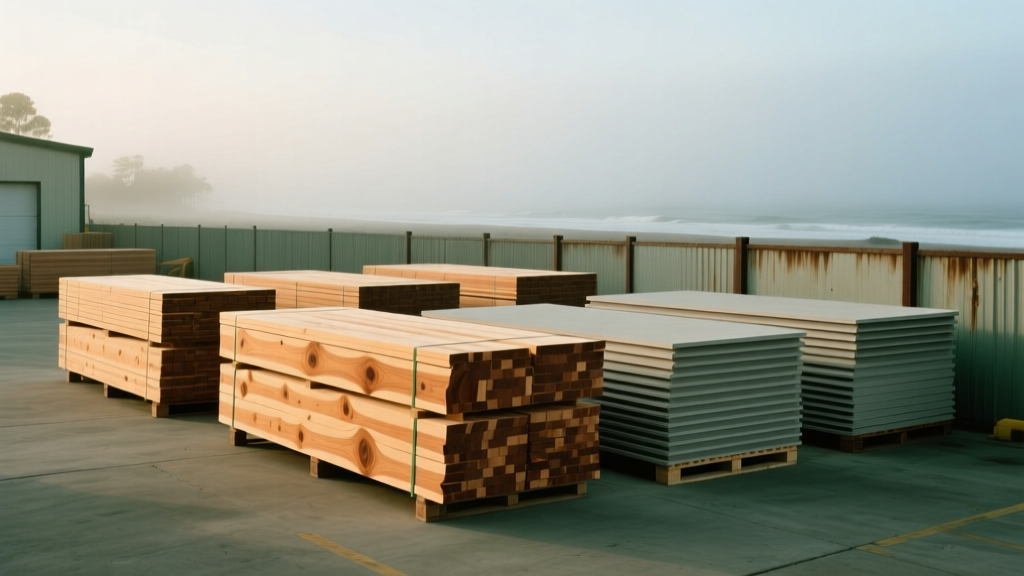
When specifying structural framing for Oxnard's multi-family and custom residential builds, the distinction between standard No. 2 grade and 'Prime' or Select Structural lumber is critical for shear wall design. Ventura County's high wind loads and seismic zone 4 classifications demand higher allowable stress design (ASD) values, which are only achievable with premium grades.
Douglas Fir-Larch (DF-L) Grade Comparison for Shear Walls
| Material Grade | Bending (Fb) PSI | Shear (Fv) PSI | Best Application |
|---|---|---|---|
| Select Structural (Prime) | 1,500 | 180 | High-load shear walls, engineered headers, coastal beam spans. |
| No. 1 Grade | 1,000 | 180 | Standard load-bearing walls, floor joists. |
| No. 2 Grade | 900 | 180 | Non-critical framing, interior partitions, blocking. |
According to the American Wood Council's National Design Specification (NDS), utilizing Select Structural lumber allows engineers to reduce the total number of studs or hold-downs in a shear wall assembly, offsetting the higher upfront material cost with reduced labor and hardware expenses. For Oxnard builds, always specify borate-treated (SBX) DF-L for the bottom plates to mitigate the region's persistent subterranean termite threat.
Exterior Cladding & Fasteners: Beating the Pacific Salt Air
The marine layer that defines Oxnard's climate is highly corrosive to exterior building envelopes. Material overviews for this region must prioritize ignition-resistant and moisture-impervious cladding systems.
Fiber Cement vs. Engineered Wood in Coastal Zones
- Fiber Cement (e.g., James Hardie HardiePlank): The dominant choice for Oxnard exteriors. It offers a Class A fire rating (mandatory for WUI zones near the Oxnard Plain agricultural edges) and is impervious to salt spray degradation. Installation Note: All cut edges must be field-primed with a 100% acrylic exterior primer within 24 hours to prevent moisture wicking into the cementitious core.
- Engineered Wood Siding (e.g., LP SmartSide): Treated with zinc borate for termite and fungal resistance. While cost-effective and faster to install, it requires strict adherence to the manufacturer's 3/8-inch minimum clearance from roofing and hardscapes. In heavy marine fog zones, the bottom edge sealant is prone to micro-cracking, making it a secondary choice compared to fiber cement for oceanfront properties.
Concrete & Masonry: Meeting California Seismic and Soil Standards
Oxnard's soil composition varies drastically from sandy loam near the coast to expansive, alkaline clays further inland. A standard 3,000 PSI concrete mix is insufficient for long-term foundation integrity in these conditions.
For foundations in Oxnard's inland agricultural and residential expansion zones (such as RiverPark), specify a minimum 4,000 PSI mix utilizing Type V Portland cement. Type V is specifically formulated to resist sulfate attack, which is prevalent in the region's clay-heavy soils. Furthermore, all continuous footings must incorporate a minimum of two #5 (5/8-inch) Grade 60 continuous rebar top and bottom, tied with #3 stirrups at 16-inch centers, to satisfy the California Building Standards Commission seismic detailing requirements.
Local Sourcing Logistics & 2026 Pricing Trends
Procurement strategies in Oxnard are heavily influenced by the Port of Hueneme. As a major entry point for imported cement, specialty steel, and roofing materials, local supply yards benefit from reduced overland freight costs for bulk commodities, though specialized prime-grade lumber still incurs standard Pacific Northwest transit premiums.
| Material Category | 2026 Oxnard Market Avg. Cost | Supply Chain Notes |
|---|---|---|
| Select Structural 2x6 DF-L | $3.85 - $4.40 / LF | High demand for seismic shear walls; 3-week lead times common. |
| Type V Sulfate-Resistant Concrete | $195 - $225 / CY | Local batch plants charge a 15% premium for Type V cement. |
| 316 Stainless Steel Framing Anchors | $18.00 - $35.00 / ea | Rarely stocked locally; requires special order via regional distributors. |
| Class A Fire-Rated Asphalt Shingles | $145 - $180 / sq | Readily available; WUI compliance mandatory for perimeter builds. |
Permitting & Code Compliance Checklist
Before finalizing material submittals for the Ventura County RMA Building and Safety Division or the City of Oxnard Community Development Department, verify the following material-specific documentation:
- WUI Product Listing: Ensure all exterior siding, roofing, and decking materials possess a current California State Fire Marshal (SFM) WUI approval number. Standard national fire ratings are not accepted in lieu of SFM listing.
- Corrosion Protection Certificates: Provide manufacturer data sheets proving fastener and hardware coatings meet CBC Table 31A-11A requirements for the specific site's distance from the ocean.
- Lumber Grade Stamps: Confirm that all structural timber delivered to the site bears a legible, ink-stamped grade mark from an approved grading agency (e.g., WWPA, SPIB). Painted or unmarked lumber will be red-tagged by the local inspector.
- Concrete Mix Design Submittal: Submit the batch plant's specific mix design, highlighting the water-to-cement ratio (maximum 0.45 for foundations) and sulfate-resistance additive documentation prior to the pre-pour inspection.
By aligning material procurement with Oxnard's specific environmental and regulatory realities, project managers can prevent costly change orders, avoid inspection failures, and ensure the structural longevity of the built environment.
Written by
James ThorntonJames Thornton is a construction industry veteran with 25 years of hands-on experience in wood framing, lumber grading, and residential building codes. He started as a framing carpenter in rural Oregon, earned his ICC Residential Building Inspector certification, and eventually became a senior plan reviewer for the City of Portland Bureau of Development Services. James holds a B.S. in Wood Science & Technology from Oregon State University and is a certified lumber grader through the West Coast Lumber Inspection Bureau (WCLIB). He has inspected over 3,000 residential construction sites and authored the city's internal guide on advanced framing techniques (2x6 at 24" O.C.). James lives in Bend, OR, where he builds custom timber-frame cabins and competes in lumberjack sports.
More from James Thornton
View all
Insulation
Best Home Insulation Materials: Complete 2026 Guide
Compare top home insulation materials for 2026. Find R-values, installed costs per square foot, and best uses for fiberglass, spray foam, and mineral wool.
Aug 4, 2026

Sustainable Building
Certify Your Green Building Material for LEED and WELL
Step-by-step guide to certifying a green building material for LEED v5 and WELL v2. Master EPDs, HPDs, and VOC limits for 2026 project specifications.
Aug 4, 2026

Stone & Masonry
Veneer Stacked Stone Panels: Interior Design & Style Showcase
Discover how veneer stacked stone panels transform interiors. Explore modern design profiles, material pairings, and technical installation specs.
Aug 4, 2026