Building Materials Skyrim ID vs Real-World BIM Catalogs: 2026 Trends
Discover how the search for a building materials Skyrim ID highlights 2026 trends in BIM catalogs, digital material passports, and ConTech visualization.

The 'Skyrim ID' Phenomenon: What Gamers and Builders Share
Search volume for the phrase building materials skyrim id spikes periodically as gamers revisit the Hearthfire DLC to build virtual estates. By typing a simple console command like player.additem 0300306C 100, a player instantly spawns 100 units of Quarried Stone, bypassing the tedious labor of mining. While gamers rely on simple 8-character hexadecimal strings to manage virtual resources, the real-world construction industry in 2026 is solving a far more complex version of this exact problem: how to uniquely identify, track, and visualize millions of physical building materials across fragmented global supply chains.
The underlying desire is identical. A gamer wants instant, error-free material spawning to build a virtual manor. A modern General Contractor (GC) wants instant, error-free material procurement and visualization to build a 40-story commercial high-rise. The gap between a game's simple item ID and the construction industry's sprawling data ecosystem highlights the most critical ConTech (Construction Technology) trends of 2026.
The 2026 Shift: From Hex Codes to Digital Material Passports
In a game engine, an ID points to a single, unchanging 3D mesh and texture. In reality, a single piece of 5/8-inch Type X fire-rated gypsum board carries a manufacturer SKU, a UPC barcode, an OmniClass classification, a volatile pricing index, and an Environmental Product Declaration (EPD) ID. Relying on generic 'Gypsum Board' tags in Building Information Modeling (BIM) software leads to catastrophic procurement mismatches.
To solve this, the industry has fully embraced Digital Product Passports (DPPs). Driven by the EU's Ecodesign for Sustainable Products Regulation (ESPR) and adopted globally by multinational firms, DPPs assign a dynamic, scannable digital twin to every physical building material.
The Cost of the 'Generic Material' Trap
According to 2026 supply chain audits, misidentified materials in BIM models cause an average of $14,200 per week in delay penalties on mid-sized commercial projects. When a model specifies a generic 'Acoustic Ceiling Tile' rather than the exact ETIM-classified product ID, procurement teams frequently order incompatible grid systems, resulting in 12-18 day RFI (Request for Information) delays and costly tear-outs.
Game Engines Meet Job Sites: Unreal Engine and Twinmotion
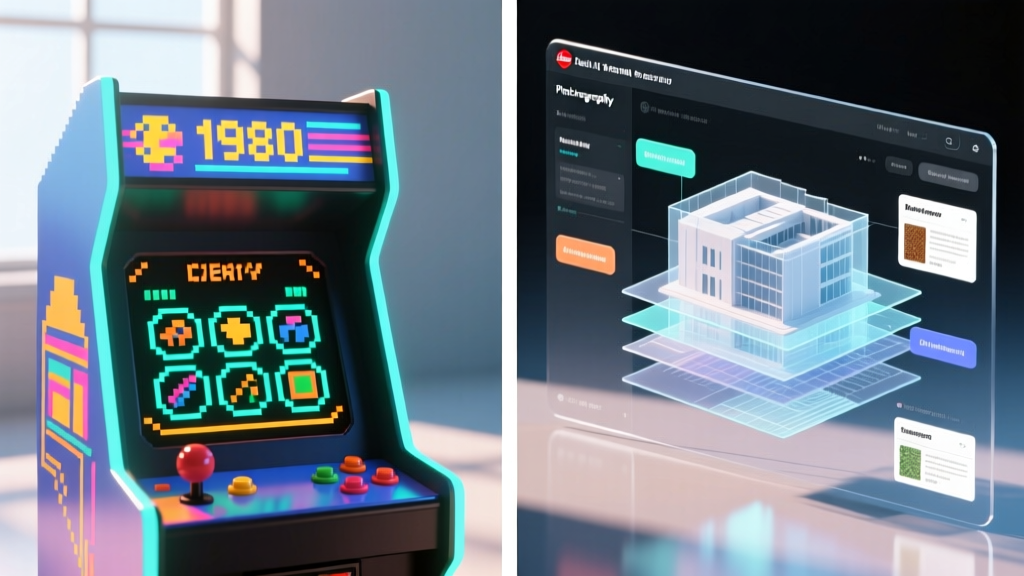
The most direct bridge between video game mechanics and real-world construction is the adoption of game engines for architectural visualization and digital twin management. Software like Twinmotion and Unreal Engine 5 are no longer just for making pretty renderings; they are active project management environments.
Mapping PBR Textures to Real-World SKUs
In 2026, advanced GCs link Physically Based Rendering (PBR) materials directly to live procurement databases. When an architect swaps a generic 'wood' texture for a specific Thermory Ash Decking PBR material in the visualization engine, the underlying material ID triggers an automated API call to the supplier's inventory system. If the supplier is out of stock, the material in the 3D model literally turns red, alerting the project manager to a supply chain bottleneck before ground is even broken.
Classification Frameworks: The Real-World 'Item IDs'
Unlike the centralized codebase of a video game, the construction industry relies on several competing and complementary classification systems to generate material IDs. Understanding which framework to use is critical for BIM managers and procurement officers.
| Standard | Governing Body | Primary Use Case | Example ID Format |
|---|---|---|---|
| OmniClass | CSI (Construction Specifications Institute) | North American BIM tagging, cost estimation, and facility management. | 23-15 11 13 (Portland Cement) |
| ETIM | ETIM International | Technical product data, MEP (Mechanical, Electrical, Plumbing) specifications. | EC000812 (Specific Cement Type) |
| UNSPSC | GS1 | Global procurement, e-procurement platforms, and supply chain analytics. | 30111500 (Concrete) |
| IFC | buildingSMART | OpenBIM interoperability, cross-software data exchange (Revit to ArchiCAD). | IfcBuildingElementProxy |
Actionable Steps for 2026 BIM Implementation
To transition your firm from relying on 'generic' material tags to a robust, game-engine-ready digital catalog, follow this implementation protocol:
- Audit Your Revit/BIM Families: Run a Dynamo script to extract all material parameters. Flag any material that lacks an OmniClass Table 23 (Products) or ETIM classification code.
- Establish a Master Data Management (MDM) Hub: Do not let individual modelers create custom materials. Route all new material requests through a centralized MDM database that automatically assigns the correct UNSPSC procurement code and links the EPD (Environmental Product Declaration) for LEED/BREEAM compliance.
- Integrate with Visualization Engines: Map your MDM material IDs to Twinmotion or Unreal Engine PBR libraries. Ensure that when a client walks through a VR headset, the 'Oak Flooring' they see is mapped to the exact SKU your procurement team is pricing.
- Enforce DPP Compliance on Subcontractors: Update your 2026 subcontractor agreements to require Digital Product Passports for all structural steel, MEP equipment, and facade materials delivered to the site, enabling instant QR-code verification upon delivery.
FAQ: Digital Material Tracking
Can I use a manufacturer's SKU instead of an OmniClass ID?
No. Manufacturer SKUs are proprietary and change frequently. OmniClass or ETIM IDs provide a standardized, software-agnostic taxonomy that ensures your BIM model remains readable and actionable even if the original manufacturer goes out of business or changes their product line.
How do Digital Material Passports affect demolition and salvage?
DPPs are revolutionizing the circular economy. By 2026, demolition contractors use DPPs to scan structural elements, instantly revealing the material composition, load-bearing history, and recycling instructions, turning demolished buildings into precise 'material banks' rather than landfills.
Written by
Priya KapoorPriya Kapoor is a real estate market analyst and construction economics researcher with expertise in housing affordability, development feasibility, and infrastructure investment. She holds a Master of Regional Planning from Cornell University and previously worked as a senior analyst at CBRE's Investment Properties group, where she modeled returns for $4B in mixed-use development pipelines. Priya now runs an independent research practice advising developers, municipalities, and REITs on construction cost forecasting and market timing. She publishes the quarterly "BuildMat Market Pulse" report tracking material price indices across 12 commodity categories. Based in Austin, TX, Priya serves on the board of Habitat for Humanity Austin and is a marathon runner.
More from Priya Kapoor
View all
Construction Cost
Cost to Build a 1600 Sq Ft Home in 2026: Full Breakdown
Accurate 2026 cost to build a 1600 sq ft home—material, labor, and regional pricing breakdowns included. Plan your budget with real-time estimates.
Aug 11, 2026

Wood & Lumber
Name the Types of Wood for Pressure Treatment and Preservation
Learn how to name the types of wood best suited for pressure treatment. Compare species treatability, chemical retention levels, and 2026 preservation costs.
Aug 4, 2026

Stone & Masonry
Stone Veneer Suppliers Lindenhurst: 2026 Cost Analysis
Analyze 2026 stone veneer costs in Lindenhurst, NY. Compare local supplier pricing, delivery fees, and Suffolk County installation labor rates.
Aug 4, 2026