El Don Building Materials: Masonry & Hardscape Sourcing Guide
Explore El Don building materials for masonry and hardscape projects. Learn specs, pricing, and sourcing strategies for contractors and builders.

Strategic Sourcing from Specialized Regional Yards
When engineering commercial retaining walls or specifying high-end residential hardscapes, generalist lumber yards often fall short on technical depth and inventory scale. Specialized distributors like El Don Building Materials bridge this gap by focusing heavily on the "heavy side" of construction: masonry, segmental retaining wall (SRW) systems, natural and manufactured stone veneers, and structural aggregates. For general contractors and landscape architects, understanding the exact specifications, lead times, and pricing structures of these specialized suppliers is critical for accurate 2026 project bidding.
This overview dissects the core material categories typically stocked by specialized regional suppliers, providing the technical thresholds, ASTM compliance metrics, and logistical frameworks required to procure heavy building materials efficiently.
Core Product Categories and Technical Specifications
Sourcing from a dedicated masonry and hardscape distributor requires familiarity with the specific product lines they move in high volume. Below is a breakdown of the primary material categories and the engineering specs you must verify before issuing a purchase order.
Segmental Retaining Wall (SRW) Blocks
SRW systems rely on dry-stacked, modular concrete units. When procuring SRW blocks, you must differentiate between pin-based systems (which use fiberglass or polymer pins for shear connection) and lip-based systems (which rely on a cast-in-place rear lip). According to the National Concrete Masonry Association (NCMA), all commercial-grade SRW units must meet strict durability and strength thresholds to prevent blowouts under high lateral earth pressure.
- Compressive Strength: Minimum 3,500 psi for commercial applications; 2,500 psi is acceptable for residential walls under 4 feet.
- Absorption Rate: Must not exceed 12% to ensure freeze-thaw durability in northern climates.
- Face Dimension Tolerance: Variations greater than 1/8 inch can cause batter inconsistencies and structural misalignment.
Manufactured and Natural Stone Veneers
Stone veneers are non-load-bearing cladding materials. Manufactured stone masonry veneer (MSMV) is cast from Portland cement, lightweight aggregates, and iron oxide pigments, offering a weight advantage over natural stone. Natural stone veneer, typically sliced to a 1-inch to 2-inch thickness, provides authentic geological variation but requires heavier structural backing.
- Weight Load: MSMV typically weighs 10 to 12 lbs per square foot. Natural stone ranges from 15 to 25 lbs per square foot. Framing and sheathing must be engineered to support the dead load plus a safety factor for seismic shear.
- Flexural Strength: Adherence to ASTM C1670 requires manufactured units to withstand rigorous freeze-thaw cycling without spalling or delaminating.
Bulk Aggregates and Base Materials
No hardscape or masonry project succeeds without a properly compacted sub-base. Specialized yards supply bulk aggregates by the ton, categorized by their gradation and California Bearing Ratio (CBR).
- Class II Road Base: A mix of crushed rock and fines (dust) that locks together when compacted. Ideal for paver bases and driveway subgrades. Requires a minimum 95% Standard Proctor density.
- 3/4-Inch Minus Crushed Rock: Used for drainage layers behind retaining walls to prevent hydrostatic pressure buildup.
- Decomposed Granite (DG): Used for permeable pathways. Stabilized DG (mixed with a polymer binder) is required for high-traffic commercial walkways to prevent rutting.
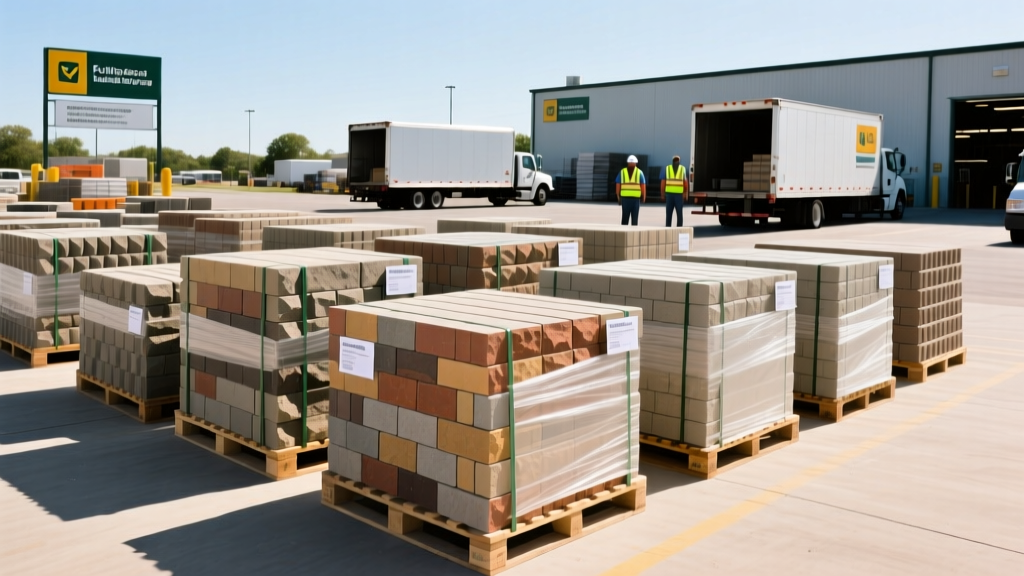
Always order manufactured stone veneer in palletized, factory-banded quantities rather than loose bins. Factory banding ensures color-blend consistency across the batch and reduces edge-chipping during forklift offloading by up to 14%.
2026 Material Specifications and Pricing Matrix
Pricing for heavy building materials fluctuates based on cement indices, diesel fuel surcharges, and regional quarry output. The table below outlines estimated 2026 contractor pricing for core materials sourced from specialized regional distributors.
| Material Category | Specific Product Type | Unit of Measure | Est. 2026 Cost | Governing Standard |
|---|---|---|---|---|
| SRW Blocks | Commercial Pin-Based (6-inch) | Per Sq. Ft. of Face | $6.50 - $8.20 | ASTM C1372 |
| Stone Veneer | Manufactured Ledge Stone | Per Sq. Ft. | $4.10 - $5.80 | ASTM C1670 |
| Stone Veneer | Natural Quartzite (1.5" thick) | Per Sq. Ft. | $9.00 - $14.50 | ASTM C616 |
| Bulk Aggregate | Class II Road Base | Per Ton | $38.00 - $45.00 | Caltrans / DOT Specs |
| Drainage Rock | 3/4" Minus Clean Crushed | Per Ton | $42.00 - $55.00 | ASTM D448 |
| Mortar / Grout | Type S Masonry Cement (Bag) | Per 80-lb Bag | $11.50 - $14.00 | ASTM C91 |
Logistics, Payload Limits, and Delivery Framework
The most frequent point of failure in heavy material procurement is miscalculating delivery logistics. Masonry and hardscape materials are exceptionally dense, meaning weight limits are reached long before volume limits on standard transport vehicles.
Flatbed vs. Moffett Delivery
Standard flatbed trailers max out at a payload of approximately 44,000 lbs. Because a single pallet of SRW blocks weighs between 2,100 and 2,400 lbs, a single truckload can only carry 18 to 20 pallets. If your project requires 40 pallets, you must schedule two separate drops or negotiate a staggered delivery schedule to avoid paying demurrage fees for trucks waiting on-site.
For sites lacking a heavy-duty forklift, you must specify a Moffett (truck-mounted forklift) delivery. Moffett units can offload pallets directly onto uneven terrain or over curbs, but they carry a 15% to 20% premium on the freight rate and require a minimum 12-foot width clearance for the offloading maneuver.
When ordering bulk aggregates like Class II base or masonry sand during wet seasons, verify the moisture content upon delivery. Aggregates with a moisture content exceeding 7% will skew your weight-to-volume calculations, meaning you are paying freight costs for water. Require your batch plant to provide a moisture-discount ticket for any material delivered after heavy rainfall.
Quality Assurance and ASTM Compliance Verification
Reputable distributors align their inventory with The Masonry Society guidelines and ASTM International standards. However, the burden of QA ultimately falls on the general contractor. Upon delivery, site superintendents should perform the following checks:
- Visual Spalling Check: Inspect the bottom layer of SRW pallets. If blocks show micro-fractures or spalled edges, they were likely dropped during yard loading and will compromise the aesthetic face of the retaining wall.
- Veneer Color Blending: Open a minimum of three different boxes of manufactured stone veneer and dry-stack a 4x4 foot test section. This confirms the manufacturer's color-blend ratio matches the architectural renderings.
- Aggregate Gradation Test: For large commercial base orders, pull a random sample and run a sieve analysis to ensure the supplier hasn't substituted 3/4-inch minus with cheaper, oversized 1.5-inch drain rock.
Frequently Asked Questions
Can El Don Building Materials or similar yards custom-match historical masonry?
Most specialized yards do not manufacture custom masonry on-site, but they act as liaisons to regional kilns and cast-stone fabricators. If you need a custom color match for a historical restoration, expect a minimum lead time of 6 to 8 weeks and a minimum order quantity (MOQ) of 500 square feet for manufactured runs.
How far in advance should I schedule delivery for large retaining wall projects?
For walls exceeding 2,000 square feet of face area, lock in your inventory 45 days prior to the scheduled start date. SRW blocks are highly susceptible to regional allocation shortages during the spring and summer peak construction seasons.
What is the standard breakage allowance for natural stone veneer?
Industry standard dictates a 5% to 8% waste and breakage factor for natural stone veneer due to the irregular cutting required on-site. When calculating your square footage takeoff, always multiply your net wall area by 1.08 before submitting your PO to the supplier.
Written by
James ThorntonJames Thornton is a construction industry veteran with 25 years of hands-on experience in wood framing, lumber grading, and residential building codes. He started as a framing carpenter in rural Oregon, earned his ICC Residential Building Inspector certification, and eventually became a senior plan reviewer for the City of Portland Bureau of Development Services. James holds a B.S. in Wood Science & Technology from Oregon State University and is a certified lumber grader through the West Coast Lumber Inspection Bureau (WCLIB). He has inspected over 3,000 residential construction sites and authored the city's internal guide on advanced framing techniques (2x6 at 24" O.C.). James lives in Bend, OR, where he builds custom timber-frame cabins and competes in lumberjack sports.
More from James Thornton
View all
Insulation
Best Home Insulation Materials: Complete 2026 Guide
Compare top home insulation materials for 2026. Find R-values, installed costs per square foot, and best uses for fiberglass, spray foam, and mineral wool.
Aug 4, 2026

Sustainable Building
Certify Your Green Building Material for LEED and WELL
Step-by-step guide to certifying a green building material for LEED v5 and WELL v2. Master EPDs, HPDs, and VOC limits for 2026 project specifications.
Aug 4, 2026

Stone & Masonry
Veneer Stacked Stone Panels: Interior Design & Style Showcase
Discover how veneer stacked stone panels transform interiors. Explore modern design profiles, material pairings, and technical installation specs.
Aug 4, 2026