EPS Building Material: A Comprehensive Guide to Types and Uses
Master EPS building material selection with our comprehensive guide. Compare ASTM types, R-values, structural applications, and 2026 pricing data.

The Technical Foundation of Expanded Polystyrene (EPS)
Expanded Polystyrene (EPS) is a rigid, closed-cell foam plastic manufactured by expanding polystyrene beads using steam and a blowing agent—typically pentane. Unlike extruded polystyrene (XPS) or polyisocyanurate (polyiso), EPS building material is defined by its bead-fusion matrix, which creates a structure that is highly breathable, dimensionally stable, and immune to long-term thermal drift. According to the U.S. Department of Energy, EPS remains one of the most cost-effective and versatile rigid insulation materials available for both residential and commercial construction.
The defining characteristic of EPS is its permanent R-value. While XPS and polyiso rely on high-R-value chemical blowing agents that slowly diffuse out over decades (replaced by lower-R-value air), EPS uses pentane, which dissipates immediately after manufacturing. Consequently, the long-term thermal resistance (LTTR) of EPS is identical to its initial R-value—typically 3.6 to 4.0 per inch at 75°F. This lack of thermal drift makes EPS highly predictable for energy modeling and lifecycle cost analysis.
Decoding ASTM C578: Density and Compressive Strength
Selecting the correct EPS building material requires understanding ASTM C578, the standard specification for rigid cellular polystyrene. The standard categorizes EPS into distinct types based on density (pounds per cubic foot, or pcf) and minimum compressive resistance (psi). Choosing the wrong type is a primary cause of structural failure in below-grade and roofing applications.
- Type I (1.0 pcf, 10 psi): Standard wall insulation, above-grade exterior sheathing, and non-load-bearing cavity fill.
- Type II (1.35 pcf, 13 psi): The industry workhorse. Used for Exterior Insulation and Finish Systems (EIFS), under-slab insulation for residential light-duty floors, and roof recovery boards.
- Type VIII (1.25 pcf, 16 psi): A mid-tier option often specified for commercial roofing where moderate foot traffic is expected during maintenance.
- Type IX (2.0 pcf, 25 psi): Heavy-duty applications. Required for below-grade foundations, plaza decks, commercial under-slab insulation, and structural geofoam.
Core Applications in Modern Construction
1. Below-Grade Foundation Insulation
EPS is highly effective for below-grade foundation walls and under-slab insulation. Its closed-cell structure resists water absorption, though it is slightly more permeable to moisture vapor than XPS. To mitigate this, modern below-grade EPS boards are often faced with a polymeric laminate or integrated into a dimpled drainage mat system. When installed below the frost line, Type II or Type IX EPS maintains its structural integrity and prevents thermal bridging through concrete footings.
2. Structural Geofoam (EPS-19, EPS-22, EPS-29)
In civil engineering, EPS building material is manufactured in massive blocks (up to 4x8x20 feet) known as geofoam. Weighing only 1.5 to 3.0 pcf (compared to soil at 110-120 pcf), geofoam is used to construct highway embankments over soft soils, bridge approach ramps, and stadium seating. EPS-29 (2.85 pcf, 40 psi) is the standard for heavy traffic load-bearing embankments, drastically reducing lateral earth pressure on retaining walls.
3. Insulated Concrete Forms (ICFs) and SIPs
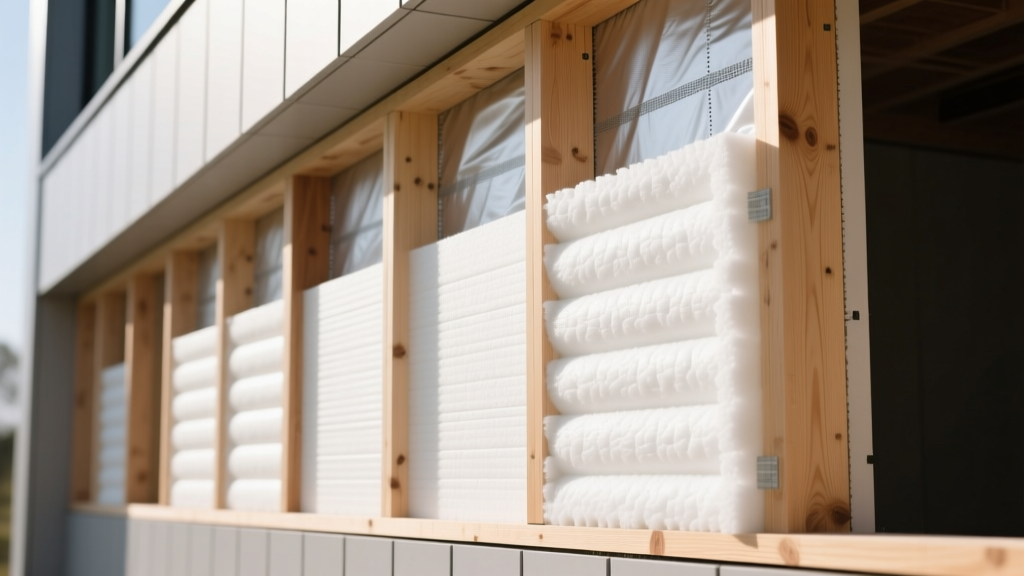
EPS is the core material for Insulated Concrete Forms (ICFs) and Structural Insulated Panels (SIPs). In ICFs, two layers of high-density EPS are tied together with plastic webs, allowing concrete to be poured into the center. This creates a wall assembly with an effective R-value of 23+ and immense thermal mass. For SIPs, thick EPS cores are laminated between oriented strand board (OSB), providing a high-strength, highly insulated envelope for roofs and walls.
Material Comparison Matrix: EPS vs. XPS vs. Polyiso
Understanding how EPS compares to other rigid foams is critical for specification. The following matrix highlights the technical trade-offs based on current industry standards and data from the British Plastics Federation (BPF).
| Property | EPS (Expanded) | XPS (Extruded) | Polyiso |
|---|---|---|---|
| Long-Term R-Value (per inch) | 3.85 (Permanent) | 5.0 dropping to ~4.5 | 6.5 dropping to ~5.6 |
| Compressive Strength | 10 - 60 psi | 15 - 100 psi | 16 - 25 psi |
| Water Absorption (Vol %) | 2.0% - 4.0% | 0.1% - 0.3% | 1.0% - 2.0% |
| Max Service Temp | 167°F (75°C) | 165°F (74°C) | 250°F (121°C) |
| Relative Cost (2026) | $ | $$ | $$$ |
2026 Pricing and Cost Breakdown
Material costs for EPS fluctuate based on petrochemical markets, but as of early 2026, regional pricing averages remain highly competitive compared to XPS and mineral wool. Below is a benchmark pricing guide for standard 4x8 foot boards and bulk geofoam:
- Type I (1-inch thick): $0.45 - $0.60 per square foot.
- Type II (2-inch thick): $1.10 - $1.45 per square foot (approx. $35 - $46 per 4x8 board).
- Type IX (2-inch thick, High Density): $1.80 - $2.30 per square foot.
- Tapered Roofing EPS (custom cut): $1.50 - $2.50 per square foot, depending on slope complexity.
- Geofoam Blocks (EPS 22): $3.80 - $5.20 per cubic foot (delivered in bulk for civil projects).
Critical Failure Modes and Installation Gotchas
Despite its versatility, EPS building material has specific chemical and environmental vulnerabilities that contractors must manage on the job site.
EPS is instantly destroyed by petroleum-based solvents. Acetone, toluene, xylene, and standard spray polyurethane foam (SPF) propellants will melt the foam into a sticky residue. Always use EPS-compatible adhesives (water-based or specifically formulated low-VOC foams) and ensure roofing membranes are installed with compatible asphalt temperatures or cold-applied adhesives.
UV Degradation
Ultraviolet light breaks down the surface of EPS, causing it to yellow and turn into a fine, brittle dust. If left exposed to direct sunlight, this degradation begins within 30 to 60 days. EPS must be covered with a protective barrier, stucco, EIFS, or UV-resistant tape within weeks of installation.
Termite and Pest Intrusion
Termites and carpenter ants do not eat EPS, but they will tunnel through it to reach wood and moisture. In termite-prone regions (like the US Southeast), building codes require EPS installed below grade to be treated with a borate-based termiticide during manufacturing, or protected by a physical stainless-steel mesh barrier at the foundation sill plate.
Sustainability and End-of-Life Management
The environmental profile of EPS has improved significantly over the last decade. Historically, EPS relied on HBCD (hexabromocyclododecane) as a flame retardant, which was phased out globally by the Stockholm Convention due to its toxicity and bioaccumulation. Modern EPS building material utilizes PolyFR (polymeric flame retardant), which is chemically bonded to the polymer chain, non-bioaccumulative, and environmentally stable.
Furthermore, EPS is 100% recyclable. Scrap generated during manufacturing and construction cut-offs is reground and re-incorporated into new boards. For demolition waste, the U.S. Environmental Protection Agency (EPA) notes that clean C&D EPS can be densified and recycled into picture frames, crown molding, and new construction plastics, diverting it from landfills where its low density otherwise consumes massive airspace.
Frequently Asked Questions (FAQ)
Can EPS be used in direct contact with the ground?
Yes, but only if specified correctly. Type II or Type IX EPS is approved for below-grade use. However, because EPS can absorb small amounts of moisture via capillary action through the bead boundaries, it should be installed on the exterior of the waterproofing membrane, or paired with a drainage mat to prevent hydrostatic pressure buildup.
Does EPS lose its R-value in cold temperatures?
No. In fact, like most insulation materials, the R-value of EPS slightly increases as the temperature drops. The 3.85 R-value per inch rating is measured at 75°F; at 40°F, the R-value can exceed 4.0 per inch, making it highly effective for cold-climate roof and wall assemblies.
Is EPS a vapor barrier?
No. EPS is a Class III vapor retarder (semi-permeable) at standard thicknesses. A 1-inch board has a perm rating of roughly 2.0 to 3.0. This breathability is actually an advantage in wall assemblies, as it allows incidental moisture to dry to the exterior, reducing the risk of mold and rot inside the wall cavity.
Written by
Marcus ChenMarcus Chen is a licensed structural engineer (PE) and building materials analyst with over 12 years of experience across residential, commercial, and industrial construction. He holds a Master of Science in Civil Engineering from UC Berkeley and spent six years at Thornton Tomasetti before transitioning to independent consulting and technical writing. Marcus specializes in material selection for seismic-prone regions, concrete reinforcement strategies, and lifecycle cost analysis. His work has been cited by the American Concrete Institute (ACI) and the Structural Engineers Association of California (SEAOC). When he is not on a job site or at his desk, you will find him hiking the Sierra Nevada or restoring a 1920s craftsman bungalow in Oakland, CA.
More from Marcus Chen
View all
Construction Cost
How Much Did the Eiffel Tower Cost to Build?
How much did the Eiffel Tower cost to build in 1889? We adjust for inflation and compare its budget to modern skyscraper construction.
Aug 4, 2026

Fire Resistance
What Is a Fire Resistant Material? Testing & Certification Guide
Discover what is a fire resistant material through ASTM and UL testing. Learn how fire ratings, certifications, and assemblies work in construction.
Aug 4, 2026

Construction Cost
How Much Did the Burj Khalifa Cost to Build?
How much did the Burj Khalifa cost to build? We break down the $1.5B project and extract 5 money-saving strategies for your next build.
Jul 30, 2026