European Building Materials Trends Reshaping Global Specs in 2026
Discover how 2026 European building materials trends, from bio-based insulations to low-carbon cements, are reshaping global construction specs.

The New Baseline: European Building Materials in Global Specs
Global construction procurement is undergoing a structural shift. Historically, specifying European building materials meant paying a premium for aesthetic finishes or niche architectural elements. In 2026, the value proposition has fundamentally changed. Driven by aggressive decarbonization mandates and circular economy frameworks, European manufacturing hubs are now exporting the baseline standards for low-carbon structural systems, advanced thermal envelopes, and next-generation binders. For international specifiers, general contractors, and developers, understanding these material trends is no longer optional—it is critical for meeting embodied carbon targets and navigating emerging carbon border taxes.
Mass Timber and Bio-Based Envelopes: Beyond the Pilot Phase
Cross-Laminated Timber (CLT) and Glued Laminated Timber (Glulam) have transitioned from experimental pilot projects to standard structural specifications in mid-rise commercial and multi-family residential builds. European manufacturers lead this sector not just in volume, but in precision engineering and adhesive chemistry.
Technical Specifications Driving Adoption
Unlike early-generation mass timber, current European exports adhere strictly to the EN 16351 standard, ensuring rigorous delamination testing and structural predictability. Leading producers like Stora Enso and Binderholz are now shipping 5-ply and 7-ply CLT panels with moisture contents tightly controlled at 12% (±2%), drastically reducing the on-site shrinkage and checking that plagued earlier North American mass timber projects.
- Adhesive Systems: A marked shift toward polyurethane (PUR) and melamine-urea-formaldehyde (MUF) adhesives that emit zero volatile organic compounds (VOCs) post-cure, securing superior indoor air quality certifications.
- Acoustic Integration: European CLT floor assemblies now routinely specify integrated elastomeric acoustic mats (e.g., Sylomer or Sylodyn) directly at the factory, achieving impact sound insulation (L'nT,w) below 45 dB without requiring secondary concrete toppings.
- Fire Performance: Through precise charring rate calculations (typically 0.65 mm/min for CLT), European-engineered mass timber assemblies routinely achieve REI 90 and REI 120 fire resistance ratings without the need for intumescent coatings or gypsum encapsulation.
The LC3 and Geopolymer Revolution in European Cement
The traditional Portland cement model, responsible for roughly 8% of global CO2 emissions, is being dismantled by European material science. The dominant trend in 2026 is the commercial scaling of Limestone Calcined Clay Cement (LC3), particularly the LC3-50 formulation.
LC3-50 reduces the clinker factor from the traditional 65-80% down to 50%, replacing the remainder with calcined clay and ground limestone. This specific chemical synergy reduces the embodied carbon of the binder by up to 40% while maintaining comparable 28-day compressive strength (typically 42.5 MPa to 52.5 MPa). Furthermore, European geopolymer concretes—utilizing alkali-activated fly ash and ground granulated blast-furnace slag (GGBFS)—are now being exported in pre-blended, just-add-water dry-mix formats for specialized precast applications, eliminating the batch-plant variability that previously hindered geopolymer adoption.
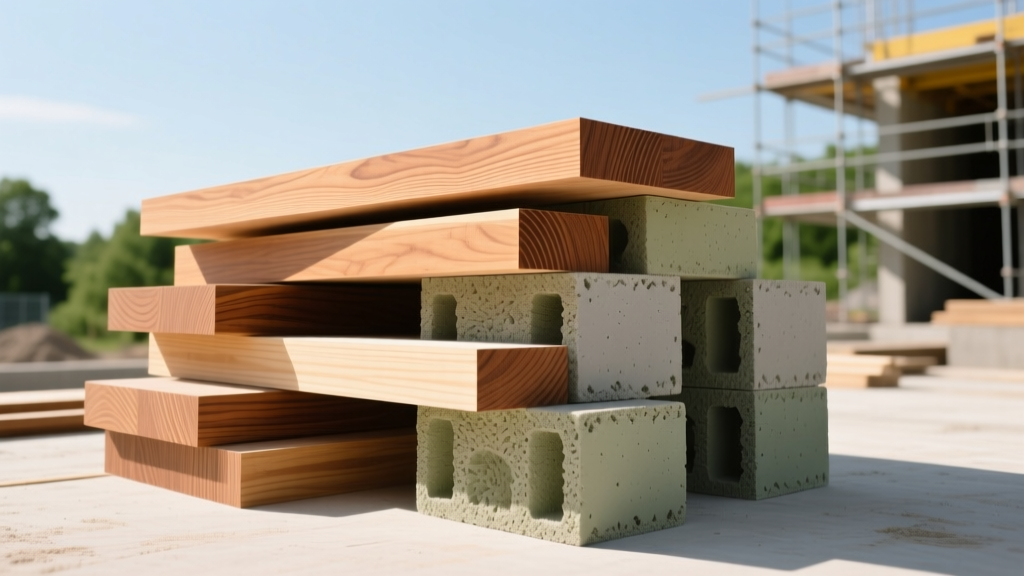
Material Comparison Matrix: Traditional vs. Euro-Spec Alternatives
| Material Category | Traditional Global Spec | 2026 European Alternative | Key Performance Delta |
|---|---|---|---|
| Structural Framing | Steel W-Shapes / Concrete | EN 16351 Certified CLT | -75% embodied carbon; 30% faster dry-in |
| Cementitious Binder | OPC (CEM I) | LC3-50 / Alkali-Activated | -40% CO2; higher sulfate resistance |
| Continuous Insulation | XPS / Polyiso Boards | Vacuum Insulation Panels (VIP) | 5x lower thermal conductivity (0.004 W/mK) |
| Vapor Barriers | 6-mil Polyethylene | Variable-permeability membranes | Adapts to seasonal humidity; prevents trapping |
High-Performance Envelopes: Aerogels and Vacuum Insulation Panels
As European building codes push toward Passive House and Net-Zero standards, the physical thickness of traditional insulation has become a spatial liability in high-density urban construction. European material suppliers have commercialized advanced envelope technologies that maximize net-lettable area.
Vacuum Insulation Panels (VIPs): Manufacturers like va-Q-tec produce VIPs with a fumed silica core encased in a high-barrier metallized film. These panels achieve a thermal conductivity (lambda value) of 0.004 W/(m·K). A mere 40mm VIP provides the equivalent thermal resistance of 200mm of standard EPS. While the upfront cost carries a 60-80% premium over conventional batts, the return on investment in dense metropolitan markets like London, New York, or Tokyo—where square footage commands premium pricing—is realized through reclaimed interior space.
Aerogel Blankets: For complex geometries, retrofits, and thermal bridge mitigation, silica aerogel blankets (such as Spaceloft) offer a lambda value of 0.014 W/(m·K) while remaining flexible and hydrophobic. They are increasingly specified in European historic building retrofits where altering the exterior facade depth is legally prohibited.
Procurement Framework: Importing vs. Domestic Equivalents
When should a global specifier absorb the freight costs of importing European building materials? Use this decision matrix:
- Import Direct: When the project requires specialized variable-permeability membranes (e.g., Pro Clima Intello), factory-integrated CLT acoustic flooring, or VIPs with verified 25-year lifespan warranties that domestic suppliers cannot yet match in scale or certification.
- Source Domestic Equivalents: For high-volume, low-complexity commodities like standard mineral wool batts, generic GGBFS slag, or basic structural lumber, where the carbon footprint of transatlantic shipping negates the manufacturing carbon savings.
Regulatory Tailwinds: CBAM and the EPBD Recast
The global dominance of European building materials is heavily fortified by regulatory mechanisms. The EU's Carbon Border Adjustment Mechanism (CBAM) places a carbon price on imported steel, aluminum, and cement. This effectively shields European low-carbon material producers from being undercut by high-carbon international competitors, stabilizing their pricing and allowing for continued R&D investment.
Simultaneously, the Energy Performance of Buildings Directive (EPBD) recast mandates stringent whole-life carbon assessments for new builds. This directive forces European manufacturers to provide granular, third-party verified EPDs for every product SKU. Consequently, when international developers purchase these materials, they receive a 'data passport' that seamlessly integrates into global lifecycle assessment (LCA) software like Tally or One Click LCA, drastically reducing the administrative burden of green building certification.
Expert Takeaway: The competitive advantage of European building materials in 2026 is no longer just the physical product—it is the embedded carbon data and regulatory compliance that travels with it. Specifiers who ignore this data layer risk severe cost overruns during the LEED or BREEAM certification phases.
Ultimately, integrating European building materials into global projects requires a shift from viewing them as premium upgrades to recognizing them as essential risk-mitigation tools against future carbon taxation and increasingly stringent embodied carbon caps. By targeting specific high-impact categories like mass timber, LC3 binders, and advanced VIPs, project teams can optimize both their environmental impact and their long-term financial performance.
Written by
David NakamuraDavid Nakamura is a licensed architect (AIA) and construction technology writer focused on sustainable building methods, mass timber engineering, and high-performance building envelopes. He holds a Master of Architecture from the University of Washington and is a certified Passive House Consultant (CPHC). David spent eight years at the Seattle firm Mithun, where he led the design of three LEED Platinum projects, before founding his own practice specializing in net-zero residential design. He serves on the editorial advisory board of GreenBuilder Magazine and has authored peer-reviewed papers on cross-laminated timber (CLT) connections for the Journal of Structural Engineering. In his spare time, David teaches woodworking at Pratt Fine Arts Center and kayaks the Puget Sound.
More from David Nakamura
View all
Construction Cost
Labor Cost to Build a Deck Per Sq Ft: 2026 Installation Guide
Discover the exact labor cost to build a deck per sq ft in 2026. This installation guide breaks down contractor rates, complexity factors, and hidden fees.
Aug 4, 2026

Construction Cost
How Much Does It Cost to Build a 3 Bedroom House? Financing Guide
Learn exactly how much it costs to build a 3 bedroom house and explore 2026 financing options, construction loan types, and budget frameworks for your build.
Aug 4, 2026

Construction Cost
Cost to Build a Tennis Court: 2026 Guide
How much does it cost to build a tennis court in 2026? Breakdowns for asphalt, concrete, and synthetic surfaces plus fencing and lighting.
Jul 30, 2026