Harris Building Materials Overview: Sure-Board MgO Sheathing Guide
Explore Harris building materials, focusing on Sure-Board MgO sheathing. Compare costs, fire ratings, and installation specs for commercial projects.

The Core Lineup: Decoding Harris Magnesium Oxide Panels
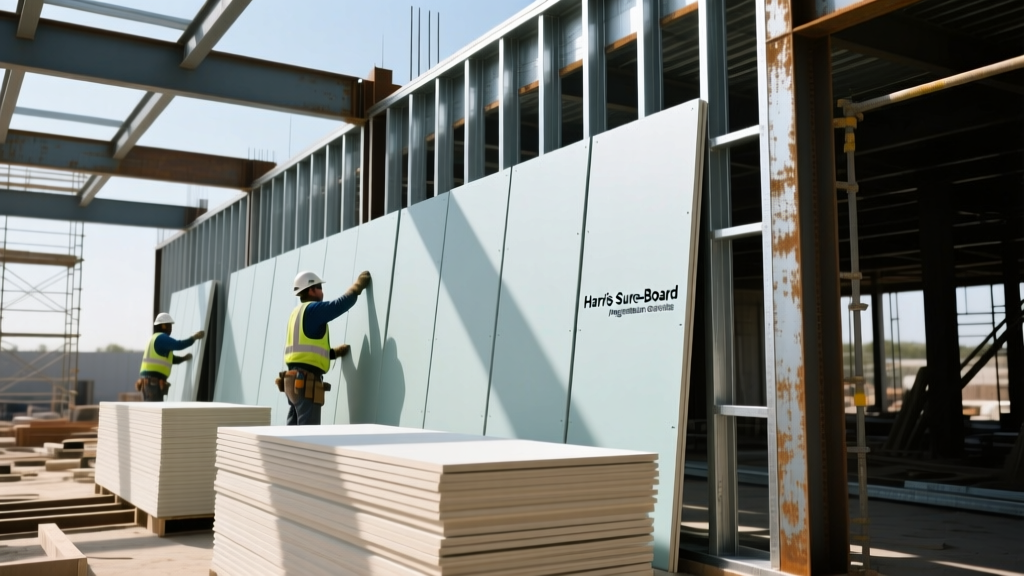
When commercial contractors and architects specify Harris building materials, they are primarily targeting the company's flagship magnesium oxide (MgO) product line, most notably Sure-Board and Sure-Panel. Unlike traditional gypsum or oriented strand board (OSB), these structural sheathing panels are engineered for extreme environments where fire resistance, mold prevention, and moisture tolerance are non-negotiable. Harris Specialty Products has carved out a dominant niche in the commercial and multi-family residential sectors by solving the inherent vulnerabilities of paper-faced gypsum and wood-based sheathing.
The fundamental appeal of the Harris lineup lies in its inorganic composition. By utilizing a magnesium oxide cement matrix reinforced with fiberglass mesh, these panels achieve a Class A fire rating and complete immunity to mold growth. However, specifying Harris MgO sheathing requires a precise understanding of its chemical properties, structural limitations, and installation nuances. Treating it like standard drywall or OSB will lead to catastrophic fastener corrosion and joint failure.
Material Chemistry: MOC vs. MOS Formulations
The global MgO market is plagued by cheap, high-chloride imports that suffer from 'weeping' (efflorescence) and subsequent steel corrosion. Harris mitigates this by strictly controlling the chloride content in their cementitious binder. While early generations of MgO boards relied heavily on Magnesium Oxychloride (MOC) cement, premium manufacturers like Harris have shifted toward Magnesium Oxysulfate (MOS) or highly purified low-chloride MOC formulations. This chemical stability ensures that the panels maintain a neutral-to-mild alkaline pH over their lifespan, preventing the galvanic corrosion of adjacent steel studs and fasteners.
Technical Specifications and Code Compliance
Harris Sure-Board 200 and Sure-Panel are designed to meet stringent international building codes for non-combustible construction. Under NFPA 220 standards for building construction types, these panels qualify as non-combustible materials, allowing them to be utilized in Type I and Type II construction assemblies where wood sheathing is strictly prohibited.
The panels are rigorously tested against multiple ASTM E136 protocols for non-combustibility and ASTM D3273 for mold resistance. Because the core is entirely inorganic, it provides zero nutritional value to mold spores, a critical factor for compliance with EPA mold guidelines in high-humidity zones like indoor natatoriums, commercial kitchens, and exterior shaft walls.
| Feature | Harris Sure-Board (1/2 in.) | DensGlass (5/8 in.) | Advantech OSB (3/4 in.) |
|---|---|---|---|
| Core Material | Magnesium Oxide Cement | Silicone-treated Gypsum | Resin-bonded Wood Strand |
| Weight (4x8 Sheet) | ~65 lbs | ~72 lbs | ~60 lbs |
| Fire Rating (Core) | Non-Combustible (ASTM E136) | Non-Combustible (ASTM E136) | Class C Flame Spread |
| Water Exposure | Impervious, no swelling | Water-resistant, degrades if submerged | Water-resistant, swells if edge-seal fails |
| Approx. Cost (4x8) | $55.00 - $75.00 | $35.00 - $45.00 | $40.00 - $50.00 |
Installation Gotchas: Fasteners, Alkalinity, and Expansion
The most frequent cause of failure in MgO sheathing installations is the misuse of standard fasteners. Despite Harris's low-chloride formulations, magnesium oxide remains inherently alkaline (pH 10-12). Standard phosphate-coated drywall screws or uncoated zinc screws will undergo rapid galvanic corrosion when driven into the MgO matrix, leading to rust bleeding through finishes and eventual structural detachment.
WARNING: Fastener Selection is Non-Negotiable
Never use standard black phosphate drywall screws with Harris MgO panels. You must specify either 410-grade stainless steel screws or high-quality ceramic-coated structural screws rated for highly alkaline environments. Furthermore, bugle-head screws can crush the fiberglass mesh facing; opt for flat-head or wafer-head screws designed specifically for cementitious sheathing to ensure a flush, non-destructive countersink.
Step-by-Step Field Installation Protocol
- Cutting and Dust Management: Cut Harris panels using a diamond-tipped or carbide-tipped blade. MgO cutting generates respirable crystalline silica dust. OSHA mandates strict dust collection systems or wet-cutting methods to maintain compliance with the 50 µg/m³ PEL (Permissible Exposure Limit).
- Spacing and Gapping: Unlike drywall, MgO panels experience minor thermal expansion and contraction. Maintain a strict 1/8-inch gap between all panel edges and ends. Do not butt joints tightly.
- Fastener Pattern: Drive screws 3/8-inch from the panel edge. Maintain a 6-inch on-center (o.c.) spacing along all perimeter edges and supported joints, and a 12-inch o.c. spacing in the intermediate field studs.
- Joint Treatment: For exterior applications serving as a substrate for cladding, tape and bed the 1/8-inch gaps using an alkali-resistant fiberglass mesh tape embedded in a polymer-modified, MgO-compatible joint compound or high-grade polyurethane sealant.
Cost Analysis and ROI for Commercial Projects
At $55 to $75 per 4x8 sheet, Harris Sure-Board carries a 40% to 60% material premium over standard fiberglass-mat gypsum sheathing. However, evaluating the ROI requires looking beyond the raw material invoice. In commercial shaft walls, elevator enclosures, and exterior shear walls, specifying Harris MgO can eliminate the need for secondary water-resistive barriers or specialized fire-blocking materials.
Labor costs also shift. Because a 1/2-inch 4x8 sheet weighs approximately 65 pounds, manual installation on upper floors or high walls is labor-intensive, often requiring two installers per sheet or mechanical panel lifts. However, the panels score and snap similarly to gypsum (though requiring heavier pressure and a specialized MgO scoring tool), which keeps cutting and fitting times comparable to traditional drywall crews. The true financial gain is realized in the reduction of warranty callbacks related to mold remediation, water damage, and fire-code violations in high-moisture zones.
Decision Matrix: When to Specify Harris MgO Over Alternatives
Use this framework to determine if Harris building materials are the correct specification for your project assembly:
- Specify Harris MgO When: Designing exterior shaft walls, parapet enclosures, or commercial kitchen partitions where prolonged moisture exposure and strict Class A fire ratings intersect. Ideal for coastal construction where salt-air corrosion destroys standard gypsum facers.
- Specify DensGlass/Gypsum When: Working on interior, climate-controlled partition walls where budget constraints are tight and moisture exposure is limited to standard ambient humidity.
- Specify Plywood/OSB When: Engineering structural shear walls that require high racking strength and specific nail-holding capacities that MgO panels cannot independently provide without specialized structural framing engineering.
By understanding the precise chemical and mechanical boundaries of Harris Sure-Board, contractors can leverage its exceptional fire and moisture resistance while avoiding the installation pitfalls that plague uninformed crews.
Written by
Priya KapoorPriya Kapoor is a real estate market analyst and construction economics researcher with expertise in housing affordability, development feasibility, and infrastructure investment. She holds a Master of Regional Planning from Cornell University and previously worked as a senior analyst at CBRE's Investment Properties group, where she modeled returns for $4B in mixed-use development pipelines. Priya now runs an independent research practice advising developers, municipalities, and REITs on construction cost forecasting and market timing. She publishes the quarterly "BuildMat Market Pulse" report tracking material price indices across 12 commodity categories. Based in Austin, TX, Priya serves on the board of Habitat for Humanity Austin and is a marathon runner.
More from Priya Kapoor
View all
Construction Cost
Cost to Build a 1600 Sq Ft Home in 2026: Full Breakdown
Accurate 2026 cost to build a 1600 sq ft home—material, labor, and regional pricing breakdowns included. Plan your budget with real-time estimates.
Aug 11, 2026

Wood & Lumber
Name the Types of Wood for Pressure Treatment and Preservation
Learn how to name the types of wood best suited for pressure treatment. Compare species treatability, chemical retention levels, and 2026 preservation costs.
Aug 4, 2026

Stone & Masonry
Stone Veneer Suppliers Lindenhurst: 2026 Cost Analysis
Analyze 2026 stone veneer costs in Lindenhurst, NY. Compare local supplier pricing, delivery fees, and Suffolk County installation labor rates.
Aug 4, 2026