Kapers Building Material Inc vs Big Box Stores: Sourcing Review
Compare Kapers Building Material Inc with big box stores for lumber, drywall, and siding. Analyze pricing, delivery, and contractor terms.

The Procurement Dilemma: Dedicated Yards vs. National Retailers
For regional general contractors and custom home builders, material procurement directly dictates gross margins and project timelines. As the construction industry navigates the 2026 building cycle, commodity lumber pricing has largely stabilized, but logistics and labor costs continue to squeeze profitability. This reality forces a critical decision: should you source your framing packages, drywall, and exterior cladding from a dedicated regional supplier like Kapers Building Material Inc, or rely on the convenience of national big box retailers like Home Depot Pro or Lowe's?
This comparison review dissects the operational, financial, and qualitative differences between sourcing from Kapers Building Material Inc versus large-scale retail chains. We evaluate inventory grading, delivery logistics, credit terms, and job-site efficiency to help you determine the optimal procurement strategy for your specific build volume.
Head-to-Head Comparison Matrix
Before analyzing specific material categories, it is essential to understand the structural differences in how these suppliers operate. The following matrix contrasts the core service models of Kapers Building Material Inc against standard big box retail and national lumber yards.
| Feature | Kapers Building Material Inc | Big Box Retail (HD/Lowe's) | National Chain (e.g., 84 Lumber) |
|---|---|---|---|
| Primary Customer Base | Mid-to-large GCs, custom builders | DIY, remodeling, small GCs | High-volume production builders |
| Lumber Storage | Covered, climate-controlled sheds | Open-air or semi-exposed racks | Open-air yard with partial covers |
| Delivery Equipment | Dedicated fleet, articulating boom trucks | Third-party flatbeds (curbside drop) | Standard flatbeds, some Moffett forklifts |
| Account Terms | Net-30/Net-60, tiered volume rebates | Commercial credit card, Net-30 (strict) | Net-30, project-specific bidding |
| Takeoff Services | In-house estimators, BIM integration | Basic software, limited human review | Dedicated estimators for large contracts |
Material Quality and Grade Availability
Framing Lumber: SPF #2 vs. Select Structural
The most glaring discrepancy between dedicated suppliers and big box stores is framing lumber quality. Big box retailers primarily stock Spruce-Pine-Fir (SPF) #2 stud lumber. Because these stores cater heavily to DIYers and small remodeling crews, the inventory is frequently picked through, leaving warped, bowed, or twisted studs at the bottom of the bunks. Furthermore, big box lumber is often stored in open-air environments, leading to moisture absorption and subsequent crowning before it even reaches your job site.
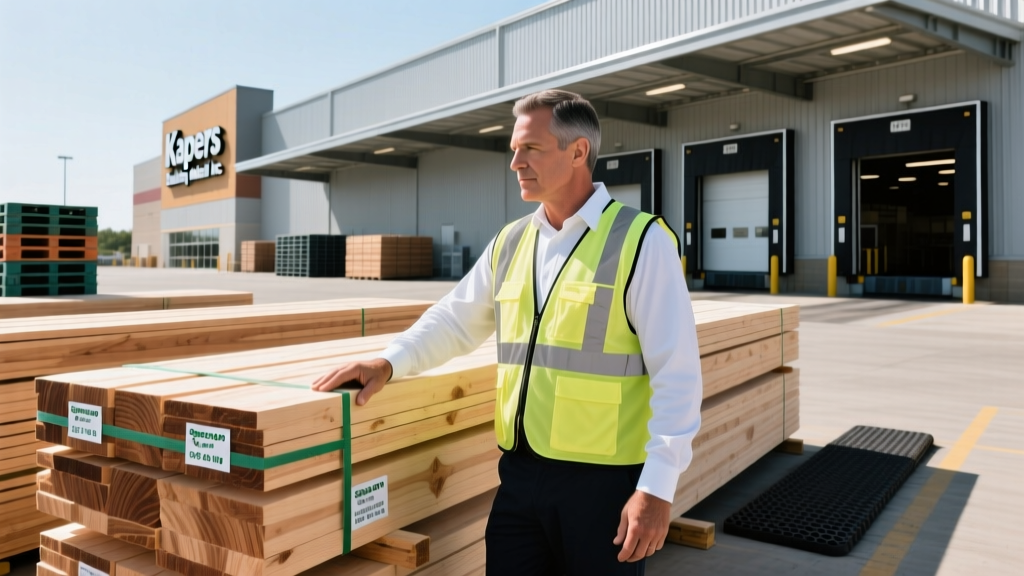
Kapers Building Material Inc maintains a contractor-first inventory protocol. Framing packages are kept banded and stored in covered, ventilated sheds to protect the kiln-dried heat-treated (KD-HT) moisture content. More importantly, Kapers stocks higher grades that big box stores rarely carry on the shelf, such as Douglas Fir-Larch Select Structural and #1 grade 2x10s and 2x12s required for long-span floor joists and heavy load-bearing headers. According to the APA Engineered Wood Association, utilizing properly graded and stored dimensional lumber reduces job-site cull rates by up to 12%, directly saving labor hours spent sorting and returning defective boards.
Drywall and Fire-Rated Assemblies
When sourcing 5/8-inch Type X fire-rated drywall, adherence to ASTM C1396 standards is non-negotiable for commercial and multi-family residential projects. Big box stores typically stock standard USG Sheetrock or Georgia-Pacific ToughRock in limited quantities. If a project requires specialized products like USG Sheetrock UltraLight Panels Firecode X or sound-damping boards (e.g., QuietRock 510), big box stores must special-order them, often with lead times exceeding two weeks and high minimum-order freight surcharges.
Kapers Building Material Inc treats drywall as a core commodity, stocking full bunk quantities of specialized acoustic and fire-rated boards. Their in-house estimators can cross-reference your architectural plans to ensure the correct fire-resistance ratings are met per local building codes, preventing costly inspection failures.
Pricing Structures and Financial Terms
Sticker price is only one variable in the total cost of materials. The financial structure of your supplier account heavily influences project cash flow.
- Commodity Indexing vs. Fixed Bids: Big box stores operate on daily retail pricing. If framing lumber spikes due to a supply chain disruption, your next pickup will reflect the new retail price. Kapers Building Material Inc offers 'project lock' pricing for contracted builds, allowing GCs to bid jobs with guaranteed material costs for 60 to 90 days, shielding the contractor from market volatility.
- Credit and Terms: While big box commercial accounts offer Net-30 terms, they are heavily reliant on commercial credit cards and will place holds on accounts for minor payment delays. Kapers provides traditional B2B open-book credit lines (Net-30 to Net-60) based on trade references and financials, which is critical for GCs waiting on bank construction draws.
- Volume Rebates: For builders doing 10+ homes a year, Kapers offers end-of-year volume rebate programs that return 1.5% to 3% of total spend back to the contractor—a margin booster that retail chains simply do not offer.
Delivery Logistics and Job-Site Safety
Material delivery is where big box stores consistently fail the commercial contractor. National retailers rely on third-party logistics (3PL) flatbed trucks. These drivers typically perform 'curbside drops,' leaving pallets of brick, bundles of shingles, and drywall on the street or driveway. This forces your framing or masonry crews to spend 3 to 5 hours manually breaking down pallets and wheeling materials to the point of installation.
Kapers Building Material Inc operates a dedicated delivery fleet equipped with specialized unloading equipment:
- Articulating Boom Trucks (HIAB Cranes): For multi-story builds, Kapers uses boom trucks to lift roof trusses, I-joists, and drywall bunk directly onto the second or third-floor decking. This eliminates the need for expensive on-site telehandler rentals and drastically reduces fall risks associated with manual hoisting.
- Moffett Truck-Mounted Forklifts: For tight urban lots or muddy suburban subdivisions where flatbeds cannot maneuver, Moffett forklifts detach from the delivery truck to carry materials precisely where the crew needs them.
Proper material handling is not just an efficiency issue; it is a regulatory requirement. OSHA Standard 1926.250 strictly governs material storage and handling on construction sites to prevent crushing hazards and structural collapses. By utilizing Kapers' specialized delivery equipment to place materials on stable, level dunnage directly at the point of use, GCs inherently improve compliance with OSHA site safety regulations.
Edge Case: The Emergency 'Short-Run' Pickup
No build goes perfectly according to the takeoff. When a framer realizes they are 15 studs short, or a tile setter needs two more bags of thinset, the big box store wins on convenience. Driving a company truck to a local retail store for a small, immediate pickup is faster than waiting for a dedicated yard to schedule a partial delivery. The optimal strategy for most mid-sized GCs is a hybrid approach: use Kapers Building Material Inc for 90% of the project's structural and heavy materials, and utilize big box stores strictly for emergency short-run consumables and hand tools.
Final Verdict: Aligning Supplier to Project Scope
Choosing between Kapers Building Material Inc and a national big box retailer is not about finding a universally 'better' option, but aligning the supplier's strengths to your specific project scope.
Use Kapers Building Material Inc when:
- Building custom homes, multi-family units, or light commercial projects.
- You require higher-grade structural lumber (Select Structural, LVLs, PSLs).
- Job-site access requires boom truck drops or specialized forklift unloading.
- You need project-locked pricing to secure bank financing and protect bid margins.
Use Big Box Retailers when:
- Executing small-scale residential remodels or interior finish carpentry.
- You need immediate, off-the-shelf access to hardware, fasteners, and small tools.
- The job site is a high-density urban environment where large delivery trucks cannot legally park or maneuver.
By leveraging the dedicated estimating, high-grade inventory, and advanced logistics of Kapers for your primary build packages, while reserving retail chains for emergency consumables, contractors can optimize both their material quality and their bottom line.
Frequently Asked Questions
Does Kapers Building Material Inc offer will-call pickup for contractors?
Yes, Kapers maintains a dedicated contractor will-call desk separate from retail traffic. However, for loads exceeding 2,000 lbs, it is highly recommended to schedule the pickup 24 hours in advance so the yard crew can stage and band the materials for your specific flatbed or trailer configuration, ensuring compliance with DOT tie-down regulations.
How do return policies differ between the two supplier types?
Big box stores generally allow returns of unused materials with a receipt, though they may charge restocking fees for special orders. Kapers Building Material Inc offers a more flexible return policy for account-holding contractors, often issuing full job-lot credits for unused, undamaged framing and sheathing materials at the end of a project, provided the materials were kept clean and banded.
Can Kapers handle specialized commercial roofing and insulation?
Absolutely. Unlike retail stores that focus on residential asphalt shingles and fiberglass batts, Kapers stocks commercial-grade polyiso insulation, EPDM membranes, TPO roofing systems, and heavy-duty metal decking. They also maintain relationships with regional commercial roofing distributors to source specific R-value assemblies required by the 2024/2026 IECC energy codes.
Written by
Marcus ChenMarcus Chen is a licensed structural engineer (PE) and building materials analyst with over 12 years of experience across residential, commercial, and industrial construction. He holds a Master of Science in Civil Engineering from UC Berkeley and spent six years at Thornton Tomasetti before transitioning to independent consulting and technical writing. Marcus specializes in material selection for seismic-prone regions, concrete reinforcement strategies, and lifecycle cost analysis. His work has been cited by the American Concrete Institute (ACI) and the Structural Engineers Association of California (SEAOC). When he is not on a job site or at his desk, you will find him hiking the Sierra Nevada or restoring a 1920s craftsman bungalow in Oakland, CA.
More from Marcus Chen
View all
Construction Cost
How Much Did the Eiffel Tower Cost to Build?
How much did the Eiffel Tower cost to build in 1889? We adjust for inflation and compare its budget to modern skyscraper construction.
Aug 4, 2026

Fire Resistance
What Is a Fire Resistant Material? Testing & Certification Guide
Discover what is a fire resistant material through ASTM and UL testing. Learn how fire ratings, certifications, and assemblies work in construction.
Aug 4, 2026

Construction Cost
How Much Did the Burj Khalifa Cost to Build?
How much did the Burj Khalifa cost to build? We break down the $1.5B project and extract 5 money-saving strategies for your next build.
Jul 30, 2026