Choosing Building Material Distributors Near Me: Big Box vs Pro Yards
Compare national big box stores, regional pro yards, and specialty wholesalers to find the best building material distributors near me for your projects.
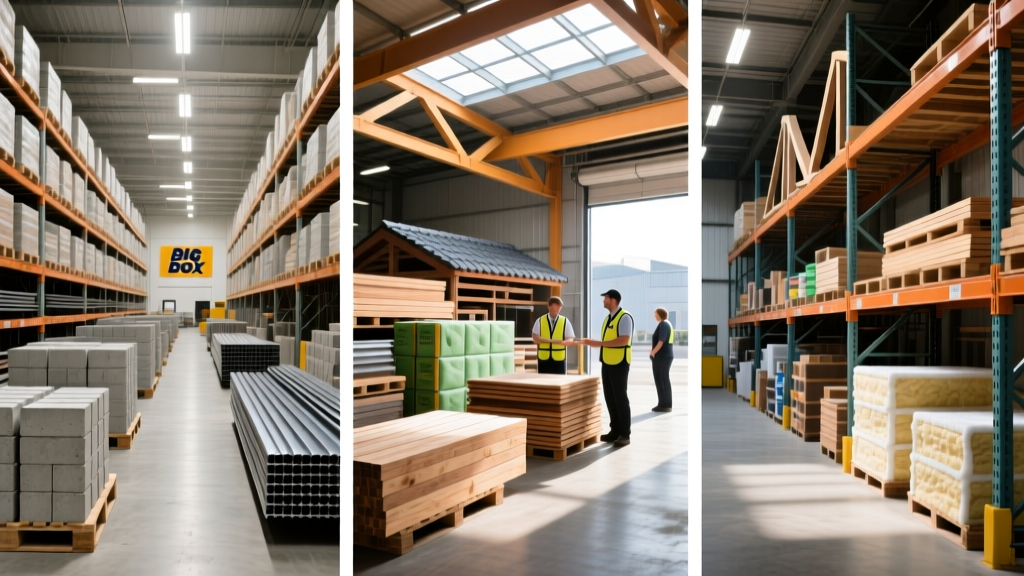
The "Near Me" Dilemma: Evaluating Local Supply Chains
When contractors, remodelers, and advanced DIYers search for "building material distributors near me," the local search results typically yield a fragmented mix of national big-box retailers, regional independent pro yards, and niche specialty wholesalers. Selecting the wrong distribution tier for your specific project scope can inflate material costs by 12% to 18% and introduce critical jobsite delays. According to the National Association of Home Builders (NAHB), material price volatility and localized supply chain bottlenecks remain primary concerns for builders navigating the 2026 construction landscape. Understanding the structural differences between these local distributors is essential for protecting your project margins.
- Under $5,000 Material Budget / Minor Repairs: National Big Box Pro Desk (Home Depot, Lowe's).
- $5,000 - $60,000 / Custom Home Remodels & Additions: Regional Independent Pro Yard (e.g., 84 Lumber, Carter Lumber, local independents).
- Over $60,000 / Multi-family, Roofing, or Masonry: Specialty Wholesale Distributors (e.g., Beacon, ABC Supply).
Tier 1: National Big Box Pro Desks
National chains dominate local search results due to their massive digital footprints. Their "Pro" programs (like Home Depot Pro Xtra or Lowe's for Pros) offer consolidated billing and basic volume discounts, but they operate fundamentally as retail environments optimized for foot traffic, not commercial jobsite logistics.
The Pricing Reality
Big box stores rely on algorithmic national pricing. While a single 2x4x8 SPF stud might cost $3.85, their "Pro" volume discounts are heavily capped, rarely exceeding 4% to 6% even on massive framing packages. For drywall, a standard 1/2-inch 4x8 USG Sheetrock Ultralight panel will hover around $13.50 to $14.25. You are paying for the convenience of immediate, off-the-shelf availability rather than wholesale commodity pricing.
Logistics and Delivery Limitations
The most significant failure point for big box distributors is jobsite delivery. They typically utilize third-party flatbed contractors or standard straight-mast forklifts. If your project requires a knuckleboom truck to lift engineered LVL beams or roof trusses to a second-story deck, big box stores generally cannot accommodate this. Delivery fees are usually a flat rate ($79 to $129), but drops are strictly limited to curbside or flat driveway surfaces.
Tier 2: Regional Pro Yards and Independent Lumberyards
Independent dealers and regional chains represent the backbone of professional residential construction. The National Lumber and Building Material Dealers Association (NLBMDA) notes that independent yards control a massive share of the professional framing and exterior finishing market due to their specialized logistics and credit flexibility.
Job Quoting vs. Retail Pricing
Unlike big box stores, regional pro yards operate on "job quotes." If you submit a complete framing list or a full exterior siding takeoff, the yard's estimators will bid the package against current wholesale indexes. It is standard to see a 10% to 15% discount off retail pricing for complete structural packages. Furthermore, pro yards carry deeper inventory of engineered wood products (like Weyerhaeuser TJI joists and Boise Cascade LVLs) that big box stores only offer via special order with 2-to-3-week lead times.
Credit Terms and Account Management
For established LLCs and general contractors, regional yards offer Net 30 or Net 60 credit terms, which is critical for managing cash flow on progress-billed projects. You are also assigned a dedicated inside sales representative who tracks your specific material holds and manages backorders, eliminating the need to argue with a rotating cast of retail floor associates.
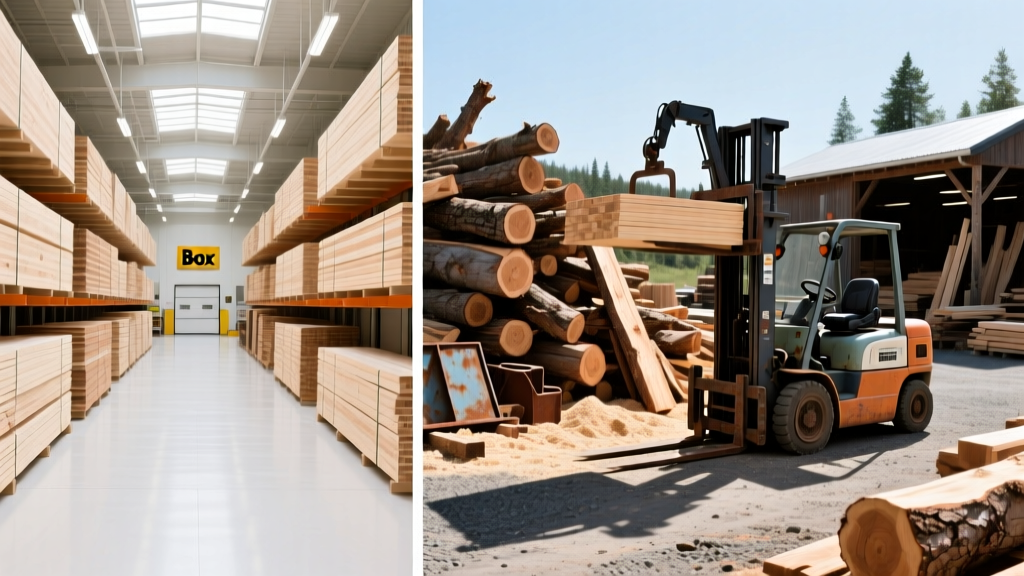
Tier 3: Specialty Wholesale Distributors
If your search for "building material distributors near me" is driven by a need for roofing, masonry, or commercial insulation, bypass the generalists entirely. Specialty wholesalers like ABC Supply (roofing/siding) or local masonry block yards operate on razor-thin margins with massive volume.
For example, purchasing architectural asphalt shingles at a big box store can result in a 20% to 30% markup over wholesale. A dedicated roofing distributor will offer contractor pricing that is significantly lower per square, alongside free jobsite boom-truck delivery that places the bundles directly onto the roof deck—a service generalist distributors simply do not provide.
Head-to-Head Distributor Comparison Matrix
| Feature | Big Box Pro Desk | Regional Pro Yard | Specialty Wholesaler |
|---|---|---|---|
| Lumber Pricing | Retail + capped 4% Pro discount | Wholesale job-quote (10-15% savings) | N/A (Focus on specialty trades) |
| Delivery Equipment | Straight mast forklift, curbside only | Knuckleboom, crane, specific lot placement | Roof-load boom trucks, conveyor belts |
| Credit Terms | Store credit card (revolving) | Net 30 / Net 60 trade accounts | Net 30, heavy volume tiered rebates |
| Restocking Fees | 15% - 20% + pickup trip fee | Often waived for uncut dimensional lumber | Strict; custom orders are non-returnable |
| Will-Call Speed | Slow (retail traffic interference) | Fast (dedicated pro loading docks) | Fast (forklift-ready pallets) |
Hidden Costs and Supply Chain Realities
When evaluating local distributors, the sticker price on the quote is only one variable. The Bureau of Labor Statistics Producer Price Index (PPI) tracks ongoing fluctuations in building material inputs, but local distributors handle these fluctuations differently.
Minimum Order Quantities (MOQs) and Freight Surcharges
Specialty wholesalers and regional yards often enforce MOQs for free delivery. A common threshold is $1,500 to $2,500 for local metro delivery. If your project requires phased deliveries (e.g., framing week one, drywall week three, trim week five), regional yards may charge a "short drop" fee of $50 to $85 per delivery if the drop does not meet the minimum threshold. Big box stores charge a flat delivery fee regardless of order size, which can actually be cheaper for micro-deliveries of under $400.
The Restocking Trap
Over-ordering is a standard industry practice to account for waste and breakage. However, returning materials reveals the true nature of your distributor. Big box stores aggressively enforce 15% to 20% restocking fees and will charge you for the return trip if you require them to pick up the surplus. Independent pro yards, valuing long-term contractor relationships, will frequently waive restocking fees on uncut, undamaged dimensional lumber and standard drywall, provided it is returned to the yard on your own trailer within 30 days.
How to Vet Your Local Search Results
Before setting up an account with a distributor found in your local search results, verify their operational capabilities against your project requirements:
- Verify Boom Truck Reach: If you are building a multi-story custom home, ask the yard for the specific reach of their knuckleboom trucks. A standard 40-foot reach cannot place I-joists on a third-floor deck; you need a yard with a 65-foot to 75-foot boom.
- Check Certification Inventories: If your municipality enforces strict green building codes (like CALGreen or local LEED equivalents), confirm the distributor carries FSC (Forest Stewardship Council) or SFI (Sustainable Forestry Initiative) certified framing lumber and low-VOC insulation as standard stock, rather than requiring a 4-week special order.
- Inspect the Yard for Material Degradation: Drive past the facility. If dimensional lumber and engineered beams are stored directly on the dirt without tarps or proper stickering, the yard is mismanaging inventory. You will inevitably receive warped, moisture-compromised materials that will fail framing inspections.
Frequently Asked Questions
Can I use a big box store for a full home build?
While physically possible, it is highly discouraged for homes over 1,500 square feet. The lack of dedicated jobsite logistics, inability to provide boom-truck deliveries, and absence of Net 30 credit terms will create severe scheduling bottlenecks and cash-flow constraints.
Do regional pro yards sell to the general public?
Most regional pro yards are open to the public, but walk-in retail pricing will be identical to or slightly higher than big box stores. The true value of a pro yard is unlocked only by opening a commercial account and requesting formal job quotes based on a complete material takeoff.
How far in advance should I order engineered lumber?
Even with stabilized supply chains in 2026, custom-manufactured engineered wood products (LVLs, PSLs, and floor trusses) require a 2 to 4-week lead time. Regional distributors require signed architectural plans to submit to the manufacturer's engineering department before the order can even be placed in the production queue.
Written by
Elena RodriguezElena Rodriguez is a civil engineer and technical writer specializing in concrete technology, masonry systems, and ASTM/ACI compliance. She earned her B.S. in Civil Engineering from Texas A&M University and spent a decade at a materials testing laboratory, performing over 2,000 concrete compressive strength tests and masonry prism evaluations. Elena is an ACI-certified Field Testing Technician (Grade I) and a member of ASTM Committee C12 on Natural Building Stone. She currently consults on forensic engineering cases involving concrete failures and moisture intrusion. Based in San Antonio, TX, Elena is a proud member of the Society of Women Engineers (SWE) and coaches her daughter's FIRST Robotics team.
More from Elena Rodriguez
View all
Walls & Panels
Cost Analysis: Light Gauge Steel Framing Advantages and Disadvantages
Evaluate light gauge steel framing advantages and disadvantages through a strict cost analysis lens, comparing material, labor, and lifecycle expenses.
Aug 4, 2026

Walls & Panels
Gypsum Board Types: Exact Specifications, Thickness & Dimensions
Compare standard, Type X, and moisture-resistant gypsum board types. Get exact specifications, thicknesses, dimensions, and ASTM standards for your project.
Aug 4, 2026

Fire Resistance
Best Fire-Resistant Outdoor Decking Materials: 2026 Buyer Guide
Discover the best fire-resistant outdoor decking materials for 2026. Compare Class A PVC, aluminum, and hardwood options for WUI compliance and safety.
Aug 4, 2026