Valley Wide Building Materials: 2026 Supply Trends & Product Shifts
Explore 2026 industry trends at Valley Wide building materials, from WUI-compliant siding and synthetic roofing to digital supply chain shifts.

Regional Supply Chain Evolution in the Western US
As one of the largest independent building materials distributors in the Western United States, Valley Wide operates over 100 locations across Colorado, Wyoming, Montana, Idaho, Utah, Arizona, New Mexico, Nevada, and California. Because this footprint spans regions with extreme temperature fluctuations, high-altitude snow loads, and severe wildfire risks, the product mix stocked at these regional yards serves as a leading indicator for broader construction material trends. In 2026, the inventory shifting through Valley Wide's supply chain reflects a definitive move away from traditional, code-minimum materials toward high-performance, climate-resilient building envelopes.
For general contractors, architects, and procurement managers, understanding these regional shifts is critical. Specifying outdated materials in Western states now results in failed inspections, inflated insurance premiums, and severe supply bottlenecks. This analysis breaks down the specific product categories driving volume at Valley Wide this year, detailing the technical specifications and code mandates forcing these changes.
The Shift Toward Advanced Synthetic Roofing
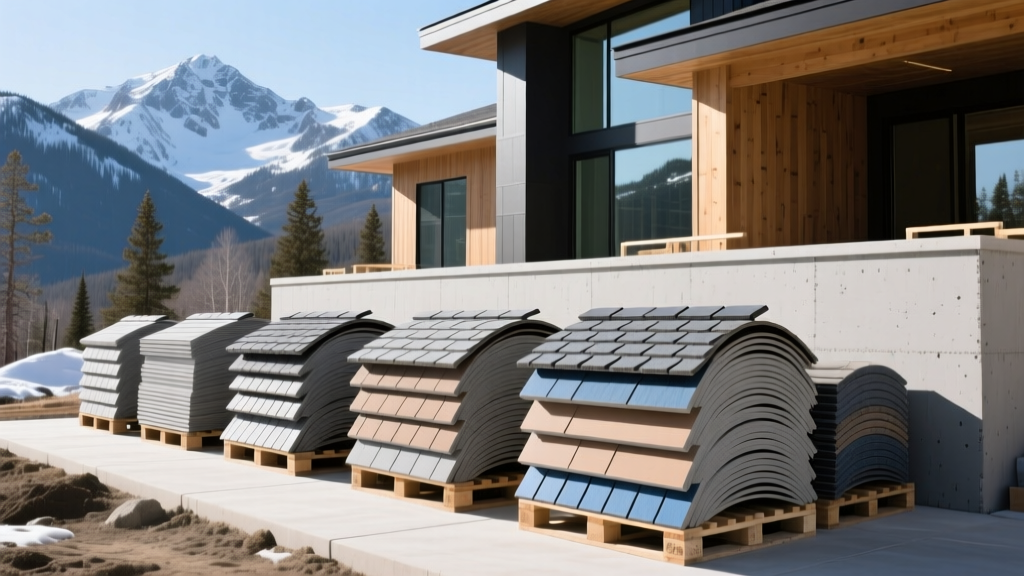
The most dramatic inventory shift in mountain and foothill markets is the rapid displacement of architectural asphalt shingles by synthetic polymer roofing. Driven by skyrocketing property insurance premiums in hail-prone and wildfire-adjacent zones, contractors are increasingly ordering synthetic shake and slate profiles. Brands heavily distributed through regional networks, such as DaVinci Roofscapes and Inspire Roofing, have seen double-digit volume growth.
Unlike traditional asphalt, which becomes brittle in sub-zero temperatures and loses its protective granules during severe hail, synthetic roofing is engineered from virgin resins and UV stabilizers. These products consistently achieve a UL 2218 Class 4 impact resistance rating—the highest possible—and a Class A fire rating. For projects in Colorado's Front Range or Utah's Wasatch Front, specifying a Class 4 synthetic roof is now a baseline requirement to secure insurable coverage at manageable rates.
| Roofing Material | Material Cost (per sq. ft.) | Impact Rating (UL 2218) | Fire Rating | Typical Warranty |
|---|---|---|---|---|
| Architectural Asphalt | $1.80 - $3.50 | Class 3 or 4 | Class A | 30 - 50 Years |
| Synthetic Slate/Shake | $8.50 - $14.00 | Class 4 | Class A | 50 - Lifetime |
| Standing Seam Metal | $9.00 - $16.00 | Class 4 | Class A | 30 - 50 Years |
Wildfire-Resistant Siding and WUI Mandates
The expansion of the Wildland-Urban Interface (WUI) has fundamentally altered exterior cladding procurement. According to the National Fire Protection Association (NFPA), WUI codes mandate strict ignition-resistant construction for structures located within designated fire hazard severity zones. Valley Wide's siding yards have responded by drastically increasing their stock of fiber cement and architectural metal panels while reducing the footprint of combustible wood and vinyl products.
James Hardie's fiber cement siding, particularly the Artisan Collection and the pre-finished ColorPlus Technology lines, remains the dominant cladding choice for WUI compliance. Fiber cement is non-combustible and will not ignite when exposed to direct flame or airborne embers. However, material selection is only half the battle; installation details dictate actual performance. The Insurance Institute for Business & Home Security (IBHS) emphasizes that even non-combustible siding can fail if embers enter the wall cavity through unsealed gaps or standard vinyl vents.
- Maintain a minimum 6-inch clearance between the bottom of fiber cement siding and the final grade to prevent moisture wicking and ember accumulation.
- Specify 1/8-inch corrosion-resistant wire mesh over all attic, soffit, and foundation vents to block wind-blown embers.
- Establish a strict 5-foot non-combustible zone around the structure's perimeter using gravel, pavers, or concrete—no wood mulch or combustible landscaping.
- Use fire-rated caulk and sealants at all siding penetrations and butt joints.
Insulation Upgrades Driven by IECC Adoptions
Western states are aggressively adopting updated iterations of the International Energy Conservation Code (IECC), pushing envelope performance far beyond historical baselines. Colorado, Utah, and Nevada have all moved toward stricter continuous insulation (ci) requirements to eliminate thermal bridging through wood and steel framing. Consequently, regional distributors are moving massive volumes of rigid polyisocyanurate (polyiso) boards and insulated structural sheathing.
Standard cavity insulation (like fiberglass batts) is no longer sufficient to meet the R-20 to R-30+ wall assembly requirements in Climate Zones 5 through 7 without a continuous exterior layer. Products like Owens Corning FOAMULAR NGX extruded polystyrene (XPS) and Huber's ZIP System R-sheathing are now standard line items on commercial and high-end residential purchase orders. ZIP System R-sheathing, which integrates the weather-resistive barrier (WRB) with a layer of continuous polyiso foam, has become particularly popular because it reduces the number of trades required on-site and accelerates the dry-in timeline—a critical factor in regions with short building seasons.
Digital Procurement and Just-In-Time Logistics
Beyond the physical materials, the mechanism of procurement has evolved. The traditional model of a superintendent calling a yard dispatcher to send a flatbed of 2x6s is being replaced by API-driven logistics. In 2026, mid-sized and enterprise general contractors are integrating their project management software (such as Procore or Buildertrend) directly with distributor ERPs. This allows for automated, just-in-time (JIT) material staging.
JIT delivery is not just a convenience; it is a site-safety and material-preservation necessity. Staging moisture-sensitive materials like engineered I-joists, LVL beams, and drywall too early leads to warping, mold, and costly replacements. By leveraging digital procurement portals, GCs can schedule phased deliveries tied directly to their critical path milestones, ensuring that Valley Wide's flatbeds arrive exactly when the framing or drywall crews are ready to install, minimizing on-site storage and reducing material degradation.
Frequently Asked Questions
How do WUI codes affect the availability of wood decking?
While traditional wood decking (like pressure-treated pine or cedar) is still available, its use is heavily restricted or entirely banned in strict WUI zones. Distributors have pivoted heavily toward capped composite decking (such as Trex Transcend or TimberTech Advanced PVC) and aluminum decking systems, which offer superior ember resistance and do not require the combustible sealants that wood demands.
Are synthetic roofing materials too heavy for older structural frames?
No. One of the primary advantages of synthetic slate and shake is its weight. While natural slate can weigh up to 1,500 pounds per square (100 sq. ft.), synthetic alternatives typically weigh between 300 and 400 pounds per square. This allows contractors to upgrade to a premium, Class A fire-rated aesthetic without requiring expensive structural reinforcement of the roof trusses.
What is the lead time for specialized continuous insulation?
While commodity insulation like standard fiberglass batts is typically stocked in high volume for immediate pickup, specialized continuous insulation products (like specific thicknesses of polyiso or custom-order insulated sheathing) often require a 2 to 4-week lead time from the manufacturer to the regional distribution hub. Procurement managers must finalize envelope specifications during the design phase to avoid stalling the framing schedule.
Written by
David NakamuraDavid Nakamura is a licensed architect (AIA) and construction technology writer focused on sustainable building methods, mass timber engineering, and high-performance building envelopes. He holds a Master of Architecture from the University of Washington and is a certified Passive House Consultant (CPHC). David spent eight years at the Seattle firm Mithun, where he led the design of three LEED Platinum projects, before founding his own practice specializing in net-zero residential design. He serves on the editorial advisory board of GreenBuilder Magazine and has authored peer-reviewed papers on cross-laminated timber (CLT) connections for the Journal of Structural Engineering. In his spare time, David teaches woodworking at Pratt Fine Arts Center and kayaks the Puget Sound.
More from David Nakamura
View all
Construction Cost
Labor Cost to Build a Deck Per Sq Ft: 2026 Installation Guide
Discover the exact labor cost to build a deck per sq ft in 2026. This installation guide breaks down contractor rates, complexity factors, and hidden fees.
Aug 4, 2026

Construction Cost
How Much Does It Cost to Build a 3 Bedroom House? Financing Guide
Learn exactly how much it costs to build a 3 bedroom house and explore 2026 financing options, construction loan types, and budget frameworks for your build.
Aug 4, 2026

Construction Cost
Cost to Build a Tennis Court: 2026 Guide
How much does it cost to build a tennis court in 2026? Breakdowns for asphalt, concrete, and synthetic surfaces plus fencing and lighting.
Jul 30, 2026