Building Material Thrift Store Guide: What to Buy and Avoid
Discover what to buy and avoid at a building material thrift store. Expert inspection tips, pricing data, and code compliance advice for salvage materials.
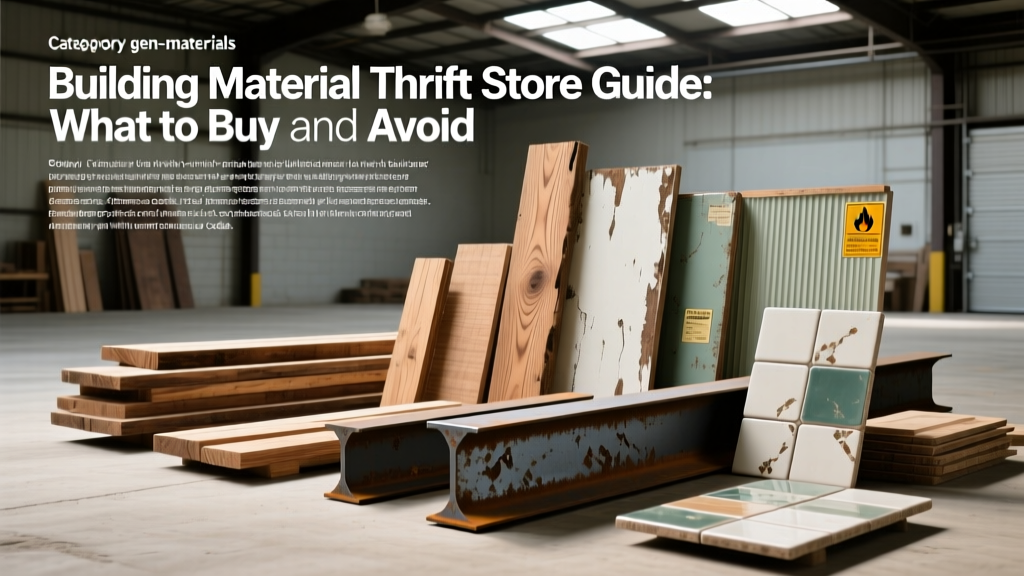
The Rise of Circular Construction and Salvage Shopping
The modern construction industry is undergoing a massive shift toward circular economy principles, driven by both environmental mandates and supply chain economics. According to the U.S. Environmental Protection Agency, over 600 million tons of construction and demolition (C&D) debris are generated annually in the United States. Diverting high-quality materials from landfills through a building material thrift store—such as independent architectural salvage yards or Habitat for Humanity ReStores—is no longer just a niche hobby for restoration purists; it is a strategic procurement method for contractors and homeowners alike.
However, navigating the aisles of a salvage warehouse requires a fundamentally different skill set than shopping at a big-box retailer. You are trading the predictability of standardized, warrantied products for the character, density, and historical value of reclaimed materials. This selection guide provides the technical frameworks, inspection protocols, and code-compliance checks required to successfully source materials from a building material thrift store in 2026.
Reclaimed Lumber and Millwork: The Density Advantage
Old-growth timber salvaged from deconstructed barns, factories, and pre-1950s homes possesses a cellular density that modern plantation-grown lumber simply cannot match. Reclaimed heart pine, for example, often boasts a Janka hardness rating exceeding 1,200 lbf, compared to roughly 870 lbf for contemporary southern yellow pine. But purchasing raw salvage lumber carries hidden risks that require on-site verification.
Moisture Content and Acclimation
Never purchase reclaimed flooring or interior millwork without verifying its moisture content (MC). Lumber stored in unclimate-controlled thrift store warehouses will equilibrate to the ambient humidity, which can be as high as 14-16% in humid coastal regions. Installing wood at this MC in a modern, HVAC-controlled home (which typically maintains an equilibrium moisture content of 6-9%) will result in catastrophic cupping and gapping.
Heavy Metal and Pest Screening
Any painted millwork or trim manufactured before 1978 must be treated as a potential lead hazard. While encapsulation is an option, sanding or planing lead-painted trim releases toxic dust. Always carry a 3M LeadCheck swab kit to test painted salvage. Additionally, inspect the end-grain of structural timbers for the tiny, perfectly round exit holes (1-2mm in diameter) indicative of powderpost beetles. If you find fine, talc-like frass dust beneath a stack of beams, the infestation is active, and the wood must be fumigated or avoided.
Architectural Salvage: Doors, Windows, and Hardware
Sourcing doors and windows from a building material thrift store offers unparalleled aesthetic value, particularly for solid-core wood doors and divided-light sash windows. Yet, dimensional discrepancies and modern energy codes create significant installation hurdles.
The Dimensional Trap of Historic Doors
Modern interior doors are standardized at 80 inches tall and 1.375 inches thick. Pre-1960s salvage doors frequently measure 78 inches, 82 inches, or even 84 inches in height, with thicknesses ranging from 1.5 to 1.75 inches. Before purchasing a lot of salvaged doors, measure your rough openings and account for the cost of custom jamb fabrication. Furthermore, historic doors often utilize mortise locksets rather than modern bored cylindrical locks. Retrofitting a modern cylindrical lock into a door with a massive, hollowed-out mortise pocket requires extensive Dutchman patching and wood-epoxy consolidation.
Window Sash and 2026 Energy Codes
While original wavy-glass single-pane windows are architecturally stunning, they fail to meet the International Energy Conservation Code (IECC) requirements for most climate zones in 2026. If you are sourcing salvage windows for a permitted renovation, you will likely need to pair them with custom-built, low-E exterior storm windows to achieve a compliant U-factor of 0.30 or lower. Alternatively, restrict salvaged single-pane sashes to unconditioned spaces like sunrooms, garages, or interior partition walls where thermal transfer is irrelevant.
Masonry, Tile, and Hardscape Salvage
Reclaimed brick and stone offer a weathered patina that new manufacturing processes attempt, but fail, to replicate authentically. The Building Materials Reuse Association notes that masonry salvage is one of the highest-volume categories in deconstruction, but quality control is paramount.
- Spalling and Freeze-Thaw Damage: Inspect the faces of salvaged face-brick for flaking or peeling (spalling). This indicates the brick was previously exposed to moisture ingress and freeze-thaw cycles, compromising its structural integrity. Tap the bricks together; a dull thud indicates internal micro-fractures, while a clear, metallic ring indicates a sound, fully vitrified unit.
- Mortar Compatibility: Reclaimed brick from pre-1930s structures was often laid with soft, lime-based mortar (Type O or Type K). When reusing this brick, you must repoint it with a historically appropriate lime putty or NHL (Natural Hydraulic Lime) mortar. Using modern, rigid Portland cement (Type N or S) on soft antique brick will trap moisture and cause the brick faces to shear off during the next freeze cycle.
- Tile Dye-Lot Variations: When buying salvaged ceramic or encaustic tile, always calculate your square footage and add a 20% overage. Salvage yards rarely carry identical dye-lots, meaning if you run short, finding a matching batch to complete your backsplash or bathroom floor is virtually impossible.
Mechanical, Electrical, and Plumbing (MEP): The Danger Zones
The MEP aisles of a building material thrift store are fraught with code violations and latent failures. While a vintage clawfoot tub is a safe and excellent purchase, electrical panels and pressurized plumbing components should generally be avoided.
Never purchase used electrical breaker panels. Several legacy brands, specifically Federal Pacific Electric (FPE) Stab-Lok and Zinsco panels, are known to have catastrophic failure rates where breakers fail to trip during overcurrent events, leading to structural fires. Furthermore, used panels lack the UL certification continuity required by modern AHJs (Authority Having Jurisdiction), meaning your local electrical inspector will likely fail the installation, forcing you to rip it out and buy new.
Plumbing Fixtures: Avoid pre-1994 toilets. Fixtures manufactured before the Energy Policy Act of 1992 consume 3.5 to 5.0 gallons per flush (GPF). In 2026, most municipal codes mandate a maximum of 1.28 GPF (WaterSense certified). However, salvaging cast-iron clawfoot tubs, brass bridge faucets (provided you replace the internal cartridges and valves), and copper pedestal sinks is highly recommended, as the metallurgical quality of mid-century brass and copper far exceeds modern imported alternatives.
Cost Comparison: Thrift Store vs. Big Box Retail
Understanding the true cost-benefit ratio requires looking beyond the sticker price. Salvage materials often require additional labor for refinishing, resizing, or retrofitting. Below is a comparative pricing matrix based on average 2026 market rates.
| Material Category | Thrift Store / Salvage | Big Box Retail (New) | Hidden Salvage Costs |
|---|---|---|---|
| Solid Core Wood Door (32x80) | $45 - $120 | $250 - $450 | Planing, mortise patching, refinishing ($150+) |
| Hardwood Flooring (per sq. ft.) | $3.50 - $6.00 | $7.00 - $14.00 | Kiln drying, nail removal, sanding ($4.00/sq ft) |
| Cast Iron Clawfoot Tub | $300 - $800 | $1,500 - $3,500 | Interior reglazing, freight shipping ($600+) |
| Reclaimed Face Brick (per pallet) | $250 - $400 | $600 - $900 | Mortar chipping, power washing (Labor intensive) |

The 5-Point Salvage Inspection Checklist
Before loading your truck at the building material thrift store, run through this mandatory inspection checklist to ensure your procurement doesn't turn into a costly liability.
- Verify Code Compliance: Does the item meet current local building codes? (e.g., tempered glass requirements for doors and low-level windows, low-flow mandates for plumbing).
- Test for Toxins: Swab all pre-1978 painted surfaces for lead. Avoid asbestos-containing materials like vintage linoleum tiles or old pipe insulation entirely.
- Measure Thrice: Confirm thickness, width, and height. Historic dimensional lumber (e.g., a "2x4") actually measures a full 2.0" x 4.0", which will not fit into modern framing layouts without planing.
- Check for Structural Rot: Use a sharp awl to probe the bottom 6 inches of any salvaged exterior door, window sill, or structural post. If the metal sinks in easily, the wood has advanced dry rot and is structurally compromised.
- Assess the Refinishing Burden: Calculate the labor hours required to strip, sand, and seal the item. If the refinishing labor exceeds the cost of buying a new, pre-finished equivalent, leave it on the shelf.
Sourcing from a building material thrift store bridges the gap between sustainable deconstruction and high-end architectural design. By applying rigorous material science principles and strict code-compliance checks, builders and homeowners can extract immense value, character, and durability from the circular supply chain.
Written by
Elena RodriguezElena Rodriguez is a civil engineer and technical writer specializing in concrete technology, masonry systems, and ASTM/ACI compliance. She earned her B.S. in Civil Engineering from Texas A&M University and spent a decade at a materials testing laboratory, performing over 2,000 concrete compressive strength tests and masonry prism evaluations. Elena is an ACI-certified Field Testing Technician (Grade I) and a member of ASTM Committee C12 on Natural Building Stone. She currently consults on forensic engineering cases involving concrete failures and moisture intrusion. Based in San Antonio, TX, Elena is a proud member of the Society of Women Engineers (SWE) and coaches her daughter's FIRST Robotics team.
More from Elena Rodriguez
View all
Walls & Panels
Cost Analysis: Light Gauge Steel Framing Advantages and Disadvantages
Evaluate light gauge steel framing advantages and disadvantages through a strict cost analysis lens, comparing material, labor, and lifecycle expenses.
Aug 4, 2026

Walls & Panels
Gypsum Board Types: Exact Specifications, Thickness & Dimensions
Compare standard, Type X, and moisture-resistant gypsum board types. Get exact specifications, thicknesses, dimensions, and ASTM standards for your project.
Aug 4, 2026

Fire Resistance
Best Fire-Resistant Outdoor Decking Materials: 2026 Buyer Guide
Discover the best fire-resistant outdoor decking materials for 2026. Compare Class A PVC, aluminum, and hardwood options for WUI compliance and safety.
Aug 4, 2026