Westside Building Materials Hesperia CA: High Desert Guide
Discover the ultimate guide to sourcing westside building materials in Hesperia, CA. Learn High Desert specs, 2026 pricing, and local delivery logistics.

Navigating the High Desert Supply Chain
Sourcing construction supplies in San Bernardino County's High Desert requires more than just comparing line-item quotes. The extreme thermal cycling, expansive soils, and strict Wildland-Urban Interface (WUI) fire codes dictate a highly specialized material palette. When contractors and developers search for westside building materials Hesperia CA, they are typically targeting suppliers positioned near the US-395 corridor and Main Street, which offer the most direct logistical routes to both residential tracts and commercial zones on the city's western edge.
This comprehensive guide breaks down the exact material specifications, 2026 pricing benchmarks, and logistical frameworks required to execute successful builds in Hesperia's unique environment. Whether you are framing a custom single-family home near Silver Lake or pouring a commercial slab off Bear Valley Road, understanding local material behavior is non-negotiable for structural longevity and code compliance.
Climate-Driven Material Specifications
Hesperia experiences severe diurnal temperature shifts. Summer daytime highs frequently exceed 100°F, while winter nights routinely drop below freezing. This thermal cycling causes aggressive expansion and contraction in building envelopes, leading to premature failure if standard coastal or valley materials are used.
Exterior Cladding and Fasteners
Traditional wood lap siding and standard vinyl are highly susceptible to warping and UV degradation in the High Desert. For westside Hesperia builds, fiber cement siding (such as James Hardie Artisan series) is the baseline standard. It offers a Class A fire rating and resists UV fading. Crucially, fasteners must be upgraded. Standard galvanized nails will corrode due to the alkaline nature of local dust and occasional winter moisture. Specify ASTM A153 Class D hot-dip galvanized fasteners or stainless steel ring-shank nails for all exterior sheathing and cladding.
Insulation and Title 24 Compliance
Meeting the California Energy Commission's Title 24 standards in Climate Zone 12 requires aggressive thermal envelope sealing. Standard R-13 fiberglass batts are insufficient for 2x4 exterior walls in this zone. The 2026 standard for Hesperia custom builds utilizes 2x6 exterior framing to accommodate R-21 mineral wool batts (like Rockwool Safe'n'Sound or Comfortbatt), paired with R-10 continuous exterior rigid foam insulation. This combination mitigates thermal bridging through the wood studs, which is critical given the intense summer solar gain.
Wildland-Urban Interface (WUI) Fire Code Requirements
Portions of Hesperia's westside and northern perimeters fall within designated WUI zones. The CAL FIRE WUI regulations mandate ignition-resistant construction. Sourcing the correct materials from local yards is critical to passing the initial framing and exterior inspections.
- Roofing: Class A fire-rated assemblies are mandatory. Concrete tile (e.g., Boral Roofing) or standing seam metal roofs with a fire-rated underlayment are required. Wood shakes are strictly prohibited.
- Vents: All attic, soffit, and foundation vents must be WUI-approved to resist ember intrusion. Specify Vulcan Vents or Brandguard Vents, which feature 1/8-inch mesh and intumescent coatings that expand when exposed to high heat.
- Decks and Appendages: Within 5 feet of the primary structure, no combustible decking materials are permitted. Heavy timber, concrete pavers, or composite materials with specific fire-retardant additives must be used.
Foundation Engineering for Expansive Soils
The western sectors of Hesperia contain significant deposits of expansive clay soils. When these soils absorb moisture from winter rains or landscape irrigation, they swell, exerting thousands of pounds of upward pressure on concrete slabs. Standard slab-on-grade foundations will crack and fail.
Structural engineers in the High Desert routinely specify post-tensioned (PT) slabs or deepened grade beams. According to guidelines from the Post-Tensioning Institute, PT slabs use high-strength steel tendons tensioned after the concrete cures, compressing the slab and preventing tensile cracks caused by soil movement. When ordering concrete for these foundations, specify a minimum compressive strength of 4,000 PSI with a 5-inch slump, and ensure the mix includes 4% to 6% air entrainment to survive the winter freeze-thaw cycles.
2026 Material Pricing & Inventory Matrix
Pricing for building materials fluctuates based on global supply chains and regional freight costs. The table below outlines estimated Q1-Q2 2026 pricing for core materials sourced from suppliers servicing the Hesperia market.
| Material Category | Recommended Specification | Est. 2026 Unit Cost |
|---|---|---|
| Framing Lumber | 2x6x10 SPF #2 & Btr (KD) | $8.40 - $9.15 / piece |
| Concrete | 4000 PSI w/ 3/4" Aggregate, 5% Air | $155 - $170 / cubic yard |
| Insulation | R-21 Mineral Wool Batts (2x6 wall) | $1.45 - $1.60 / sq. ft. |
| Roofing Underlayment | Synthetic, WUI Fire-Rated | $0.55 - $0.70 / sq. ft. |
| Exterior Sheathing | 1/2" CDX Plywood (4x8) | $52.00 - $58.00 / sheet |
Logistics and Delivery Routing
Delivering heavy materials to Hesperia's westside requires careful logistical planning. The primary arteries—I-15 South to Main Street or Bear Valley Road—are heavily trafficked and subject to commercial vehicle restrictions during peak school commute hours.
Crane Truck Access and Setbacks
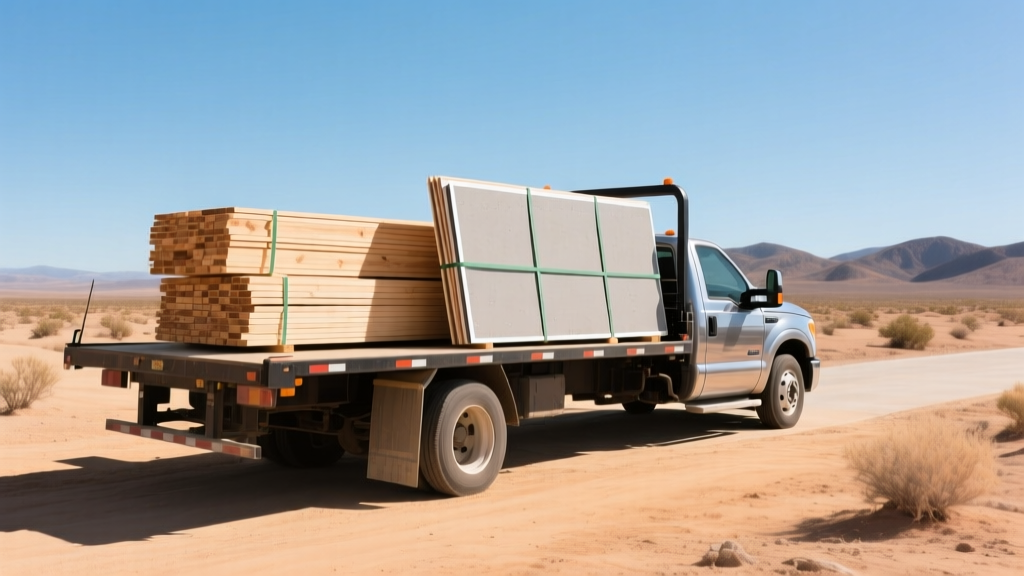
Many new developments on the westside feature narrow setbacks and dense lot configurations. Standard flatbed deliveries with forklift offloading (piggyback) often lack the maneuverability to drop trusses or lumber packages in the backyard. Contractors must order articulating crane trucks (knucklebooms). These trucks can reach over single-story rooflines to drop materials directly onto the slab. Ensure your supplier confirms the crane's reach radius (typically 45 to 60 feet) against your site plan before dispatching.
Dust Control and Site Storage
The High Desert is notorious for sudden, high-velocity wind events. Materials stored on-site must be secured. Gypsum board and OSB sheathing must be elevated on 4x4 dunnage and wrapped in 6-mil poly sheeting. Uncovered OSB will absorb ambient humidity and morning dew, leading to edge swelling that requires costly sanding before flooring installation.
Frequently Asked Questions
Can I use standard asphalt shingles in Hesperia?
While architectural asphalt shingles with a Class A fire rating are technically permitted in non-WUI zones, they are not recommended for the High Desert. The intense UV radiation and high surface temperatures drastically reduce their lifespan, often causing premature curling and granule loss. Cool-roof rated metal or concrete tile is vastly superior for long-term durability and energy efficiency.
How do local suppliers handle winter concrete pours?
Reputable batch plants servicing Hesperia will automatically adjust concrete mix designs during the winter months (November through February). They utilize accelerating admixtures and hot water mixing to ensure the concrete reaches its critical strength before freezing temperatures penetrate the slab. Always verify the use of non-chloride accelerators to prevent corrosion of post-tension cables or rebar.
What is the lead time for custom WUI-rated windows?
As of early 2026, lead times for dual-pane, Low-E366 windows with WUI-approved steel or heavy-duty aluminum mesh screens range from 10 to 14 weeks. Contractors must finalize window schedules and place purchase orders immediately upon foundation pour to avoid delaying the dry-in phase of the project.
Written by
Marcus ChenMarcus Chen is a licensed structural engineer (PE) and building materials analyst with over 12 years of experience across residential, commercial, and industrial construction. He holds a Master of Science in Civil Engineering from UC Berkeley and spent six years at Thornton Tomasetti before transitioning to independent consulting and technical writing. Marcus specializes in material selection for seismic-prone regions, concrete reinforcement strategies, and lifecycle cost analysis. His work has been cited by the American Concrete Institute (ACI) and the Structural Engineers Association of California (SEAOC). When he is not on a job site or at his desk, you will find him hiking the Sierra Nevada or restoring a 1920s craftsman bungalow in Oakland, CA.
More from Marcus Chen
View all
Construction Cost
How Much Did the Eiffel Tower Cost to Build?
How much did the Eiffel Tower cost to build in 1889? We adjust for inflation and compare its budget to modern skyscraper construction.
Aug 4, 2026

Fire Resistance
What Is a Fire Resistant Material? Testing & Certification Guide
Discover what is a fire resistant material through ASTM and UL testing. Learn how fire ratings, certifications, and assemblies work in construction.
Aug 4, 2026

Construction Cost
How Much Did the Burj Khalifa Cost to Build?
How much did the Burj Khalifa cost to build? We break down the $1.5B project and extract 5 money-saving strategies for your next build.
Jul 30, 2026