Least Expensive Building Materials for Budget Construction 2026
Discover the least expensive building materials for 2026. Compare OSB, corrugated steel, and precast concrete costs, specs, and installation tips.

The True Cost Equation: Material Price vs. Installed Cost
When evaluating the least expensive building materials, focusing solely on the unit price per square foot is a critical error. The true cost of any building material is its installed cost, which factors in material acquisition, specialized labor, equipment rentals, and long-term maintenance. In 2026, supply chain stabilization has lowered baseline commodity prices for engineered wood and steel, but skilled labor shortages continue to drive up installation costs for traditional masonry and stick framing.
Rule of Thumb: A material that costs 20% more upfront but reduces installation time by 40% will almost always yield a lower total project cost in commercial and multi-family residential builds.
This guide breaks down the most cost-effective structural and envelope materials available today, providing exact specifications, 2026 pricing baselines, and technical limitations to help you optimize your construction budget without compromising structural integrity or code compliance.
Top 5 Least Expensive Building Materials for Structural & Envelope Use
1. Oriented Strand Board (OSB) for Sheathing
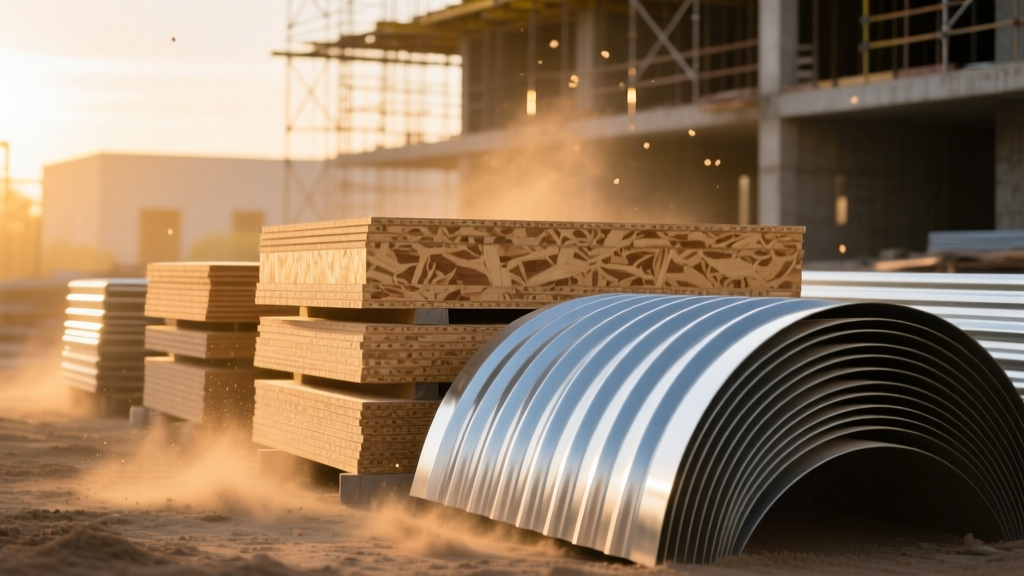
OSB remains the undisputed leader for cost-effective wall and roof sheathing. Manufactured from compressed, resin-bonded wood strands, it performs identically to plywood in structural shear but at a significant discount. According to APA - The Engineered Wood Association, modern OSB meets all International Building Code (IBC) requirements for structural panels.
- Specification to Buy: APA Rated Sheathing 24/16, 7/16-inch thickness, Exposure 1.
- 2026 Cost Baseline: $26.00 - $32.00 per 4x8 sheet (roughly $0.81 - $1.00 per sq. ft.).
- Technical Limitation: OSB is highly susceptible to edge swelling if exposed to liquid water for more than 14 days. It must be covered with a weather-resistive barrier (WRB) immediately upon installation.
2. 29-Gauge Corrugated Galvanized Steel
For roofing and exterior cladding on agricultural, industrial, and modern budget-residential projects, corrugated steel offers the lowest lifecycle cost. The 2026 market has seen a surge in G90 galvanized coatings, providing superior rust resistance compared to older G60 standards.
- Specification to Buy: ASTM A653 G90 galvanized, 29-gauge (0.0149 inches thick), 2.67-inch corrugation pitch.
- 2026 Cost Baseline: $1.65 - $2.30 per linear foot (approx. $2.00 - $2.80 per sq. ft. installed).
- Technical Limitation: High thermal conductivity requires a continuous insulation layer (ci) or spray foam backing to prevent condensation and thermal bridging, which adds to the envelope budget.
3. Precast Tilt-Up Concrete Panels
For commercial structures, warehouses, and large footprints, pouring concrete on-site and tilting it into place eliminates the need for expensive concrete masonry units (CMU) and the slow labor of laying block. The National Institute of Standards and Technology (NIST) recognizes tilt-up as a premier method for reducing schedule-driven overhead.
- Specification to Buy: 6-inch nominal thickness, 5,000 psi compressive strength at 28 days, #4 rebar grid at 12 inches on center.
- 2026 Cost Baseline: $8.50 - $11.50 per sq. ft. of wall area (installed), compared to $16.00+ for reinforced CMU.
- Technical Limitation: Requires a massive, flat casting bed (usually the building's own floor slab) and heavy crane rentals. Not viable for tight urban infill lots.
4. Compressed Earth Blocks (CEB)
In arid and semi-arid climates, CEBs represent the absolute lowest material cost, as the primary ingredient—subsoil—is often excavated directly from the building site. Modern hydraulic presses create blocks that rival fired brick in compressive strength.
- Specification to Buy: 3-5% Portland cement stabilizer, cured for 28 days, meeting ASTM D1635 standards for soil-cement.
- 2026 Cost Baseline: $0.70 - $1.10 per block (unfired). Material cost drops to near-zero if site soil is suitable.
- Technical Limitation: Highly labor-intensive. Requires specialized plastering (usually earth-lime renders) and deep overhangs to protect from driving rain.
5. Autoclaved Aerated Concrete (AAC) Blocks
AAC is a lightweight, precast foam concrete that provides both structure and insulation. While the unit cost is higher than standard CMU, the elimination of separate insulation framing and the drastic reduction in mortar usage make it highly cost-effective for mid-rise residential builds.
- Specification to Buy: 8-inch nominal thickness, 35-40 pcf density, compressive strength of 580 psi.
- 2026 Cost Baseline: $3.50 - $4.50 per block (installed cost averages $9.00 - $12.00 per sq. ft. of wall, including thin-bed mortar).
- Technical Limitation: AAC is brittle and highly porous. It requires specialized fasteners for hanging heavy cabinetry and must be sealed with vapor-permeable stucco or specialized AAC coatings.
Material Cost & Performance Comparison Matrix
| Material | Primary Use | Material Cost (per sq. ft.) | Installed Cost (per sq. ft.) | Labor Skill Required | R-Value (per inch) |
|---|---|---|---|---|---|
| 7/16" OSB Sheathing | Wall/Roof Decking | $0.81 - $1.00 | $1.80 - $2.50 | Low (Standard Carpentry) | 0.62 |
| 29-Ga Corrugated Steel | Roofing/Siding | $2.00 - $2.80 | $4.50 - $6.50 | Medium (Metal Trades) | 0.00 (Conductive) |
| Precast Tilt-Up | Commercial Walls | $4.00 - $6.00 | $8.50 - $11.50 | High (Crane/Rigging) | 0.08 |
| Compressed Earth (CEB) | Residential Walls | $0.30 - $0.80 | $14.00 - $18.00 | High (Specialty Masonry) | 0.20 |
| 8" AAC Block | Residential Walls | $3.50 - $4.50 | $9.00 - $12.00 | Medium (Masonry) | 1.25 |
Strategic Sourcing: Cutting Material Costs by 15-20%
Finding the least expensive building materials is only half the battle; acquiring them strategically is where profit margins are secured. Implement these procurement frameworks for your 2026 projects:
The 'Overstock & Drop' Strategy
Contact regional distributors for 'drop yard' inventory. These are materials (particularly dimensional lumber, steel coils, and brick) that were over-ordered on previous commercial jobs and are sitting in the yard accruing storage fees. Distributors will often liquidate this stock at 15-30% below market rate to clear space. Ensure you inspect the lot for UV degradation or moisture damage before purchasing.
Standardization of Dimensions
Design your architectural plans around standard material dimensions to eliminate off-cuts and waste. For example, designing ceiling heights at exactly 8 feet or 9 feet aligns perfectly with standard stud lengths and drywall sheets, reducing waste from 12% (industry average) to under 3%. According to the USDA Forest Products Laboratory Wood Handbook, optimizing dimensional lumber usage directly correlates to massive reductions in structural framing costs.
Hidden Cost Traps to Avoid
Warning: The 'Cheap Fastener' Fallacy
When using budget-friendly materials like corrugated steel or OSB, never compromise on fasteners. Using standard zinc-plated screws with G90 galvanized steel will cause galvanic corrosion, leading to panel failure and roof leaks within 3 to 5 years. Always specify Type 304 or 316 stainless steel fasteners, or manufacturer-approved polymer-coated screws. The $400 premium on a $20,000 roof prevents a $15,000 water damage claim.
Technical FAQ
Is OSB structurally weaker than plywood for roof decking?
No. Under the IBC and APA guidelines, 7/16-inch OSB and 15/32-inch plywood have identical span ratings (24/16) and shear capacities. The only structural difference manifests in long-term moisture exposure, where plywood dries out and recovers its strength faster than OSB. If the roof will be exposed to weather for more than a week before shingling, use plywood or a premium edge-sealed OSB product.
Can I use corrugated steel for interior walls to save money?
Yes, but it requires acoustic dampening. Bare corrugated steel reflects sound, creating severe echo in interior spaces. To use it cost-effectively indoors, install it over a layer of 1-inch rigid mineral wool or spray foam, which deadens the sound and provides necessary thermal separation.
Are Compressed Earth Blocks (CEB) code-compliant in the US?
CEBs are not explicitly covered in the prescriptive sections of the IBC. To use them legally, your structural engineer must design the walls using the 'alternative materials and methods' clause (IBC Section 104.11), providing compression test data from a certified lab to prove the blocks meet the required psi for your specific seismic and wind load zones.
Written by
Sarah WhitfieldSarah Whitfield is a chartered quantity surveyor (MRICS) and construction cost analyst with 15 years of experience in material pricing, procurement strategy, and project budgeting. She earned her degree in Construction Management from the University of Reading (UK) and has worked on projects ranging from $2M custom homes to $180M mixed-use developments across North America and Europe. Sarah currently leads cost estimating for BuildMat Insight, maintaining a proprietary database of 4,000+ material price points updated quarterly. She is a frequent contributor to RSMeans cost data panels and has presented at the International Cost Engineering Council (ICEC) congress. Based in Denver, CO, Sarah is an avid trail runner and volunteer mentor for Women in Construction.
More from Sarah Whitfield
View all
Wood & Lumber
What Are the Different Types of Wood? A Builder's Guide
Compare structural softwoods, finish hardwoods, and engineered lumber. Analyze Janka ratings, MOE values, and 2026 pricing for construction.
Aug 4, 2026

Walls & Panels
Steel Framing vs Wood Framing: Corrosion and Moisture Defense
Compare steel framing vs wood framing for moisture resistance. Learn about galvanized coatings, condensation risks, and corrosion protection strategies.
Jul 21, 2026

Stone & Masonry
How to Cut Stone Veneer: Wet Saw vs Grinder Comparison
Compare the best tools for cutting stone veneer. We review wet saws, angle grinders, and chop saws to help you achieve clean, chip-free cuts.
Jul 21, 2026