Building Material for Washington Monument: A Stone Masonry Overview
Explore the building material for Washington Monument, analyzing Cockeysville marble, bluestone gneiss, and modern sourcing lessons for large-scale masonry.

The Geological Blueprint of an American Icon
When evaluating the building material for Washington Monument, architects and masons are looking at a masterclass in 19th-century structural geology and logistical ambition. Weighing in at approximately 81,120 tons and standing 555 feet, 5 1/8 inches tall, the obelisk is not a single monolithic structure but a highly engineered composite of distinct regional stones. Understanding the specific lithology of these materials provides critical insights for modern professionals sourcing natural stone for monumental, high-load, or exterior cladding applications.
The selection of these materials was driven by the need for immense compressive strength, regional availability, and the aesthetic demand for a bright, uniform white facade. However, the 22-year construction hiatus between 1854 and 1876 introduced severe supply chain disruptions, resulting in the monument's most famous visual characteristic: the distinct color shift visible at the 152-foot mark. According to the National Park Service, this shift is a permanent geological record of the challenges inherent in large-scale natural stone procurement.
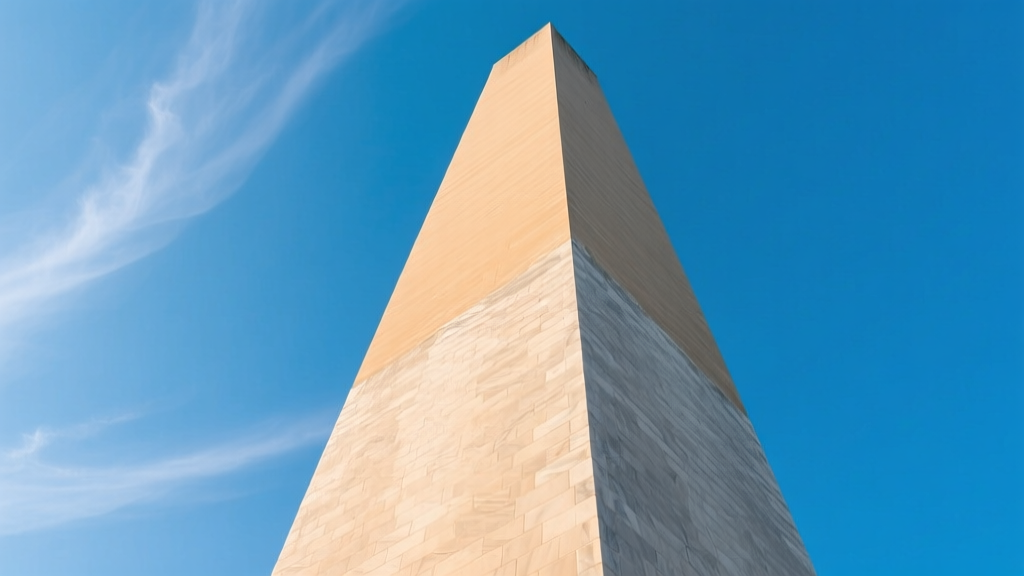
Primary Building Material for Washington Monument: Cockeysville Marble
The vast majority of the visible exterior facade is composed of Cockeysville Marble, a highly metamorphosed dolomitic marble from the Precambrian to early Paleozoic era. The lower 152 feet of the monument utilizes stone specifically quarried from the Texas Station quarry in Baltimore County, Maryland. This specific bed of Cockeysville marble is prized for its low porosity, high calcite-to-dolomite ratio, and exceptional structural integrity.
Dolomitic marbles, which contain a significant percentage of calcium magnesium carbonate (dolomite), generally exhibit superior resistance to acidic weathering compared to pure calcite marbles. This chemical composition was vital for the monument's longevity in the humid, pollution-heavy environment of the Mid-Atlantic region. The Natural Stone Institute notes that dolomitic marbles often outperform pure limestones in exterior applications due to their denser crystalline structure and lower water absorption rates.
Material Properties of the Exterior Marble
Modern masons and structural engineers can reference the baseline geological properties of the Cockeysville marble used in the lower courses to understand the benchmarks for monumental exterior stone. Testing standards such as ASTM C97 (Absorption and Bulk Specific Gravity) and ASTM C170 (Flexural Strength) are critical when specifying similar materials today.
| Property | Cockeysville Marble (Lower Section) | Sheffield Marble (Upper Section) |
|---|---|---|
| Geological Classification | Dolomitic Marble | Calcitic/Dolomitic Marble |
| Compressive Strength | ~13,000 - 15,000 psi | ~11,000 - 13,500 psi |
| Water Absorption (ASTM C97) | 0.15% - 0.25% | 0.20% - 0.35% |
| Density (lbs/cu ft) | ~170 lbs | ~168 lbs |
| Primary Weathering Risk | Sulfation (Black Crust) | Differential Sugaring/Spalling |
The Foundation and Core: Bluestone Gneiss and Granite
While the marble facade captures the public's attention, the structural survival of the obelisk relies on the building material for Washington Monument's foundation and internal core. The massive step-raft foundation, which extends 37 feet below grade and spans over 60 feet wide at its base, is constructed primarily of bluestone gneiss and concrete. Bluestone gneiss, a high-grade metamorphic rock characterized by its distinct foliation and immense compressive capacity, was sourced from local Maryland and Virginia quarries.
The internal core and the structural backing for the marble ashlar veneer utilize a mix of rubble masonry, brick, and later, Portland cement-based concrete. During the 1879 resumption of construction, Lieutenant Colonel Thomas Lincoln Casey transitioned the internal structural methodology, utilizing early high-strength concrete and granite rubble to ensure the upper 400 feet could be completed without overloading the original 1850s foundation. This hybrid approach—using high-compressive rubble and concrete for the core and reserving the expensive, precision-cut marble strictly for the exterior veneer—remains a standard cost-saving and structural best practice in modern monumental masonry.
Sourcing Challenges and the Famous Color Shift
The most critical lesson derived from the monument's material history is the danger of assuming geological uniformity across different quarry beds. When the Army Corps of Engineers resumed work in 1879, they initially sourced marble from Sheffield, Massachusetts. This stone was geologically distinct from the Maryland Cockeysville marble, possessing a slightly different mineral matrix and a higher susceptibility to atmospheric oxidation. Within a few years, the Sheffield marble weathered to a noticeably different hue than the Texas Station marble below.
Realizing the aesthetic mismatch, engineers quickly abandoned the Sheffield stone and secured a contract with the Beaver Dam quarry in Maryland. The Beaver Dam stone was from the same Cockeysville geological formation as the original Texas Station stone, but it was extracted from a different stratigraphic bed. While it matched much closer than the Massachusetts stone, subtle differences in iron oxide content and crystalline grain size still resulted in the permanent, visible demarcation line at the 152-foot mark that visitors see today.
Modern Applications: Sourcing Framework for Monumental Stone
Contemporary architects and masonry contractors can avoid the "Washington Monument effect" by implementing rigorous material tracking and testing protocols when specifying large-format natural stone. Relying solely on a quarry's commercial name for a stone type is insufficient for projects requiring visual and structural continuity over thousands of square feet.
- Block-Level Tracking: Require the supplier to map and number specific quarry blocks before cutting. Do not allow mixing of stone from different stratigraphic beds within the same elevation plane.
- Range Samples vs. Control Samples: Mandate that the fabricator provides a 9-panel range sample set (showing the lightest, darkest, and median tones of the specific bed) rather than a single polished control sample.
- Accelerated Weathering Testing: For exterior dolomitic or calcitic marbles, require ASTM C119 testing for modulus of rupture both before and after accelerated thermal cycling to predict long-term color oxidation and structural sugaring.
- Dry Lay Inspection: For monumental facades, enforce a mandatory dry-lay inspection at the fabrication facility covering at least 20% of the total square footage to visually verify vein continuity and tone consistency before shipping.
Preservation and Weathering of Monumental Stone
Over 140 years of exposure to the elements have provided extensive data on how the building material for Washington Monument weathers. The primary degradation mechanism for the lower Cockeysville marble is sulfation. Atmospheric sulfur dioxide reacts with the calcium carbonate in the marble, combined with moisture, to form gypsum (calcium sulfate dihydrate). This gypsum crust traps atmospheric particulates, resulting in the hard, black crusts that historically plagued the monument's surface.
Modern preservation efforts, including the extensive scaffolding and restoration campaigns of the early 2000s and subsequent maintenance, have shifted away from abrasive blasting, which destroys the marble's protective crystalline surface layer. Instead, conservators now utilize laser ablation technologies and ammonium carbonate poultices. The poultices draw the soluble gypsum out of the stone's pore structure without damaging the underlying sound marble. For modern masonry projects in high-pollution urban environments, specifying stones with lower initial absorption rates and applying breathable, penetrating siloxane-based water repellents can significantly delay the onset of sulfation and freeze-thaw spalling.
Ultimately, the Washington Monument stands not just as a tribute to the first U.S. president, but as an enduring, 81,000-ton case study in material science, quarry logistics, and the long-term weathering dynamics of American natural stone.
Written by
James ThorntonJames Thornton is a construction industry veteran with 25 years of hands-on experience in wood framing, lumber grading, and residential building codes. He started as a framing carpenter in rural Oregon, earned his ICC Residential Building Inspector certification, and eventually became a senior plan reviewer for the City of Portland Bureau of Development Services. James holds a B.S. in Wood Science & Technology from Oregon State University and is a certified lumber grader through the West Coast Lumber Inspection Bureau (WCLIB). He has inspected over 3,000 residential construction sites and authored the city's internal guide on advanced framing techniques (2x6 at 24" O.C.). James lives in Bend, OR, where he builds custom timber-frame cabins and competes in lumberjack sports.
More from James Thornton
View all
Insulation
Best Home Insulation Materials: Complete 2026 Guide
Compare top home insulation materials for 2026. Find R-values, installed costs per square foot, and best uses for fiberglass, spray foam, and mineral wool.
Aug 4, 2026

Sustainable Building
Certify Your Green Building Material for LEED and WELL
Step-by-step guide to certifying a green building material for LEED v5 and WELL v2. Master EPDs, HPDs, and VOC limits for 2026 project specifications.
Aug 4, 2026

Stone & Masonry
Veneer Stacked Stone Panels: Interior Design & Style Showcase
Discover how veneer stacked stone panels transform interiors. Explore modern design profiles, material pairings, and technical installation specs.
Aug 4, 2026