Specifying Brown Building Materials in Spokane: A Technical Guide
Technical specifications and climate-driven selection guide for brown building materials in Spokane, covering Corten steel, fiber cement, and clay brick.

Climate-Driven Material Selection for Spokane's Zone 5B Environment
Specifying exterior cladding in Spokane, Washington, requires navigating a demanding thermal and moisture profile. Situated in IECC Climate Zone 5B, the region experiences cold, dry winters with temperatures routinely dropping below 0°F, alongside hot, arid summers exceeding 95°F. Annual precipitation hovers around 17 inches, creating a high-evaporation environment with severe freeze-thaw cycling.
When architects and contractors select brown building materials in Spokane—ranging from earth-toned fiber cement to weathering steel and manganese-doped clay brick—the aesthetic warmth must be matched by rigorous technical performance. Moisture management, thermal expansion coefficients, and UV resistance are the primary engineering constraints. This guide details the exact technical specifications, installation tolerances, and failure mitigation strategies required for brown exterior assemblies in the Inland Northwest.
Technical Profile: Weathering Steel (Corten) Facades
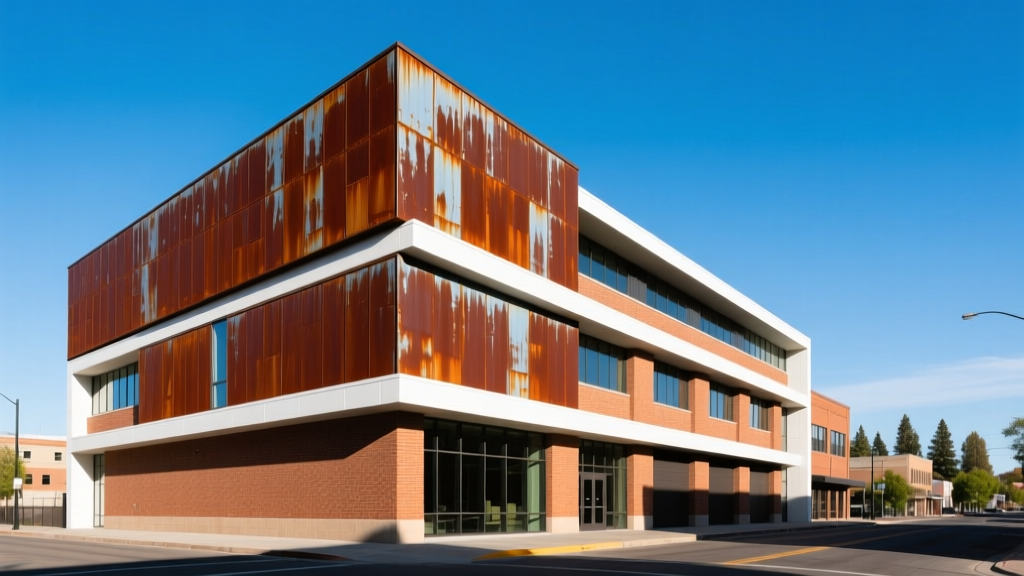
Weathering steel, commonly specified under ASTM A588 for its rich, rusty-brown patina, is highly popular in Spokane's modern commercial and high-end residential sectors. The alloy contains copper, chromium, and nickel, which form a dense, protective oxide layer when exposed to wet/dry cycles.
Spokane-Specific Patina Formation
According to the American Institute of Steel Construction (AISC), weathering steel requires alternating wet and dry periods to stabilize its patina. Spokane's low humidity and dry summers can stall this process, leaving the steel in an unstable, active corrosion state for longer than in coastal climates.
- Minimum Thickness: 16-gauge (0.0598 inches) for vertical facade panels; 14-gauge (0.0747 inches) for structural corrugated roofing.
- Yield Strength: 50 ksi minimum.
- Patina Acceleration: In Spokane, specify an initial artificial wet/dry cycling protocol (misting panels twice daily for 14 days during summer installation) to force the protective oxide layer to form before winter freeze sets in.
During the first 18 to 24 months, weathering steel releases iron-rich runoff. In Spokane's climate, this runoff will permanently stain adjacent light-colored concrete, stucco, or limestone. Always specify a 12-inch minimum gravel splash block or integrated aluminum drip edges with PVC downspout routing to isolate runoff from porous substrates.
Technical Profile: Earth-Tone Fiber Cement Siding
For residential and light commercial projects, brown fiber cement siding (such as James Hardie's "Monterey Taupe" or "Khaki Brown") offers the look of wood without the moisture susceptibility. Fiber cement is a composite of Portland cement, silica sand, and cellulose fibers.
Material and Installation Specifications
Fiber cement is highly resistant to Spokane's freeze-thaw cycles due to its low moisture absorption rate, but improper installation negates this advantage.
| Parameter | Technical Specification |
|---|---|
| Density | ~85 lbs/ft³ |
| Moisture Absorption | < 15% (per ASTM C1186) |
| Fastener Type | Stainless steel or hot-dipped galvanized (min 1-1/4" penetration into studs) |
| Joint Spacing | 1/8" gap at all end joints to accommodate thermal expansion |
| Cut Edge Treatment | Must be sealed with 100% acrylic caulk or factory-applied primer to prevent silica wicking |
Pro-Tip for Spokane Winters: When installing brown fiber cement in temperatures below 40°F, the material becomes more brittle. Pre-drill all nail holes within 2 inches of the board ends to prevent micro-fracturing, which can lead to moisture ingress and subsequent freeze-spalling.
Technical Profile: Manganese-Doped Brown Clay Brick
Extruded brown clay brick achieves its color through the addition of manganese dioxide during the firing process. For Spokane's climate, the Brick Industry Association (BIA) strictly mandates the use of Grade SW (Severe Weathering) brick, which is engineered to withstand repeated freezing and thawing in a saturated state.
Absorption and Mortar Compatibility
The critical failure point for brick masonry in the Inland Northwest is the interface between the brick and the mortar. If the mortar is harder than the brick, thermal expansion forces will cause the brick face to spall (pop off) during Spokane's deep winter freezes.
- Maximum Water Absorption (Grade SW): 12.5% average, with no individual unit exceeding 15%.
- Initial Rate of Absorption (IRA): If the IRA exceeds 30 g/30 sq in./min, the brick must be wetted before laying. Spokane's dry summer air rapidly pulls moisture from mortar; failing to wet high-IRA brown bricks results in weak, powdery mortar joints.
- Mortar Selection: Specify Type N mortar (750 psi compressive strength). Avoid Type S (1800 psi) for exterior veneers, as its high rigidity traps stress and accelerates brick spalling.
Comparison Matrix: Brown Exterior Materials for Spokane (2026)
| Material | Governing Standard | Compressive/Yield Strength | Est. Installed Cost (2026) | Primary Spokane Risk |
|---|---|---|---|---|
| Weathering Steel (16ga) | ASTM A588 | 50 ksi (Yield) | $18 - $24 / sq ft | Runoff staining; delayed patina |
| Fiber Cement (Lap Siding) | ASTM C1186 | 1,200 psi (Flexural) | $12 - $16 / sq ft | End-joint micro-fracturing in cold |
| Brown Clay Brick (SW) | ASTM C216 | 8,000+ psi | $24 - $30 / sq ft | Spalling from rigid Type S mortar |
| Cedar Shingles (Stained Brown) | CSA O118.1 | N/A (Wood) | $20 - $28 / sq ft | UV degradation; moisture rot |
Fastener and Flashing Specifications for Earth-Tone Assemblies
A frequently overlooked technical detail when specifying brown building materials in Spokane is galvanic corrosion, particularly when pairing weathering steel with dissimilar metals.
Galvanic Isolation Protocols
Weathering steel is highly anodic compared to aluminum and standard galvanized steel. If brown Corten panels are fastened directly to aluminum Z-girts or flashings, the Spokane moisture profile will trigger rapid galvanic corrosion, destroying the sub-framing.
- Fasteners: Use only 304 or 316 stainless steel fasteners for weathering steel assemblies. Electroplated zinc fasteners will stain the patina and fail within 5 years.
- Flashing Isolation: Apply a 30-mil thick butyl rubber peel-and-stick membrane between weathering steel panels and any aluminum window bucks or flashings.
- Color Matching: For fiber cement and wood, use ceramic-coated stainless steel screws (e.g., Simpson Strong-Tie or FastenMaster) color-matched to the specific manufacturer's brown/taupe SKU to prevent visible fastener heads from oxidizing and streaking the facade.
Common Failure Modes and Mitigation Strategies
Cause: Water-soluble salts (often from manganese additives used to create the brown color) migrate to the brick surface and crystallize, leaving a white, powdery residue.
Mitigation: Ensure cavity walls have a minimum 2-inch air space and weep holes spaced at 24 inches on center. Never use muriatic acid to clean brown manganese brick, as it reacts with the manganese to create a permanent dark brown/black stain. Use a specialized, non-acidic masonry cleaner.
Cause: Spokane's intense summer UV exposure and high altitude (approx. 1,900 ft) degrade exterior acrylic paints faster than in coastal regions, causing the brown factory finish to chalk and peel.
Mitigation: Specify factory-applied ColorPlus® technology finishes, which are baked on and contain higher UV-blocking pigment loads than field-applied paints. If field painting is required, mandate a 100% acrylic exterior paint with a Light Reflectance Value (LRV) of 55 or higher to minimize heat absorption and thermal bowing.
Summary of Best Practices
Successfully deploying brown building materials in Spokane requires moving beyond aesthetic selection and focusing on hygrothermal performance. By strictly adhering to Grade SW specifications for masonry, managing the unique patina requirements of weathering steel in low-humidity environments, and isolating dissimilar metals to prevent galvanic decay, builders can ensure that earth-tone facades remain structurally sound and visually striking through decades of Inland Northwest winters.
Written by
Elena RodriguezElena Rodriguez is a civil engineer and technical writer specializing in concrete technology, masonry systems, and ASTM/ACI compliance. She earned her B.S. in Civil Engineering from Texas A&M University and spent a decade at a materials testing laboratory, performing over 2,000 concrete compressive strength tests and masonry prism evaluations. Elena is an ACI-certified Field Testing Technician (Grade I) and a member of ASTM Committee C12 on Natural Building Stone. She currently consults on forensic engineering cases involving concrete failures and moisture intrusion. Based in San Antonio, TX, Elena is a proud member of the Society of Women Engineers (SWE) and coaches her daughter's FIRST Robotics team.
More from Elena Rodriguez
View all
Walls & Panels
Cost Analysis: Light Gauge Steel Framing Advantages and Disadvantages
Evaluate light gauge steel framing advantages and disadvantages through a strict cost analysis lens, comparing material, labor, and lifecycle expenses.
Aug 4, 2026

Walls & Panels
Gypsum Board Types: Exact Specifications, Thickness & Dimensions
Compare standard, Type X, and moisture-resistant gypsum board types. Get exact specifications, thicknesses, dimensions, and ASTM standards for your project.
Aug 4, 2026

Fire Resistance
Best Fire-Resistant Outdoor Decking Materials: 2026 Buyer Guide
Discover the best fire-resistant outdoor decking materials for 2026. Compare Class A PVC, aluminum, and hardwood options for WUI compliance and safety.
Aug 4, 2026