When Was Asbestos Banned in Building Materials? A Complete Guide
Discover exactly when asbestos was banned in building materials, the 2024 EPA chrysotile ruling, and what legacy risks remain in modern construction.

The Great Misconception: Was Asbestos Ever Fully Banned?
Ask most contractors or homeowners when asbestos was banned in the United States, and the standard answer is "the late 1970s" or "1989." Both answers are factually incorrect regarding a comprehensive ban. The U.S. never enacted a blanket prohibition on all asbestos-containing materials (ACM) during the 20th century. Instead, the regulatory landscape was defined by partial bans, devastating court overturns, and a decades-long legal battle that only reached a definitive conclusion for building materials in March 2024.
The Definitive Timeline: U.S. Asbestos Bans in Construction
To understand the current compliance landscape in 2026, we must map the exact regulatory milestones that restricted asbestos in building materials. The U.S. Environmental Protection Agency (EPA) and the Consumer Product Safety Commission (CPSC) targeted specific high-risk applications rather than the mineral itself for most of the last 50 years.
| Year | Regulatory Action | Impact on Building Materials |
|---|---|---|
| 1973 | EPA bans spray-applied surfacing materials. | Stops the use of asbestos fireproofing and acoustic insulation sprayed on steel beams and ceilings. |
| 1977 | CPSC bans wall-patching compounds and artificial embers. | Eliminates asbestos from consumer drywall joint compounds and fireplace ash. |
| 1989 | EPA issues final rule banning most ACM. | Intended to ban floor tiles, roofing, and shingles. Overturned in 1991, leaving only the 1973/1977 bans intact. |
| 2019 | EPA Significant New Use Rule (SNUR). | Prevents discontinued asbestos products from re-entering the market without EPA review. |
| 2024 | EPA Final Rule under TSCA Section 6(a). | Comprehensive ban on chrysotile asbestos, the last remaining type legally imported and used in the U.S. |
The 2024 EPA Chrysotile Asbestos Final Rule Explained
On March 18, 2024, the EPA finalized a landmark rule under the Toxic Substances Control Act (TSCA) that fundamentally changed the answer to "when was asbestos banned in building materials." This rule specifically targets chrysotile asbestos (white asbestos), which accounted for 100% of the raw asbestos imported into the U.S. in its final years of legal use.
What is Banned Immediately?
For the construction and building materials sector, the 2024 rule is absolute. The manufacture, importation, processing, and distribution in commerce of chrysotile asbestos for bulk or commercial use in building products is prohibited. This definitively closes the door on imported asbestos-cement pipes, roofing felts, and specialty gaskets that were still slipping into the supply chain via international vendors.
The Phase-Out Exceptions
While building materials face an immediate ban, the EPA granted extended phase-out periods for specific industrial applications. The chlor-alkali industry was given up to 12 years to transition away from asbestos diaphragms, and certain specialty gaskets used in extreme-heat environments (like titanium dioxide production) received a 5-year phase-out. However, these exceptions do not apply to general construction, residential remodeling, or commercial building materials.
Global Bans vs. U.S. Regulations: A Comparison Matrix
While the U.S. lagged in implementing a comprehensive ban, other major global economies acted decades earlier. If you are managing international supply chains or importing building materials, understanding these disparities is critical for compliance.
| Region | Year of Comprehensive Ban | Scope and Enforcement |
|---|---|---|
| United Kingdom | 1999 | Banned all types, including amphiboles (banned earlier in 1985). Strict HSE enforcement on legacy removal. |
| Australia | 2003 | Total ban on import, use, and mining. Border control strictly seizes suspect imported building goods. |
| European Union | 2005 | Directive 1999/77/EC mandated a union-wide ban on all asbestos types by January 1, 2005. |
| United States | 2024 | Chrysotile banned under TSCA. Amphiboles (crocidolite, amosite) were effectively banned via the 1989 partial rule and SNUR. |
Legacy Risks: Which Building Materials Still Contain Asbestos?
The 2024 ban stops new manufacturing and importation, but it does not mandate the removal of existing asbestos in place. According to OSHA regulations, asbestos-containing materials that are in good condition and non-friable can legally remain in commercial and residential structures. When renovating or demolishing, contractors must treat the following legacy materials as Presumed Asbestos Containing Material (PACM) until proven otherwise:
- 9x9 Inch Vinyl Floor Tiles: Often containing 1% to 5% chrysotile asbestos in the binder. The associated black cutback adhesive (mastic) can contain up to 15%.
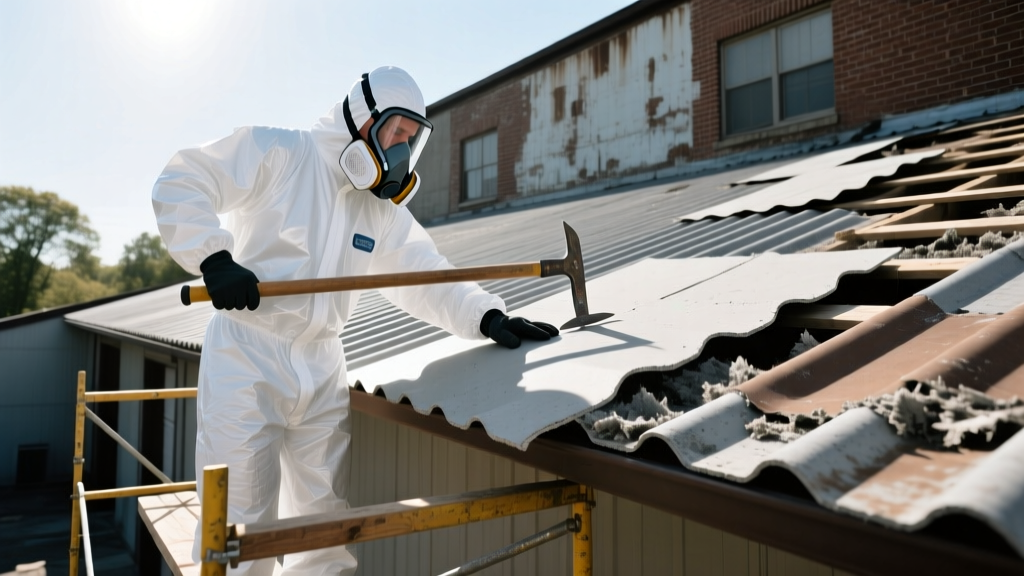
- Corrugated Transite Roofing & Siding: Cementitious panels manufactured through the 1980s containing 10% to 15% asbestos for structural reinforcement and fire resistance.
- HVAC Duct Mastic and Tape: White or gray canvas tapes and sealants used on sheet metal duct joints frequently contain 3% to 8% chrysotile.
- Popcorn (Acoustic) Ceilings: Spray-applied textures applied between 1950 and 1980 can contain 1% to 10% asbestos, making them highly friable and dangerous during scraping.
- Pipe Insulation (Air-Cell):strong> Corrugated cardboard-style wrap on steam pipes, often containing 15% to 40% amosite and chrysotile. Highly friable when degraded.
Actionable Protocol: Testing and Abatement Standards for 2026
Before initiating any demolition, renovation, or material disturbance on a structure built before 1990, project managers must follow strict testing protocols to comply with the EPA NESHAP (National Emission Standards for Hazardous Air Pollutants) guidelines.
- Engage an AHERA-Certified Inspector: Do not rely on visual identification. Hire an inspector certified under the Asbestos Hazard Emergency Response Act (AHERA) to conduct a comprehensive survey.
- Bulk Sampling via PLM: The inspector will extract bulk samples for Polarized Light Microscopy (PLM). This test typically costs $30 to $50 per sample and identifies asbestos types and percentages down to 1%.
- TEM Testing for Trace Amounts: If PLM results are inconclusive or if you are testing materials like floor tiles where asbestos content may be below 1%, Transmission Electron Microscopy (TEM) is required. TEM costs $75 to $120 per sample but provides definitive quantification at the 0.1% threshold.
- Abatement and Air Monitoring: If materials test positive at >1% (classified as Regulated Asbestos-Containing Material or RACM), hire a licensed abatement contractor. They must establish negative air pressure enclosures using HEPA filtration and perform aggressive final air clearance testing.
- Waste Disposal: All RACM must be wetted, sealed in 6-mil thick leak-tight polyethylene bags, labeled with EPA warning decals, and transported to a certified hazardous waste landfill.
Frequently Asked Questions
Can I still buy asbestos-containing building materials today?
No. Following the 2024 EPA Final Rule, the importation, manufacture, and sale of chrysotile asbestos for building materials is strictly prohibited. Any vendor claiming to sell new asbestos-cement pipes or roofing is violating federal TSCA regulations.
Does homeowners insurance cover asbestos abatement?
Standard homeowners insurance policies explicitly exclude pollution and hazardous material cleanup, including asbestos. Abatement is considered a maintenance and environmental liability issue. However, if a covered peril (like a tree falling through an asbestos roof) causes sudden damage, some policies may cover the incremental cost of safe debris removal, though not the full remediation of undisturbed materials.
Is it legal to encapsulate asbestos rather than remove it?
Yes. The EPA and OSHA strongly recommend encapsulation or enclosure over removal if the material is in good condition and will not be disturbed by renovation. Encapsulation involves applying a penetrating or bridging sealant (such as specialized acrylic or epoxy coatings) that binds the asbestos fibers together, preventing them from becoming airborne.
Written by
Sarah WhitfieldSarah Whitfield is a chartered quantity surveyor (MRICS) and construction cost analyst with 15 years of experience in material pricing, procurement strategy, and project budgeting. She earned her degree in Construction Management from the University of Reading (UK) and has worked on projects ranging from $2M custom homes to $180M mixed-use developments across North America and Europe. Sarah currently leads cost estimating for BuildMat Insight, maintaining a proprietary database of 4,000+ material price points updated quarterly. She is a frequent contributor to RSMeans cost data panels and has presented at the International Cost Engineering Council (ICEC) congress. Based in Denver, CO, Sarah is an avid trail runner and volunteer mentor for Women in Construction.
More from Sarah Whitfield
View all
Wood & Lumber
What Are the Different Types of Wood? A Builder's Guide
Compare structural softwoods, finish hardwoods, and engineered lumber. Analyze Janka ratings, MOE values, and 2026 pricing for construction.
Aug 4, 2026

Walls & Panels
Steel Framing vs Wood Framing: Corrosion and Moisture Defense
Compare steel framing vs wood framing for moisture resistance. Learn about galvanized coatings, condensation risks, and corrosion protection strategies.
Jul 21, 2026

Stone & Masonry
How to Cut Stone Veneer: Wet Saw vs Grinder Comparison
Compare the best tools for cutting stone veneer. We review wet saws, angle grinders, and chop saws to help you achieve clean, chip-free cuts.
Jul 21, 2026